
The new year has barely begun, but early polling shows a tight race on the horizon for the Arizona gubernatorial race, with Democratic Governor Katie Hobbs at risk of losing the race for Democrats.
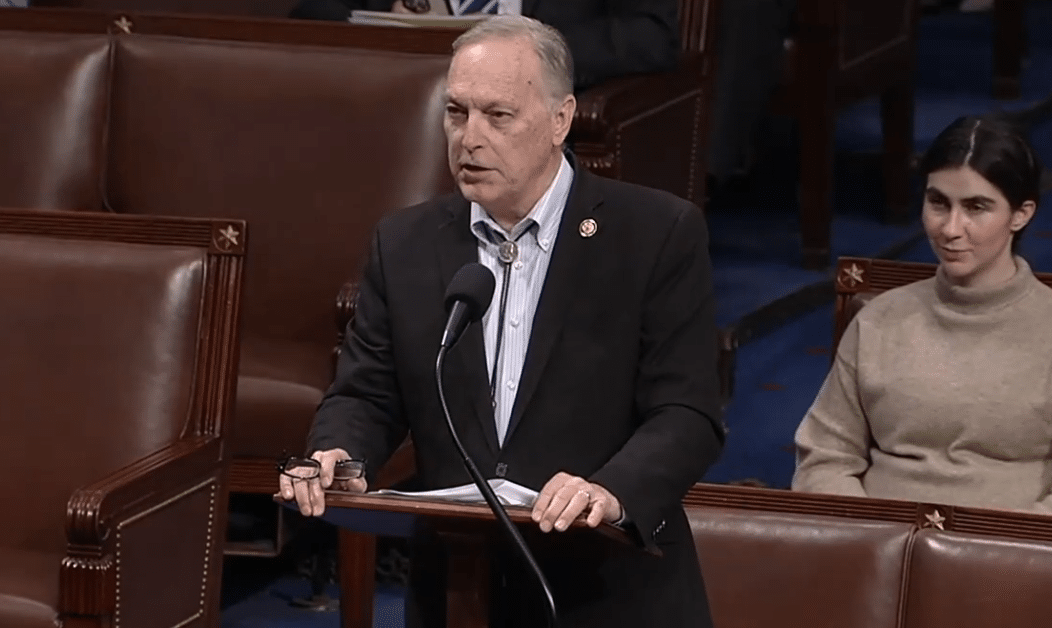
According to a Nov. 14, 2025, Emerson College survey, the race between Hobbs and three possible Republican contenders is already tight. The survey finds that U.S. Rep. Andy Biggs, who received an endorsement from President Donald Trump in April, poses the greatest challenge to Hobbs.
Among GOP primary voters, Biggs earns 50 percent of the vote, while Attorney Karrin Taylor Robson — who President Trump also endorsed — earns 17 percent. Representative David Schweikert earns eight percent. A full quarter of GOP primary voters are undecided as of late November.
In a head-to-head race between Katie Hobbs, Biggs is already at 43 percent of the vote to Hobbs’ 44 percent, relatively significant for a candidate challenging an incumbent. Robson performs close to Biggs against Katie Hobbs, securing 42 percent to Hobbs’ 43 percent, and Schweikert comes in at 39 percent to Hobbs’ 44 percent. Both Biggs and Robson could present a serious challenge to Hobbs, at least in early surveys. The survey confirms that despite her incumbent-status, Governor Hobbs is at risk of losing the governor’s seat.
Hobbs narrowly won the governor’s race in 2022, beating Republican Kari Lake by a slim 0.66 percentage points in a race fraught with voting machine irregularities that raised questions about legitimacy. Hobbs became the first Democrat to win the governor’s seat since Janet Napolitano in 2006, and there is evidence that the state could be ready for a changing of the guard.
Hobbs’ support among Latino voters — who make up around 1.3 million eligible voters or 25 percent of the state’s voters — has dropped since she won their vote by 28 points in 2022, 64 percent to 36 percent. A November survey of 600 registered Latino voters by Equis Research finds Latinos still support Hobbs, but by less. The survey finds Latinos support Hobbs against a generic Republican gubernatorial candidate by 19 points, 55 percent to 36 percent. This is nine points less than her margin over her GOP opponent Kari Lake in 2022.
It is worth emphasizing that even a no-name generic Republican candidate is polling within 20 points of the well-established Democrat incumbent Katie Hobbs among Latinos. The Equis Research survey also shows that two in three Latino voters are unable to rate Andy Biggs negatively or positively, indicating that with greater name recognition, his chances could rise substantially, depending on how he positions himself in the race.
In addition, Latinos showed up for President Donald Trump in the 2024 presidential election at a significantly higher margin than they did for Kari Lake in 2022. Trump lost the Latino vote by just ten points, 44 percent to 54 percent, compared to Lake’s 28-point-loss in 2022. This data indicates Arizona Latinos are swing voters, not default-Democrats, and there is room to court them in 2026.
Another group Republicans may be able to court is independent and unaffiliated voters, which make up around 34 percent of all registered voters in the state. 2022 exit polls from ABC News show GOP gubernatorial contender Kari Lake lost independents — which made up the largest share of the vote at 40 percent of voters — by seven points, 45 percent to 52 percent. However, two years later in 2024, President Trump won independents by a nine-point margin, 53 percent to 44 percent. This indicates an eight-point-swing toward the Republican candidate between 2022 and 2024.
One last group that could pose a serious threat to Democrat Katie Hobbs? Young people. GOP contender Kari Lake lost voters aged 30-44 by eight points in the 2022 gubernatorial election, 45 percent to 53 percent. President Trump won their vote in 2020 by four points, 51 percent to 47 percent. In 2024, President Trump significantly upped that margin, winning millennials by fifteen points, 57 percent to 42 percent. This indicates a twelve-point swing among millennials toward the GOP candidate between 2022 and 2024.
The same trend applies to Gen Z. Voters under age 30 voted for President Trump in 2024 by a greater margin than they voted for Trump in 2020 or Lake in 2022. According to CNN exit polls, President Trump lost young people in Arizona in 2020 by 31-percentage points, 63 percent to 32 percent. Two years later, Lake lost them by 42-percentage points, 71 percent to 29 percent. In the 2024 presidential election, Trump earned a larger chunk of the youth vote, securing 34 percent of voters under 30 to Kamala Harris’ 65 percent. This indicates a modest five-point shift among Gen Z toward the GOP candidate between 2022 and 2024.
The Arizona gubernatorial race is already shaping up to be a highly contested race and given the voting machine irregularities that plagued the race in 2022, voters are on alert. Swing voters, including independents, Latinos and young people, did move toward the Republican Party in the 2024 presidential election compared to the way they voted in 2022. This is not a guarantee that one of the three GOP primary contenders will perform as well as President Donald Trump did in 2024, but it does show appetite for conservative leadership. The three GOP gubernatorial candidates will need to make their case to voters, but 2026 could be the year Arizona hands the governor’s keys back to a Republican.
Manzanita Miller is the senior political analyst at Americans for Limited Government Foundation.