
The way the public views the war with Iran is complex and rapidly evolving, but a March 3 CBS News-YouGov poll shows a full 76 percent of Americans support military action against Iran if the conflict lasts days or weeks, a huge boost of support for President Donald Trump’s choice to launch a preemptive attack.
But make it quick. The survey, conducted March 2-3, finds that support for military action in Iran rapidly declines however if the conflict were to last months or even years. While a full 76 percent of Americans support military action against Iran if the conflict lasts only days or weeks, that number drops to 46 percent if the conflict lasts months, and a mere 13 percent will support the conflict if it lasts years.
This is a strong indicator that while Americans are behind President Trump’s strategic use of the U.S. military to prevent Iran from developing nuclear weapons, voters are unwilling to support the United States being drawn into a long and costly war.
There is strong historic precedent for a short war with a decisive U.S. victory being widely supported by the American people and driving presidential approval ratings up. However, wars that drag out over years do the exact opposite and erode confidence and presidential approval ratings.
When conflicts have been long and drawn out, as was the case under President Truman in Korea, President Johnson in Vietnam, and President George W. Bush in the second Iraq War, those presidents ended up with very low approval ratings. In the Iraq war, George W. Bush went from a jubilant approval rating of 70 percent during the initial surge in 2003 to just 28 percent approval in April 2008. Though other factors, like the mortgage crisis and financial crash, impacted President Bush’s approval there is no doubt the costly and expensive war took a toll.
However, when victories against foreign nations have been swift, as was the case under George H.W. Bush in the Persian Gulf War and Bill Clinton in Kosovo, those presidents earned high approval coming out of those conflicts.
Geroge H.W. Bush, who was placed into the Persian Gulf War conflict, saw a victorious rise in approval after the war ended due to successfully completing the relatively short war. He entered the war with an approval rating in the mid-50s in late 1990, and his approval surged to over 80 percent at the start of the Persian Gulf War in January 1991. President George H. W. Bush’s approval peaked at a record 89 percent in March 1991 immediately after the war’s successful conclusion.
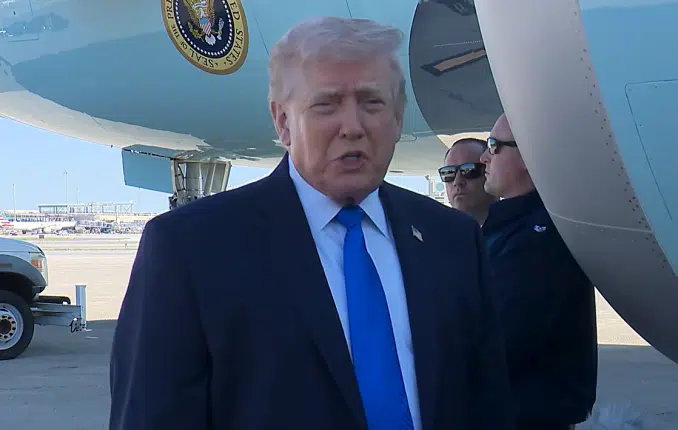
President Trump has said that he thinks the war could end quicky and is ahead of schedule, with the president stating Monday that although the U.S. military has the capability to go far longer than its estimated four-to-five-week time frame he estimates the conflict will last weeks.
“We have the strongest and most powerful by far, military in the world, and we will easily prevail,” President Trump said. “We’re already substantially ahead of our time projection, but whatever the time is, it’s okay. Right from the beginning, we projected four to five weeks, but we have capability to go far longer than that.”
However, missing from President Trump’s statements so far has been a formal address from the Oval Office, cutting into network television as is often the common practice by presidents, that explains the U.S. mission in Iran and might help in shoring up support from voters. Instead, the President announced the action in a recorded video that appeared in the middle of the night in the U.S. Given the timing of the attack, that would explain why there was not a live address.
Speaking from the Oval Office on Tuesday in a meeting that was not dedicated to discussing Iran, President Trump answered a reporter’s question about whether Israel “forced” the U.S. to enter the war on their behalf, stating he ordered U.S. forces to support Israel against Iran because he believed Iran was a security threat to the U.S.
“I might have forced their (Israel’s) hand,” President Trump told reporters. “We were having negotiations with these lunatics, and it was my opinion that they were going to attack first. If we didn’t do it, they were going to attack first. I felt strongly about that.”
The statement from President Trump came during his meeting with German Chancellor Friedrich Merz. So far, a full address from the Oval Office, as is common when presidents begin exerting military force, has not been held. This could be part of why a large share of Americans say the Trump Administration has not clearly explained U.S. goals in the region.
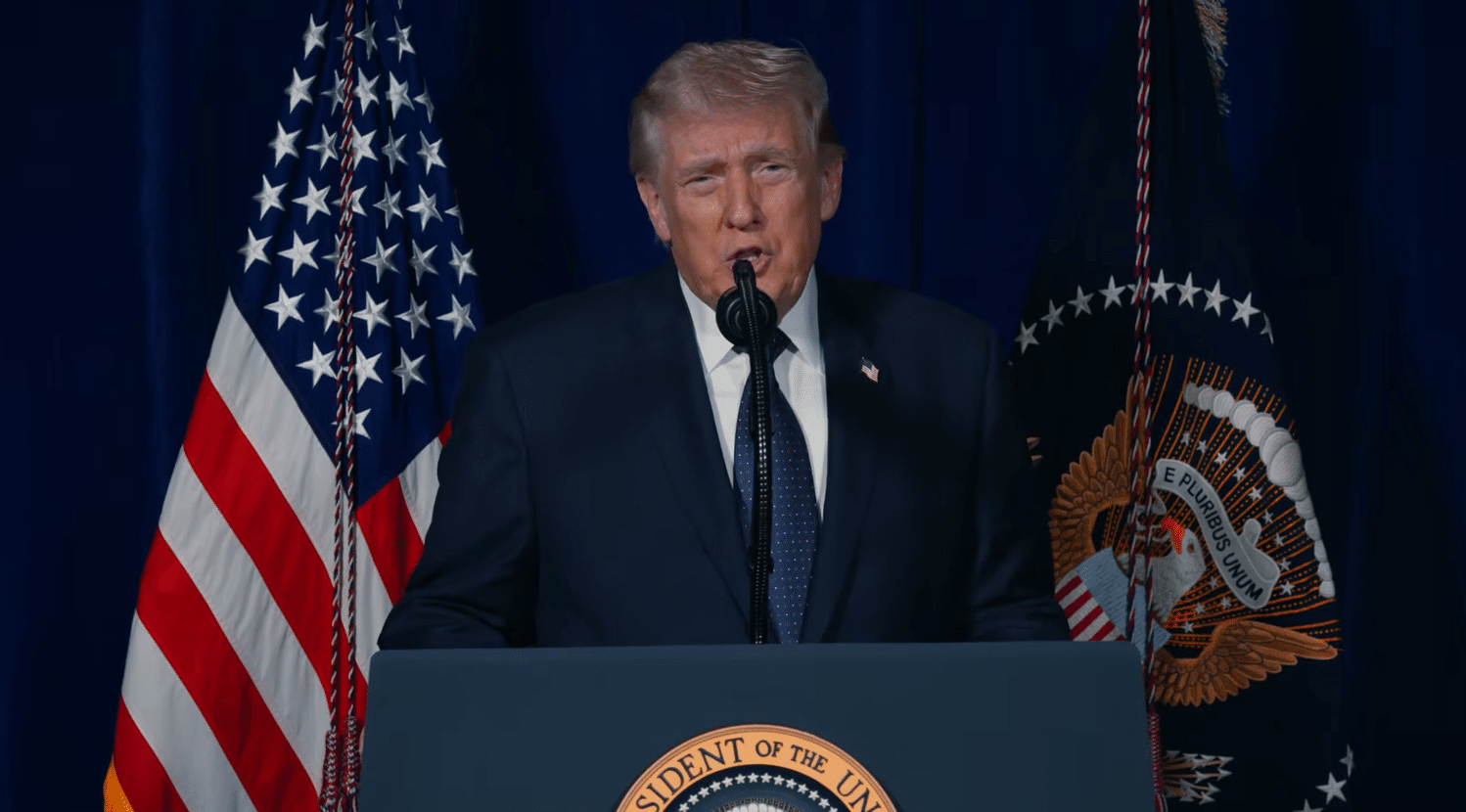
Although President Trump has yet to make a formal address from the Oval Office outlining U.S. goals in Iran, President Trump did explain the justification for war in a second video statement released Sunday March 1.
In the video, President Trump laid out a concise case for why he chose to direct the United States military to target Iran.
“An Iranian regime armed with long-range missiles and nuclear weapons would be a dire threat to every American,” President Trump declared. “We cannot allow a nation that raises terrorist armies to possess such weapons. It would allow them to extort the world to their evil will. We’re not gonna let it happen. It will not happen to us and we’re not gonna let it happen to others.”
President Trump concluded his statement Sunday by urging the Iranian military to lay down their arms and receive full immunity or face “certain death”. He also called upon “all Iranian patriots who yearn for freedom” to “be brave, be bold, be heroic, and take back your country.”
Despite these statements polls still show a majority of Americans believe the Trump Administration has not clearly outlined U.S. goals in Iran.
The March 3 CBS News survey showed Americans say 62 percent to 38 percent the Trump Administration has not clearly explained U.S. goals in Iran.
A March 1 Reuters/Ipsos poll found that while 27 percent of Americans approve of the strikes, 43 percent disapprove and 29 percent are not sure.
Iran’s pursuit of nuclear weapons is an incredibly charged geopolitical issue that has been brewing for many years, and it is a conflict President Trump is dedicated to ending. Polls shows the American people are behind him as long as the conflict is short.
Americans don’t mind a use of force. They are well aware that there are threats to freedom and peace in the world, and they are well aware that the United States military is the most powerful deterrent of those threats when directed properly. A full 76 percent of Americans support President Trump’s use of military action against Iran if that action falls within the timeframe of days or weeks.
However, wars do not always turn out as expected, especially in modern history. Americans clearly do not want to return to a period of nation building and excessive foreign entanglements, setting political limits to what the President can accomplish. Support for war rapidly declines under the prospect of a foreign conflict dragging out months or years.
President Trump thus far has shown a strong effort to use negotiation, but also a willingness to use force to protect peace through strength when necessary. He has stated he expects the war to last weeks, not months. But it will remain important for President Trump to continue voicing to the American people that while a nuclear Iran will never be tolerated, the United States will do everything in its power to use the force required to put an end to the conflict quickly — and decisively.
Manzanita Miller is the senior political analyst at Americans for Limited Government Foundation.