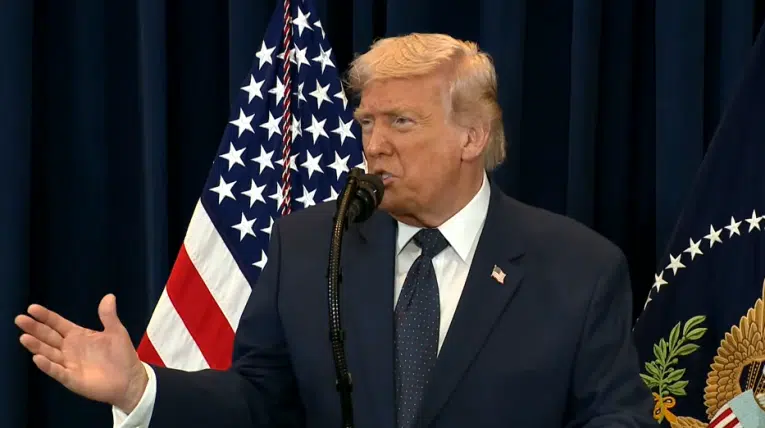

President Donald Trump’s approval rating, which was tempered during the first year of his second term due to a slowly thawing economic mood, is beginning to rise since his State of the Union speech and decision to launch air and naval strikes against Iran to curb its nuclear weapons development.
In the past two weeks, which spans President Trump’s highly rated State of the Union (SOTU) address on Feb. 24 and decision to launch an attack on Iran to curtail its pursuit of nuclear weapons on Feb. 28, President Trump’s approval rating has been rising.
A Harvard CAPS/HarrisX poll conducted just after President Trump’s SOTU speech Feb. 25–26 found President Trump’s approval rating sitting at 46 percent, with President Trump earning a modest rise in support across economic policy areas. 52 percent of voters said in the post-SOTU survey that the economy is better today than it was under Biden, and that number is up five points since Jan. 2026.
The survey found voters are finally beginning to feel relief from Biden-era inflation, with 51 percent of voters saying the economy is strong today, up two points from Jan. 2026 and a full eight points from Nov. 2025.
Overall, President Trump’s approval rating across a Real Clear Polling average is beginning to tick up, with President Trump sitting at an approval rating of 43.3 percent, up from 42.1 percent in February.
His net approval rating shows that improvement more clearly. President Trump’s net approval rating is still underwater at -11 points. But on Feb. 23 he sat at a net approval rating of – 13.4 points. His disapproval rating has dropped 1.8 percentage points since that peak on Feb. 23. His disapproval rating was peaking at 55.9 percent and is now down to 54.1 percent.
This rise in presidential approval rating appears to be a symptom of the “rally around the flag effect”, a historic precedent that dictates the American people tend to rally around the president in times of conflict.
However, one key aspect of this is that the effect is short-lived. Presidents that receive a bump in the polls when launching attacks against hostile nations only hold onto that positive momentum if they are able to end the wars swiftly — and with a decisive U.S. victory.
One of the best examples of a significant wartime bump is George W. Bush experiencing a surge in approval rating as the U.S. launched the Global War on terror against Afghanistan on Oct. 7, 2001, following the 9/11 terrorist attacks on the United States. President Bush went from an approval rating of 51 percent before 9/11 to an approval rating of 90 percent within a few weeks of the attacks, a full 49-percentage-point increase in less than a month. His approval rating was sitting at 87 percent when he officially launched the Global War on Terror in Oct 2001. However, the effect was short lived. His approval rating immediately began to fall after that spike and fell ten points by the spring of 2002. It continued falling, with many historians attributing the long drawn out war to the significant decline in President Bush’s support.
President H.W. Bush experienced a similar significant rally around the flag effect when he led the U.S. into the Persian Gulf War to liberate Kuwait with Operation Desert Storm on Jan. 17, 1991 with an approval rating sitting at 58 percent. He received an immediate 31-point bump in the month that followed. Although his approval rating began to tick down precipitously two months into the war, it remained elevated above pre-war levels until Oct. 1991 as the economic recession came to the fore.
Although President Bill Clinton did not experience the same surge in his approval rating for smaller military operations that both Bush presidents did, he did receive a bump in the polls around Operation Desert Fox, a short bombing campaign against Iraq from Dec. 16–19, 1998. Clinton launched the attack because Iraq for violating United Nations sanctions and to target its weapons of mass destruction program, and it was a very short, four-day bombing attack. Clinton had an approval rating that was already relatively high at 63 percent, but within a few weeks of the bombings he had gained ten percentage points.
In historical context, this short and sweet campaign directly targeting a nation’s weapons of mass destruction program and earning the president a modest bump in the polls is the closest to the situation we are in now. If President Trump can pull the calculated attacks against Iran off quickly, he may be able to hold onto the rise in approval rating and carry that momentum into the midterms.
A March 3 CBS News-YouGov poll showed a full 76 percent of Americans support military action against Iran if the conflict lasts days or weeks, but support plummets if the conflict last months or years.
World War II is another good example of the rally around the flag effect. Polling shows that when the U.S. entered World War II on Dec. 8, 1941, President Roosevelt gained 13 percentage points in the first few weeks that followed. He came in at an already high approval rating of 70 percent in Sep. 1941, but by Jan. 1942 immediately after taking the country to war his approval rating had risen to 83 percent. This was his highest on record. However, by March 1942, three-and-a-half months into the war, that momentum was slowing and Roosevelt’s approval rating dropped back into the mid-70s.
After the death of President Roosevelt, President Harry Truman initially benefited from a huge patriotic surge as he took over as commander in chief on April 12, 1945 and stewarded the U.S. through the remainder of the war. After two months in office in June, 1945, President Truman’s approval rating peaked at 87 percent. However, his approval rating fell to 82 percent by Oct. 1945, the month after World War II ended. Historians attribute this drop to rising postwar inflation. Later, in the Korean War, Truman went into the war with 37 percent approval, got a bump to 46 percent, but then went promptly back under water, never the return. No matter the decade, Americans have little tolerance for inflation.
One exception depending on how the data is read is President Lyndon Johnson in Vietnam. President Johnson’s approval rating followed a long downward trajectory for much of his presidency after Feb. 1964 when his approval peaked at 79 percent. By the time he took the U.S. into the Vietnam war, his approval rating sat at 68 percent, and it dipped four points as the U.S. entered the war in March 1965. By May 1965, two months into the war, Johnson’s approval rating had risen to 70 percent, but it never rose above 65 percent again, and going completely underwater by 1967. By the time he withdrew from the 1968 presidential race, it was down to 36 percent.
We are at an important moment in history. Winning a war quickly is one of the most important aspects of whether a president sustains that rally around the flag support, or sees it erode completely and flip upside down.
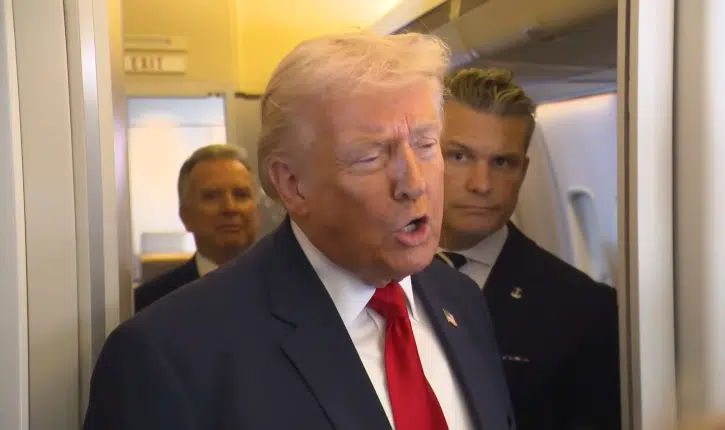
There is evidence that President Trump is aware of these optics. On Monday, March 9, President Trump stated in a CBS News interview that the war is “complete”, noting the successful demolishment of much of Iran’s infrastructure over the past two weeks.
“I think the war is very complete, pretty much,” President Trump said. “[Iran has] no navy, no communications, they’ve got no air force. Their missiles are down to a scatter. Their drones are being blown up all over the place, including their manufacturing of drones.”
While the geopolitical landscape could change, President Trump appears to be going in full force, with the intention of securing a fast victory. His earlier estimates were that the conflict could last four-to-five weeks, and as of March 11, we are now two weeks into the conflict.
While the American people will rally around their president in times of war, as the last two weeks have shown, presidents tend to lose that momentum and end up worse off than they were pre-conflict if the conflict drags on and does not end in a decisive U.S. victory. This gives President Trump a narrow window. If the conflict with Iran turns into a long, arduous road, it is entirely possible the momentum he is experiencing now will evaporate by the midterms, taking momentum for Republicans with it.
Manzanita Miller is the senior political analyst at Americans for Limited Government Foundation.