
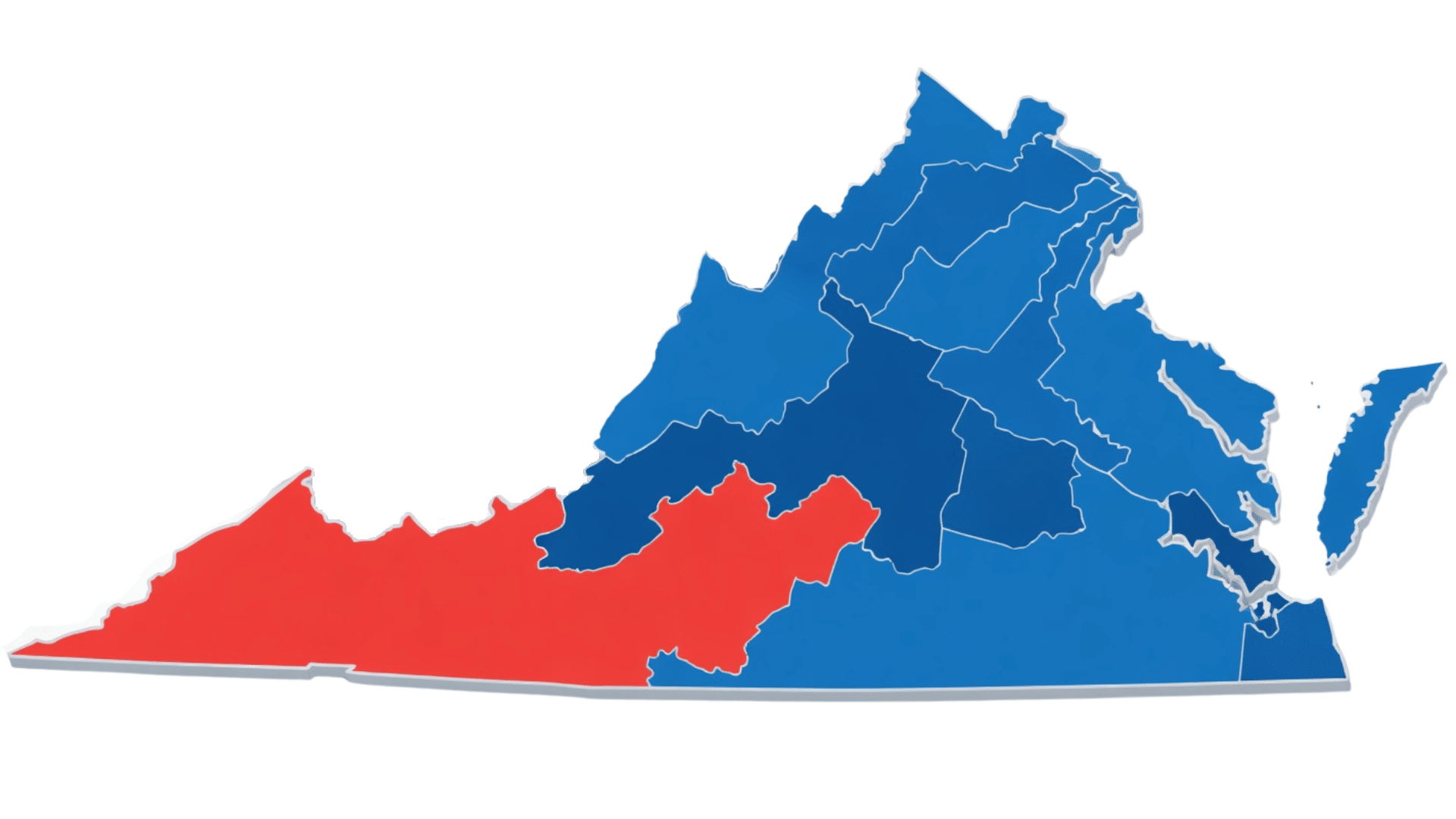
Virginia is locked in a heated redistricting battle over the next two weeks, with Democrats pushing a redistricting scheme that could give them up to four additional House seats if the proposed redistricting amendment passes a statewide referendum vote on April 21.
The proposed redistricting amendment would allow Democrats to implement newly redrawn congressional districts “mid cycle”, or before the next U.S. Census, which doesn’t take place until 2030. The mid cycle redistricting plan is intended to limit Republican legislative force by temporarily tipping the balance of power back in Democrats’ favor for the next two major election cycles — 2026 and 2028.
While the redistricting amendment will be put to a public vote on April 21, early voting over the past few days has shown massive interest from voters. According to the Virginia Public Access Project (VPAP), 715,047 early ballots were cast statewide as of April 6.
It is worth noting that the counties recording the highest percentage of early ballots returned skew Republican, indicating conservatives are putting up a fight against Democrats’ redistricting plan.
For example, Mathews County, which President Trump won by 40 points in 2024, leads the state in early vote with 27 percent of registered voters casting ballots early as of April 6.
In Northumberland County, which President Trump won by 21 points in 2024, 22 percent of ballots have been cast early.
In Middlesex County, which President Trump won by 24 points, 21 percent of ballots have been cast early.
It is not only Trump-friendly counties that are showing strong early voter turnout, although Trump counties are showing the highest percentage of early votes so far. Kamala Harris cleared Williamsburg City County by 44 points in 2024, and the county has seen 19 percent of ballots cast early as of April 6.
A Washington Post–Schar School poll from late March shows narrow support for the Virginia redistricting amendment, but the survey shows Republicans and independents are more motivated to vote, and based on an uptick in early voting from Republican-friendly counties, the data supports this finding.
The poll, conducted March 26-31, shows narrow support for the referendum allowing Democrats to change the district maps mid-cycle, with 52 percent of likely Virginia voters supporting the redistricting measure, while 47 percent oppose it.
The survey found Republicans and independents are more motivated to turn out to vote, as we are seeing in early vote returns. While nearly 85 percent of Republicans and Republican-leaning independents said they would vote or said they had already voted, 77 percent of Democrats and Democratic-leaning independents said the same, an eight-point enthusiasm gap that could be enough to deter the amendment.
In general, Virginia voters stand against gerrymandering in opinion surveys. A survey from Heritage Action that asked Virginia voters to weigh in specifically on gerrymandering found strong opposition to congressional districts designed to give one pollical party an unfair advantage.
The survey of 814 likely Virginia voters released by Heritage Action on March 26 found 87 percent of Virginia voters say district maps should represent voters’ interests rather than politicians’, and 76 percent say gerrymandering should not be allowed at all. The survey found widespread rejection of gerrymandering across Republicans, independents, and Democrats.
Virginia voters also strongly prefer maps drawn by bipartisan commissions over maps drawn by lawmakers. Nearly three quarters (74 percent) of voters support independent or bipartisan bodies drawing district maps and only 26 percent support allowing officials to override those maps, according to Heritage Action.
While Virginia voters are clearly opposed to the concept of gerrymandering, Democrats have been selling the mid-cycle redistricting map as a way to push back against President Donald Trump and Republicans and restore “fairness”.
In fact, the language of the redistricting amendment is so biased toward Democrat power being labeled as “fairness” that the Republican National Committee attempted to sue the Virginia Department of Elections earlier this year. However, the amendment made its way onto the ballot for voters to weigh in on.
The redistricting amendment reads: “Should the constitution of Virginia be amended to allow the General Assembly to temporarily adopt new congressional districts to restore fairness in the upcoming elections, while ensuring Virginia’s standard redistricting process resumes for all future redistricting after the 2030 census?” The “restore fairness” wording is arguably inaccurate, because it implies restoring fairness equates handing Democrats more power.
The decision on redistricting is likely to be a narrow one, with polls showing Virginia voters narrowly back the redistricting amendment but are otherwise opposed to gerrymandering. Early vote totals so far show counties President Trump won by double digits in 2024 are leading in the percentage of early votes, but some Harris-friendly counties are also reporting significant turnout. Virginia voters need to cast their ballots and ensure their voices are heard on this mid-cycle redistricting scheme.
Manzanita Miller is the senior political analyst at Americans for Limited Government Foundation.