
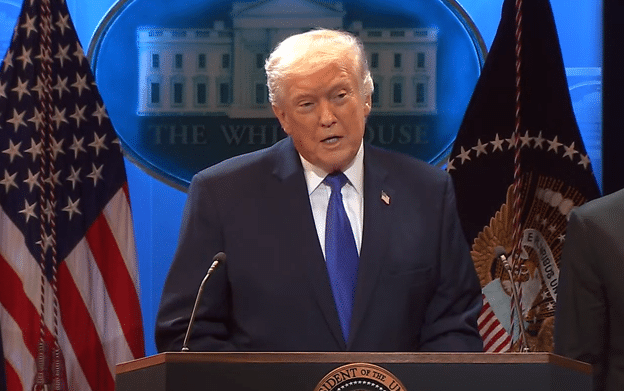
Two weeks into President Donald Trump’s decision to launch an attack against Iran to end its pursuit of nuclear weapons, polls show President Trump’s approval rating ticking up among voters as the rally around the flag effect kicks in. His latest net approval rating is up 2.2 points since Feb. 23.
Voters were just beginning to feel relief from Biden-era inflation last month. A Harvard CAPS/HarrisX poll from Feb. 25-26 conducted after President Trump’s State of the Union (SOTU) speech found 51 percent of voters said the economy is strong, up two points from Jan. 2026 and a full eight points from Nov. 2025.
However, the conflict with Iran is causing 20 percent of the world’s oil supply to come to a standstill since Iran retaliated against U.S. military operations by threatening oil vessels passing from the Persian Gulf through the Strait of Hormuz. This has elevated the price of oil — currently at $94 a barrel as of this writing — which will be reflected in inflation numbers for March once that report is released next month.
This spike in oil prices could already be doing damage to President Trump’s approval rating, particularly among Hispanics, a group he was strongly recovering with near the end of February.
In the Economist/YouGov survey from Feb. 27-March 2 a full 40 percent of Hispanics approved of the way President Trump was handling his job, up four percentage points from early January when 36 percent approved. That number was also up a full 15 percentage points since Oct. 17-20, 2025, when just 25 percent of Hispanics approved of the job President Trump was doing. President Trump was well on the way to recovering Hispanic support last month.
However, just over two weeks into the conflict with Iran with fuel prices rising, President Trump’s approval rating has taken a 12-point nosedive, with the latest Economist/YouGov survey from March 6-9 showing just 28 percent of Hispanics approve of the job President Trump is doing.
The survey does show a strong recovery for President Trump among black voters since the conflict with Iran began, although if consumer prices continue to rise due to an oil bottleneck that could change in coming weeks, too. Since early March, President Trump’s overall approval rating is up ten points with Black voters, going from seven percent in the Feb. 27-March 2 survey to 17 percent in the March 6–9 survey.
The focal point of the past two weeks has been the conflict with Iran, and a majority of Black and Hispanic voters disapprove of President Trump’s actions on Iran, as do a majority of white voters. However, 17 percent of Black voters and a quarter of Hispanics approve of President Trump’s handling of Iran according to the latest Economist/YouGov survey from March 6-9.
The key issue that was driving up President Trump’s approval rating among Black voters over the past two weeks appears to be the economy, which is both good news and bad news. Since positive economic sentiment over the past two weeks has given President Trump a bump in approval rating among Black voters, it is clear that positive economic indicators can rally their support. However, with the conflict in Iran causing oil prices to spike, that goodwill could be short lived.
Approval among Black voters for President Trump’s handling of inflation has risen eight points since the Feb. 27-March 2 survey, going from five percent to thirteen percent. For Hispanics, the opposite has happened, with approval for President Trump’s handling of inflation dropping four points from 29 percent to 25 percent.
As for how the conflict with Iran could be impacting President Trump’s support among minority voters, his approval rating among Black voters has risen since February on foreign policy. The foreign policy question was not posed in the early March survey, but it was asked in the Feb. 20 -23 Economist/YouGov survey and just twelve percent of Black voters approved of President Trump’s handling of foreign policy then. In the latest survey that number is up five points to 17 percent. For Hispanics, the conflict with Iran appears to have slightly weakened their support. In the Feb. 20-23 survey 29 percent of Hispanics approved of President Trump’s foreign policy approach, but that number has fallen to 27 percent.
As for how this will play out in the midterm cycle, that depends on if the conflict with Iran ends quickly and the economy continues to recover. Economic issues are highly motivating for both Hispanic and Black voters, with both groups strongly increasing their support for President Trump when they believe the economy is improving, although the most recent polling has Hispanics reversing that sentiment. The conflict with Iran has not substantially reduced President Trump’s approval rating on foreign policy among Hispanics, and it has increased approval from Black voters. However, a long and costly conflict is likely to erode support from both groups.
In Texas and California, states with large Hispanic populations, there are signs that Hispanics are not supporting Democrats at the rates they were expected to.
As New York Times chief political analyst Nate Cohn pointed out, the Democrat nominee for U.S. Senate in Texas, James Talarico, earned only lukewarm Hispanic support in heavily Hispanic parts of the state in the March 3 primary. Talarico secured close to two-thirds of the Hispanic vote in the Southern counties that line the U.S.-Mexico border and did similarly well in metropolitan areas.
However, as Cohn points out, a sizable share of Hispanics along the Rio Grande refused to support Talarico. In heavily Hispanic Star County — which President Trump won by 16 points in 2024 after Hillary Clinton won it by 60 points in 2016 — close to half of Democratic primary voters left their ballots blank in the Senate race.
Then there is the California gubernatorial race, which includes a crowded primary field from which the top two contenders — regardless of party — will face off in November. According to a poll from David Binder Research cited by Politico March 5, pro-Trump Sherrif Chad Bianco, who is running as a Republican in the crowded primary, is leading among Latino voters with 20 percent of the vote. The poll shows that out of the top seven candidates Bianco earns 20 percent of the Latino vote. Democratic Sen. Eric Swalwell earns nine percent of the Latino vote, and Democrat Xavier Becerra earns eight percent. That said, 43 percent of Latinos are undecided.
President Donald Trump’s approval rating was rising significantly among Hispanics on economic issues prior to the conflict with Iran, and his approval rating is up by double digits with Black voters compared to two weeks ago. However, rising prices due to an increase in fuel prices as Iran retaliates against the U.S. could evaporate that support. What the data shows is that Hispanic and Black voters, like other voters, are highly sensitive to the economy, and with inflation on the decline their approval for President Trump rises significantly. The opposite could also be true if inflation rises. If President Trump is able to swiftly end the war with Iran and reopen the Strait of Hormuz, there are signs that Black and Hispanic voters are on the fence about supporting Democrats — but it’s a narrow window of opportunity.
Manzanita Miller is the senior political analyst at Americans for Limited Government Foundation.