
In a narrow vote, 51.56 percent to 48.44 percent, or 1.57 million to 1.48 million, as of this writing, the Virginia redistricting amendment passed a statewide vote on April 21, with Republicans putting up a strong fight against the Democrat-led effort to adopt new Congressional District maps that will heavily favor Democrats in November. What was a 6-5 split in favor of Democrats could become 10-1 or 9-2.
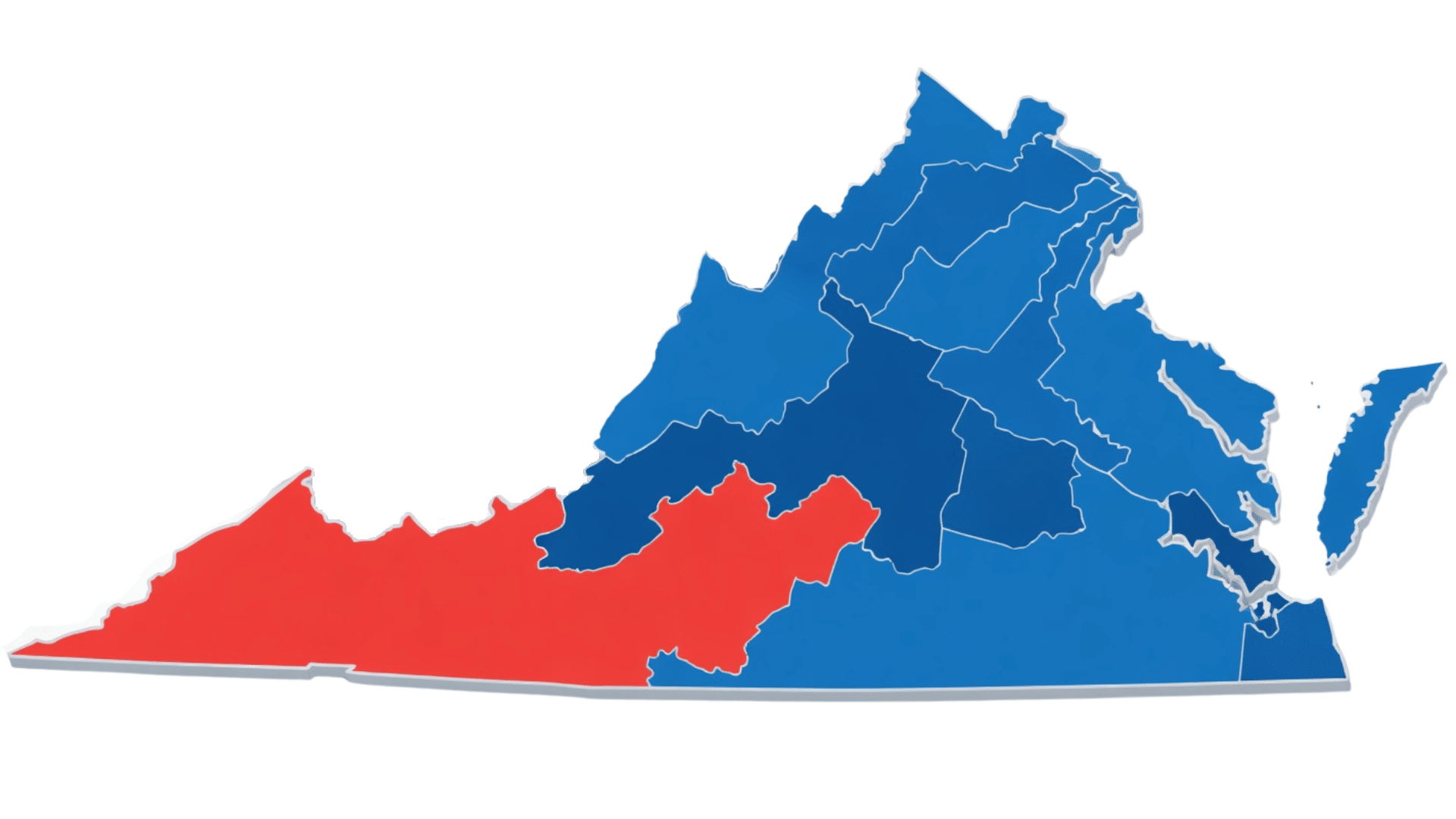
The vote was ultimately determined in the populated urban counties, with Loudoun, Fairfax, and Prince William counties and the cluster of counties around Richmond voting in favor of the new district maps that carve out four additional likely Democrat seats in the U.S. House.
A small number of swing counties including Brunswick, Chesapeake, Greensville and Suffolk in the southern part of the state supported the redistricting amendment but by much narrower margins than the urban northern regions. Aside from a number of outlier counties including Northampton and Albemarle, the rest of the state was a sea of “no” votes to the redistricting amendment as Republicans fought hard against the new maps.
Despite being outspent by over three to one, with much of that spending stemming from out of state dark money groups, Virginia Republicans and independents turned out to vote in massive numbers against the redistricting amendment, matching their 2025 showing while Democrats underperformed, making the battle for Virginia’s congressional district maps an extremely close one.
Democrats were successful enough at pushing the narrative that the new district maps would ensure “fairness” in elections, despite a wide majority of the state saying they are against gerrymandering. The new maps when completed by the legislature will carve out an additional four seats which Democrats are likely to take control of in November, making it more difficult for Republicans to hold onto the House in the midterms.
Political spending is no small player in the results of Tuesday’s redistricting battle. The Virginia redistricting contest attracted avid interest from deep-pocketed interest groups, and the primary Democrat group pushing redistricting outraised the Republican opposition by over three to one.
The primary group pushing redistricting, Virginians for Fair Elections, raised over $64 million among ten donors, several of them out of state groups, to push the redistricting amendment through according to data compiled by the Virginia Public Access Project.
The largest donor pushing redistricting was the nonprofit linked to Democratic U.S. House Minority Leader Hakeem Jeffries, House Majority Forward. The group donated over $38 million to ensure Democrats would have an edge in Virginia over the next several election cycles.
Several large donors to the Democratic side are out of state interest groups with a strong interest in turning Virginia blue. The Fund for Policy Reform, a 501(c)(4) based in New York, New York donated $5 million to push a map that favors Democrats in Virginia. American Opportunity Action, a 501(c)(4) based in San Rafael, California donated $3.6 million. Global Impact Social Welfare Fund, registered in the District of Columbia, donated $1.5 million.
The group urging Virginia voters to reject the redistricting amendment, Virginians for Fair Maps, raised just $19 million among eighteen donors. All but one of the donors are based in Virginia according to the Virginia State Board of Elections records.
While early voting data on April 6 from the Virginia Public Access Project (VPAP) showed a strong showing in early vote among counites President Donald Trump won by double digits in the 2024 election, the well-funded Democratic apparatus eventually outpaced those counties on Tuesday.
Virginia Democrats marketed the redistricting amendment as a way to restrain President Donald Trump and Republicans and used their vast war chest to push that narrative. The language on the redistricting question on Tuesday also strongly insinuated that the redistricting amendment would “restore fairness” if it passed.
The language read: “should the constitution of Virginia be amended to allow the General Assembly to temporarily adopt new congressional districts to restore fairness in the upcoming elections, while ensuring Virginia’s standard redistricting process resumes for all future redistricting after the 2030 census?” The “restore fairness” wording strongly signaled to voters that adopting the new maps was a way to restore fairness.
The mid-cycle redistricting scheme was intended to limit Republican legislative force by temporarily tipping the balance of power back in Democrats’ favor for the next two major election cycles before new maps are drawn after the next U.S. census in 2030.
Tuesday’s vote to implement new maps that strongly favor Democrats six months before the midterm election was a calculated move, and it was well funded by out of state dark money groups. The vote is a warning shot to Republicans leading into the midterm cycle. Not only will Republicans be at a disadvantage in Virginia due to the new maps favoring Democrats for four additional House seats, but it appears that Democrats are on the warpath and willing to spend big to win in purple states like Virginia.
Manzanita Miller is the senior political analyst at Americans for Limited Government Foundation.