
A report from the National Republican Congressional Committee (NRCC) released June 9 shows that Republicans have been steadily gaining voter registration numbers in battleground Congressional Districts since the 2024 election, with Republicans gaining vote share in 19 of 28 swing districts.
Democrats, meanwhile, have lost net registered voters in 27 out of 28 swing districts since 2024 the report shows.
Compared to the last midterm cycle in 2022, Republicans have gained nearly five percentage points in registration margin across battleground districts.
When looking back further at 2020 numbers, every district in the study saw net Republican growth compared to Democrat growth, with a net 737,000 new GOP voters across the districts over the past six years.
The report shows the largest shifts occurring in battleground states that played a pivotal role in the 2024 election, with the largest shifts taking place in Iowa, Florida, North Carolina, Nebraska, New Mexico, and Maine.
North Carolina is in the eye of the storm when it comes to dwindling Democrat numbers. In January of this year, the number of registered Republicans surpassed Democrats for the first time in the state’s recorded history. It is a narrow lead, with Republicans leading by just over 11,000 voters according to the latest numbers from the Secretary of State.
However, that difference is striking in the state’s history. Going back six years ago to 2020, Democrats outnumbered Republicans by over 391,000 voters, meaning Republicans have closed the gap by over 400,000 voters in six years.
This is important because North Carolina holds two of the most competitive House seats in the country. The Cook Political Report has identified the 1st District, currently held by Democrat Don Davis, and 11th District, currently held by Republican Chuck Edwards, as two of the most competitive districts this fall.
In Nevada, a small battleground state that President Donald Trump won by three percentage points in 2024, Republicans now outnumber Democrats. According to the latest numbers from the Secretary of State, Democrats trail Republicans by 3,609 voters for the first time in recent history.
While this may seem like a small number, the shift could have large implications. On Election Day 2024, there were 7,176 more registered Democrat voters in Nevada, and President Donald Trump still carried Nevada by over 46,000 votes (3.1 percent).
In 2018, Nevada Democrats held a 74,923 vote advantage over Republicans. Now, they trail Republicans by a few thousand votes. Democrat Susie Lee will be defending her seat in the competitive 3rd District in November.
Another example is Florida where the NRCC report shows dwindling Democrat voter registration numbers in the competitive 9th District.
Compared to 2018, Republicans have gained over 55,000 voters according to the report. Over that same period, Democrats have lost a net of 6,000 voters. Florida’s 9th District is currently held by Democrat Darren Soto but is shaping up to be one of the most competitive races this fall.
Why are Democrats continuing to lose registered voters in battleground districts, despite the Republican Party suffering from low approval ratings due to inflation and the Iran conflict?
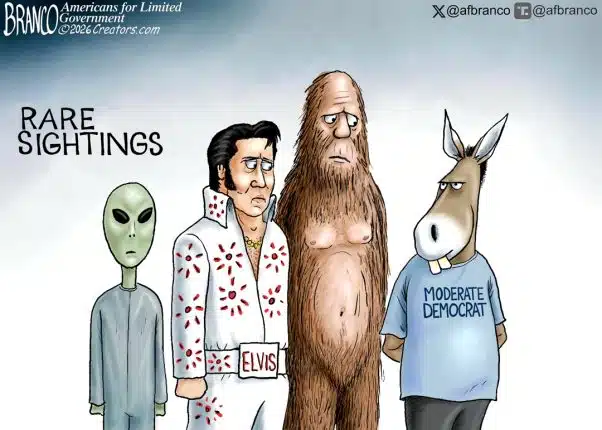
The data points to the fact that many weak Democrats and leaners feel the Democratic Party is too far to the left now. A May 20 New York Times/Siena College survey of weak Democrats and Democrat-leaning independents found a majority want the party to become more moderate.
The Times/Siena survey found that among potential Democrats, 47 percent want the Democratic Party to move to the center, versus 28 percent who want to see it move to the left and 19 percent who want to see it stay where it is.
The issues that cause the largest dissatisfaction among soft Democrats are transgender issues and immigration. The survey shows that by ten points, 41 percent to 31 percent, potential Democrats want to see the Democratic Pary move to the center on immigration. Just 31 percent want to see the party move to the left, and 24 percent want the party to stay where it is.
On transgender issues, 36 percent of voters want to see the Democratic Party move to the center, while 30 percent want the party to stay where it is and 30 percent want the party to move further to the left.
Now with a peace deal between the United States and Iran being finalized, and West Texas Intermediate (WTI) crude oil prices plummeting almost 35 percent from over $114 a barrel in early April down to a little above $76 a barrel as of this writing, conservatives will have two very large accomplishments to show voters. Of course, inflation will need to continue declining, and peace will need to be reinforced in the coming months, but if President Donald Trump is able to maintain peace and reopen the Strait of Hormuz, the midterms may not be as big of a blue wave as was expected during the height of the Iran conflict. Democrats are still struggling to recruit new voters across battleground districts, and the Democratic Party’s reckless approach to immigration, border security, and children and family issues have caused irreparable damage.
Manzanita Miller is the senior political analyst at Americans for Limited Government Foundation.