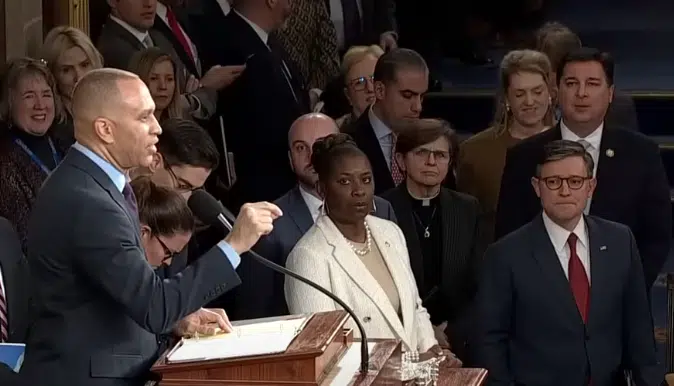


Democrats flipped at least seven Senate seats on Election Night, winning back control of the U.S. Senate, and gained 25 House seats giving them a majority in both chambers. This sets up a thorny political road for the remaining two years of President Donald Trump’s second term, but the president promised on Election Night to veto any “insane” policies the party might send across his desk.
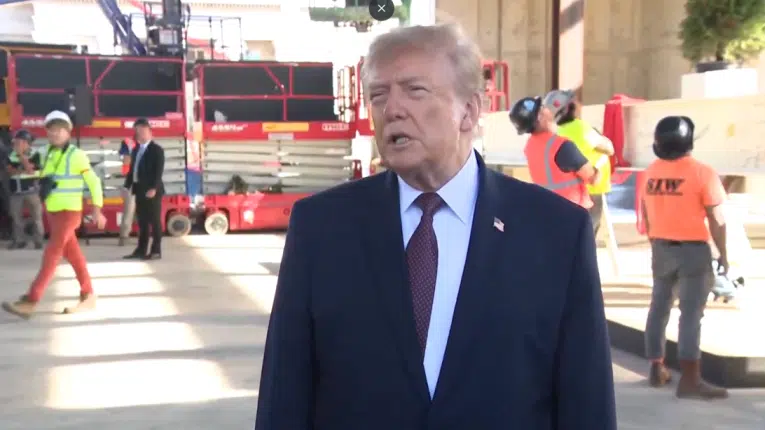
Speaking to Fox News on Election Night, President Trump promised to veto any “insane” policies the Democratic Party attempts to push forward over the next two years. “They’ll send over things that are insane and I’ll veto them,” President Trump promised. “And after a couple of months of vetoes, they’ll go out and they’ll say, ‘How do we get this stuff done?’ And we’ll work together.”
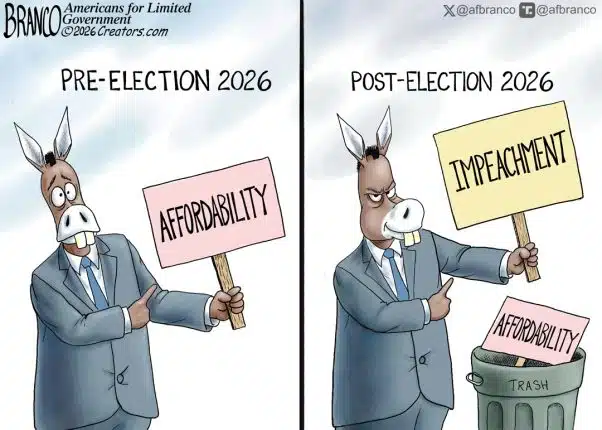
While Democrats eked out strong victories on Tuesday with exit polls revealing voters blamed President Trump and Republicans for higher prices, voters still hold a positive view of capitalism and a negative view of socialism, and less than half the country, 43 percent, think Democrats will be better stewards of the economy than Republicans. Nearly one in five voters (19 percent) say neither party would be better.
In addition, Democrats’ approval rating is still underwater and even among Tuesday’s electorate that handed Democrats both chambers of Congress, voters still say the Republican Party is better equipped to handle immigration, indicating that one of President Trump’s legacy accomplishments is paying off for conservatives.
While it is not yet clear how deep the blue wave is compared to the 2018 midterm cycle, when Democrats gained 41 House seats, it is definitely substantial. While some conservative estimates leading up to Election Day suggested if polls were off Democrats might lose as few as nine House seats, the party ended up gaining 38 seats as of this writing — and counting.
In the Senate, Democrats have gained seven seats and counting, sweeping multiple battleground Senate races. The polls leading up to the election were relatively accurate, and even underestimated Democrats in a few races.
In the Michigan Senate race, left-wing candidate Abdul El-Sayed won the race against Mike Rogers 52.44 percent to 45.56 percent, or by a 6.88 percent margin. Polling leading up to the election had El-Sayed ahead by 5.3 percent.
In Ohio, polls leading up to Election Night had Sen. Sherrod Brown ahead of Jon Husted by 2.8 points, and Brown flipped the Senate seat by 4.86 percentage points, 50.01 percent to 45.15 percent.
In Texas, James Talarico flipped the Senate seat for Democrats by over twelve points, winning 55.21 percent of the vote to Ken Paxton’s 42.87 percent. Polls leading up to the election had that race a lot closer, with Talarico leading in polls by about 2.6 percentage points.
President Trump noted on Election Night that he didn’t believe the war with Iran was a driving factor in Tuesday’s results, telling “Special Report’s” Bret Baier, “I don’t think it’s the war, Bret, I think it’s the gasoline price. People agree with what I’m doing on Iran, but they really probably weren’t willing to do the short-term consequence of paying more for gasoline.”
That appears to be a solid take from President Trump. Voters have been warning Republicans for months in polls that they were unwilling to shoulder higher prices which began to tick up again after the Iran conflict squeezed fuel prices this spring.
In NBC News exit polls from Election Night, voters said by 38 points that President Trump’s policies have worsened economic conditions, 65 percent to 27 percent. Among the 65 percent of voters who said Trump’s policies have worsened economic conditions, 81 percent cast their ballots for Democrats on Tuesday, while 16 percent voted for Republicans.
Voters also said that higher prices are more due to President Trump’s policies than they are due to factors outside his control by a 24-point margin, 62 percent to 38 percent. Among those who blame President Trump for higher prices, 83 percent supported Democrats and 15 percent cast a vote for Republicans.
While voters appear to blame President Trump and Republicans for higher prices, and sent a warning message to Republicans on Tuesday, the country has not embraced socialism as the answer.
Voters still hold a strongly or somewhat favorable view of capitalism by a 25-point margin according to exit polls, with 57 percent of voters holding a favorable view of capitalism and just under a third holding a negative view.
Only nine percent of voters hold a strongly favorable view of socialism, while another 24 percent hold a somewhat favorable view, according to the data. In other words, about a third of voters hold a strongly or somewhat favorable view of socialism in the current economic climate, an alarming number but far from the majority.
The data shows that while voters blamed President Trump and Republicans for higher prices last night, voters still hold a negative view of socialism, and less than half the country believe Democrats will be better stewards of the economy than Republicans. Democrats’ approval rating is still underwater, and voters still say the Republican Party is better able to handle immigration, a key pillar of President Trump’s second term.
The share of voters who said Democrats would be better stewards of the economy than Republicans was relatively modest, as just 43 percent of the country say so. However, only 37 percent say Republicans would be better able to handle the economy. Nineteen percent of voters say neither party would be better to handle the economy.
Despite winning control of both chambers, the Democratic Party is not swimming in praise. Of those who voted on Tuesday and participated in the exit poll, the Democratic Party’s favorable rating is upside down by six points, with 53 percent of voters giving the party an unfavorable rating and 47 percent giving the party a favorable rating.
That said, the GOP’s favorable rating is underwater by more, with 59 percent of voters giving the GOP an unfavorable rating while 41 percent give the party a favorable rating.
This stands in contrast to an Economist/YouGov poll conducted Oct. 23-26 that showed the GOP enjoyed a higher favorable rating (45 percent favorable) than the Democratic party (43 percent favorable), indicating that those who turned out for the election had a more negative view of the GOP than the potential electorate.
While the losses for Republicans were steep, and this places the party at a disadvantage for the remaining two years of President Trump’s term, polls have been warning for the past year that voters are upset with the cost of living, and Tuesday was their chance to let the party in control know that. While conservatives are well aware that President Trump and Republicans have been forced to handle the consequences of years’ worth of globalist policies that offshored jobs, weakened the standing of the U.S. on the global stage, and hollowed out the U.S. manufacturing sector, voters sent a message that they are unhappy with the cost of living and blame Republicans for price increases. That said, voters still hold a favorable view of capitalism, and less than half the country is confident Democrats will do a better job on the economy than Republicans. In addition, voters still hand the GOP credit for cleaning up the border crisis, a key electoral promise President Trump made to Americans.
Manzanita Miller is the senior political analyst at Americans for Limited Government Foundation.