
While Americans sent a tense message to Congress on Election Day over the cost-of-living crisis, which has seen significant price increases across healthcare, childcare, utilities, and fuel, an influx of government and private investment in the U.S. manufacturing sector is driving what Boston Consulting Group (BCG) is calling “the next industrial chapter for the U.S.” At the same time, the Institute for Supply Management’s Production Index hit its highest recording since November 2021 last month. U.S. manufacturing is booming back as companies reshore jobs across industries like AI, data centers, and defense.
For the first time in a quarter of a century, manufacturing companies are making a concerted effort to invest in manufacturing in the United States after years of building in countries where it was cheaper.
According to analysis from Boston Consulting Group (BCG) released Sept. 14, U.S. companies are planning to invest close to $6 trillion in U.S. manufacturing between 2025 and 2029, with a major focus on data centers, AI compute, and electrical grid contracts. BCG notes that this is a threefold increase compared to investments over the past five years and is calling the U.S. manufacturing boom a “once-in-a-generation” opportunity.
Calling the manufacturing boom “the next industrial chapter for the U.S.,” BCG notes that the U.S. manufacturing boom is going to be concentrated among six core industries over the next few years.
Companies plan to invest what will amount to $3,700 billion in data centers and AI compute between 2025 and 2029, $1,260 billion in energy infrastructure — including power generation, transmission, and distribution — $370 billion in pharma and biotech, $300 billion in batteries and clean tech manufacturing, $150 billion in aerospace and defense, and $140 billion in industrial reshoring and FDI, including machinery and automotive materials.
In what could be read as good news to job seekers and young people deciding where to focus their education, BCG estimates that finding skilled workers to fill jobs in the U.S. over the next several years could prove difficult. The consulting group estimates a skilled tradespeople shortage of two million people by 2030. To fill these gaps, BCG suggests that companies can bridge the divide by investing in training and automation, reinforcing that skilled trades will be more in demand in the U.S. in coming years, after decades of a predominantly knowledge-based economy.
The manufacturing sector as a whole is showing broad strength in President Donald Trump’s second term, with the manufacturing PMI report from the Institute for Supply Management (ISM) revealing the manufacturing sector expanded for the tenth consecutive month in October. New orders, production, employment, imports, and exports are all growing, according to the report.
The Manufacturing PMI registered one percentage point above the September figure, at 55.5, and new orders expanded for the tenth consecutive month In October.
The Production Index registered at 59 percent, 2.3 percentage points above the September reading of 57.7 percent. That reading is the highest the index has registered since November 2021, when the index hit 60.5 percent.
Susan Spence, Chair of the ISM Manufacturing Business Survey Committee, noted that October marked the 12th month in a row that U.S. output expanded, and noted a turning point in supplier feedback in the monthly survey.
“Regarding output, the Production Index expanded for the 12th month in a row, with the positive-to-negative comment ratio improving to 2 positive comments for every negative one (compared to the 1.6-to-1 ratio in September),” Spence noted.
Two industries that are exploding are the semiconductor and defense industries, with suppliers working to keep up with demand. A supplier in the machinery industry noted in the ISM survey: “Explosive growth in the semiconductor and government/defense spaces has put us on our heels as we try to work through demand. The long-awaited wave has arrived for our company, and it seems the global supply chain is in similar straits.”
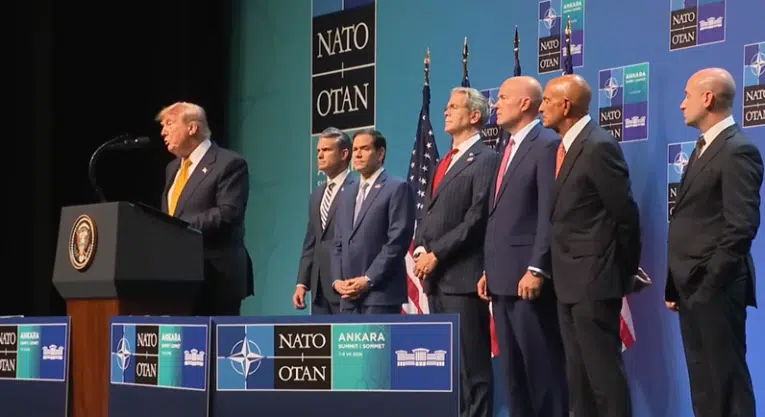
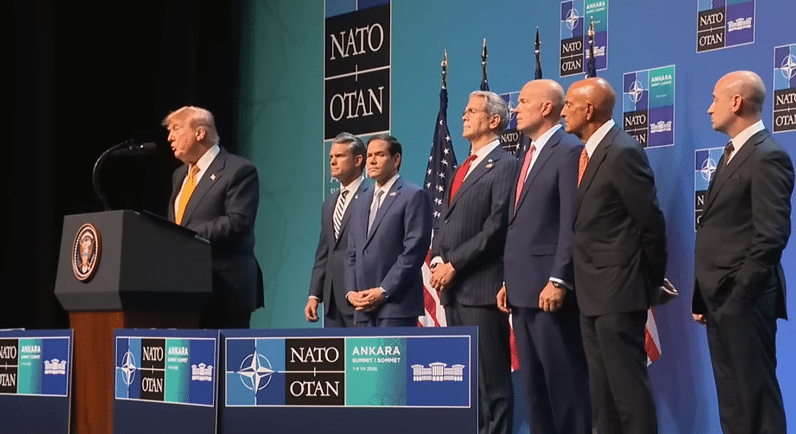
At the 2026 NATO Summit in Ankara, President Donald Trump secured $3 billion in investments from Allies to expand America’s defense manufacturing industry and generate thousands of jobs. This comes on top of investments made in 2025, when NATO allies purchased over $54 billion in defense equipment sourced in the U.S., contributing to the rapidly expanding defense sector.
In July, President Trump announced that the Department of War would fund $10 billion in production to support American-made ships, submarines, trucks, and weapons, as part of a major plan to build up America’s defense arsenal.
Commodities are experiencing strong demand, with one manufacturing supplier telling the ISM that commodities that feed into AI and data centers continue to face a supply chain and pricing crunch, while demand has refused to slow down. “Any commodity consumed by AI/data centers is in a crunch, both for supply and pricing. We keep wondering when the madness will stop. In spite of these challenges, our demand remains strong and the supply chain is getting by, albeit with a lot of work,” the manufacturing industry executive told the ISM.
While growth is exploding in the defense and data center sectors, four other sectors out of the six largest manufacturing industries tracked by the ISM increased production in October — computer and electronic products, transportation equipment, machinery, and chemical products.
Reshoring manufacturing was a critical pillar of the Trump Administration’s economic policy, and with the United States playing a key role in the development and deployment of AI technologies, that promise is becoming a reality. The reshoring of U.S. jobs goes beyond AI and data infrastructure, though. Americans will be adding to the country’s military arsenal with U.S.-made ships, submarines, and weapons, as well as contributing to the country’s machinery, pharma and biotech, transportation, and chemical product needs.
Manzanita Miller is the senior political analyst at Americans for Limited Government Foundation.