04.07.2020
$350 billion of forgivable loans for 8 weeks won’t be enough to save 30 million small businesses, Mr. President:http://dailytorch.com/2020/04/350-billion-of-forgivable-loans-for-8-weeks-wont-be-enough-to-save-30-million-small-businesses-mr-president/
One of the key aspects of President Donald Trump and Congress’ $2.2 trillion coronavirus relief package are provisions for $350 billion for 30 million small businesses to cover payrolls for 60 million Americans for eight weeks to encourage people to stay home to wait out the Chinese coronavirus pandemic. Along with the expanded unemployment and credit facilities covering critical industries and larger employers, the policy is designed to ensure that in saving as many lives as possible — the White House coronavirus task force has said as many as 2.2 million Americans could die without social distancing — we don’t find ourselves in a long, deep recession or depression as a result that might take a decade to recover from. As President Trump keeps saying, the cure cannot be worse than the disease. That is why we have to consider the very real possibility that $350 billion and eight weeks of loans will not be nearly enough to save these businesses, even if we have no new coronavirus cases come May or June. Looking back at the ten recessions that have occurred since 1948, it took on average 11 months for all the job losses to be realized to get to the labor market bottom, and another 16 months to recover. The entire ordeal lasts on average 27 months. Do you think we’ll get a speedy recovery after the pandemic ends?
04.05.2020
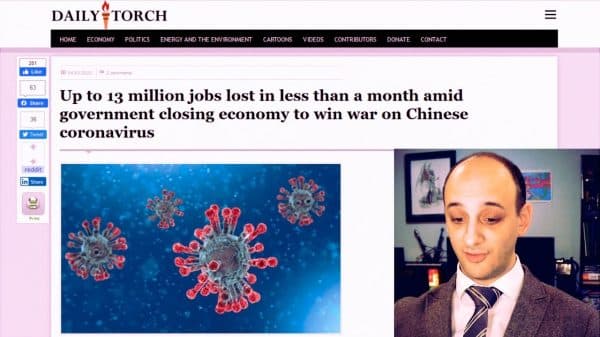
Up to 13 million jobs lost in less than a month amid government closing economy to win war on Chinese coronavirus:
http://dailytorch.com/2020/04/13-million-jobs-lost-in-less-than-a-month-amid-government-closing-economy-to-win-war-on-chinese-coronavirus/
Unemployment claims hit an all-time record at 6.6 million last week amid the national lockdown to combat the Chinese coronavirus and save as many lives as possible. 45 states have issued stay at home orders in their states, including 38 that have issued them for the entire state, effectively shutting down their economies. All 50 states have closed schools. That brings the total of unemployment claims for the past two weeks up to about 10 million, already dwarfing the total job losses in the financial crisis and 2007-2009 recession, which topped 8.3 million in Dec. 2009. Those losses took about three years to be realized as mortgage markets cratered and property values plummeted.On top of that in March alone an additional 3 million Americans lost their jobs according to the Bureau of Labor Statistics. Added to the past two weeks’ data on unemployment claims, that could bring the total job losses from coronavirus related closings up to 13 million and counting. To prevent a long, deep recession the federal government must make these economic incentives passed by Congress to maintain payroll for the duration of the pandemic available now. Aggressive advertising will be needed to bring these programs to everyone’s attention. Now, how deep the recession is will largely be determined by the extent of the pandemic, how long states remain closed and how effective social distancing is. When the pandemic is over, it will be up to the states to reopen as quickly as possible and the emergency benefits encouraging people not to work phased out. The long-term consequences of delay could mean it takes a decade to recover economically from this virus, with much of the damage already done. What do you think?
04.02.2020

U.S. daily death toll from Chinese coronavirus reaches 1,000, double seasonal flu, as private sector quickly moves to build ventilators:
http://dailytorch.com/2020/04/daily-death-toll-from-chinese-coronavirus-reaches-1000-double-seasonal-flu-as-private-sector-quickly-moves-to-build-ventilators/
The daily death toll from Chinese coronavirus in the U.S. sadly has reached more than 1,000, already double that of the seasonal flu, with the worst yet to come according to certain models that plot hospitals becoming overwhelmed with ventilator shortages. Thankfully, the private sector is moving as quickly as possible to produce the number of ventilators believed to be needed with Ford, GE, 3M, General Motors and others acting, and President Donald Trump has invoked the Defense Production Act to expedite the orders being made. It projects that the daily death toll could top 4,500 a day at the high end, almost 10 times worse than the seasonal flu. That is if the rate of infection exceeds the private sector’s capacity to produce enough beds and ventilators, according to the model. The overall death toll could reach 177,000 if the health care system becomes overwhelmed. And that’s with the entire country on lockdown. Without the lockdown, the White House coronavirus task force projects as many as 2.2 million could have perished in the U.S. in the pandemic this year, with the elderly and those with underlying health conditions the most at risk. The struggle, and a large part of the reason for the uncertainty has to do with ventilator production. The reason is because, in order to be useful, ventilators must be rigorously tested before put to use. And as the President noted yesterday, they take some time to build. Now, a point of optimism. These data are all moving targets and hopefully these numbers start falling rapidly as the federal government, state governments and the private sector all swing into action. Here at Americans for Limited Government, we will be monitoring the situation and comparing projected mortality to what transpires on the ground. According to the model, if it’s on the lower end, that means the mitigation and production of critically needed items like ventilators were effective and lives truly were saved by everything that has been set into motion by President Trump’s national emergency declaration. What do you think?