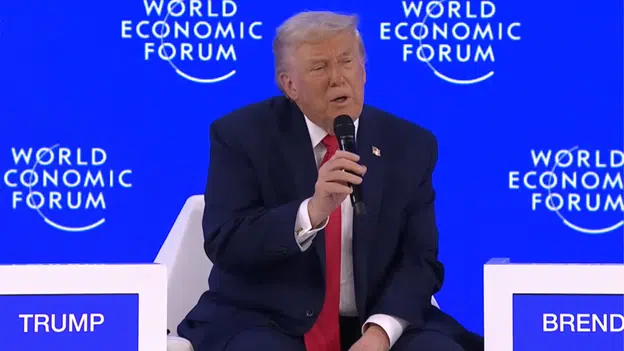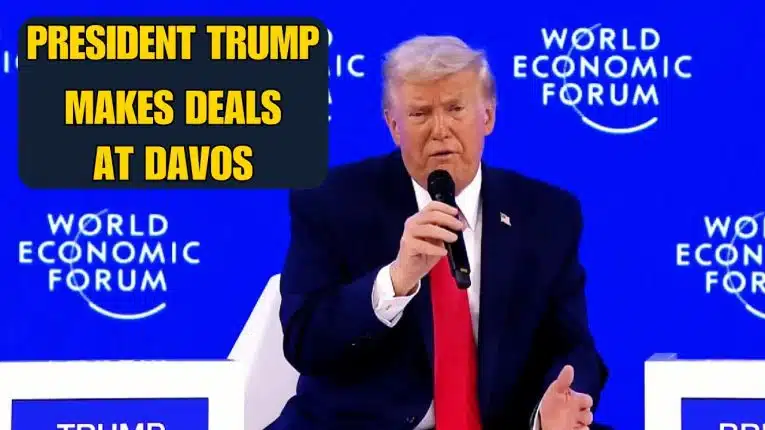


President Trump capped off his historic visit to the World Economic Forum in Davos, Switzerland on Jan. 22 by seating the Board of Peace that will administer Gaza and the demilitarization of Hamas in the aftermath of the Israel-Hamas war ending, but not before working his art of the deal on Jan. 21 to reach a “framework” agreement with NATO and Denmark that will enable the U.S. to build the new Golden Dome missile defense system in and around Greenland.
The announcement came some time after his speech before the forum in Davos, posting on Truth Social on Jan. 21, “Based upon a very productive meeting that I have had with the Secretary General of NATO, Mark Rutte, we have formed the framework of a future deal with respect to Greenland and, in fact, the entire Arctic Region. This solution, if consummated, will be a great one for the United States of America, and all NATO Nations… Additional discussions are being held concerning The Golden Dome as it pertains to Greenland.”
As a result, the President wrote, he would not be following through with planned additional 10 percent tariffs on Denmark, Germany, the UK, Norway, Sweden, France, the Netherlands, Finland and Germany: “Based upon this understanding, I will not be imposing the Tariffs that were scheduled to go into effect on February 1st.”
Later speaking to reporters, the President said of the deal, “It’s right now a little bit in progress… But pretty far along. It gets us everything we needed to get.”
And, then off the record, sources close to the matter said that the deal might include U.S. sovereignty over the U.S. military bases being used for the missile defense system, with the New York Times initially reporting on Jan. 21: “The announcement followed a NATO meeting on Wednesday where top military officers from the alliance’s member states discussed a compromise in which Denmark would give the United States sovereignty over small pockets of Greenlandic land where the United States could build military bases, according to three senior officials familiar with the discussion. The officials spoke on condition of anonymity to discuss a sensitive diplomatic matter, and they said the idea was one Mr. [Mark] Rutte [NATO Secretary General] had been pursuing.”
So, U.S. sovereign control over the bases and the systems is indeed being discussed, but has it been agreed to? Maybe not yet, according to reporting from the Times on Jan. 22, “NATO officials have discussed expanding the 1951 pact with a new agreement that would effectively create pockets of American soil in the territory.”
But, with an important caveat: “The officials cautioned that many details have yet to be finalized.”
If Golden Dome ultimately gets built, obviously, that’s the important part. Russia’s intercontinental ballistic missiles launched from its Arctic Sea locations pass largely over Greenland, Canada and Alaska depending on the target.
For now, the missile defense system will initially cost $24 billion, authorized in the One Big Beautiful Bill Act and also in the 2026 National Defense Authorization Act. According to the Congressional Research Service, it is “an integrated air and missile defense system… to combine a range of capabilities to create a ‘system of systems’ to protect the United States from ‘aerial attacks from any foe,’” quoting the President’s January 2025 executive order and a May 2025 statement from War Secretary Pete Hegseth.
Critics of the President’s approach have charged that Trump could have accomplished an agreement on putting the systems in place in Greenland without demanding U.S. be allowed to purchase the island. With or without full sovereign control—that might still be up in the air—the President again said “It gets us everything we needed to get.”
The freak out reactions to the President’s positions predictably helped him get to the resolution and then to gain maximum political credit when it comes out his way. A part of the demonstration was the President apparently wanted the American people to visibly see Europe and saying no to handing over Greenland for missile defense in spite of everything the U.S. has done to defend Europe, all of which educated a new generation of Americans about why we need missile defense.
Now who can forget the graphics shown all over news outlets of the ICBM routes that mostly come over Greenland to hit Washington, D.C.?
Of course, the outcome of all this was highly predictable going all the way back to the first term. On May 30, 2019, he threatened 5 percent tariffs on Mexico and then used that to get Mexican troops on the border and Remain in Mexico. Critics at the time attempted to claim those things would have happened anyway but all anyone remembers is the tariff threat — which never had to be instituted — and then the concessions.
The pattern seems to be the President exercises power, using leverage even on allies and the President’s critics don’t have the stomach for it, but then Trump ends of getting much of what he wanted anyway and claims victory. It’s not a hard analysis insofar as this happens a lot. His opening bid is usually 150 percent of what he’s after. Initially, he wouldn’t rule out using the military and then later threatened tariffs on the European nations—and then negotiated those away to get what he was really after.
In the 1980s, when Ronald Reagan was putting upgraded nuclear missiles into Europe, it was met with similar consternations overseas (and at home) but it all gave way to negotiations with Mikhail Gorbachev and then the 1987 Intermediate Nuclear Forces (INF) Treaty where the missiles Reagan had fought to put into place were then taken off the table to denuclearize the continent in the world’s first strategic arms reductions. It was all controversial at the time, but the projection of American strength paid off to the benefit of all.
In a similar vein, President Trump didn’t get Europe to agree to pay for their own defense in NATO at 5 percent of GDP by being nice, and since no other president had achieved these things, and they in contrast have appeared overly deferential to allies, maybe the President has identified the real problem. With a track record like that, maybe we can just thank him later.
Robert Romano is the Executive Director of Americans for Limited Government Foundation.