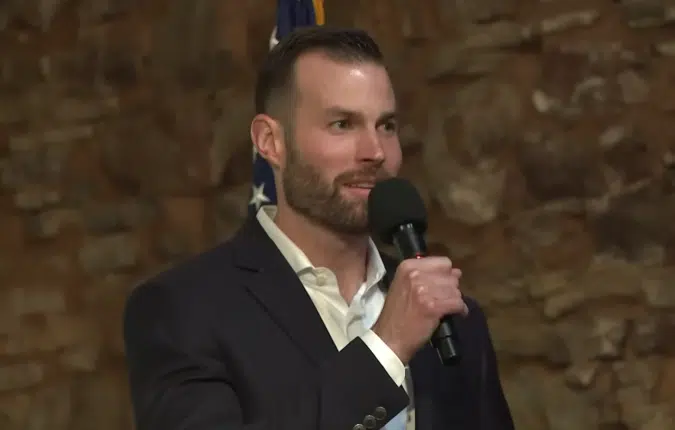

Former National Counterterrorism Center Director Joe Kent resigned from his post in the Office of the Director of National Intelligence on March 17 due to what he stated was because President Donald Trump had allegedly taken the U.S. to war with Iran on behalf of Israel, writing in his resignation letter without proof, “it is clear that we started this war due to pressure from Israel and its powerful American lobby…” adding “Iran posed no imminent threat to our nation…”
The decision to attack Iran, both in June 2025 and again in February 2026 in joint U.S.-Israeli military operations, was made by President Trump, in accordance with his constitutional Article II executive powers as Commander-in-Chief of the U.S. armed forces and to conduct foreign relations, and provided appropriate notifications to Congress under the 1973 War Powers Act.
In the both actions, the President clearly stated to the American people what U.S. interests were at stake as combat operations were ensuing, stating on March 1, “An Iranian regime armed with long range missiles and nuclear weapons would be a dire threat to every American. We cannot allow a nation that raises terrorist armies to possess such weapons [that] would allow them to extort the world to their evil will. Not going to let it happen. We’re not [letting it] happening to us and we’re not going to let it happen to others.”
Similarly, on June 21, 2025, President Trump stated in announcing Operation Midnight Hammer, “A short time ago, the U.S. military carried out massive precision strikes on three key nuclear facilities in the Iranian regime: Fordow, Natanz and Isfahan. Everybody heard those names for years as they built this horribly destructive enterprise. Our objective was the destruction of Iran’s nuclear enrichment capacity, and to stop the nuclear threat posed by the world’s number one state sponsor of terror.”
Trump added, “Tonight, I can report to the world that the strikes were a spectacular military success. Iran’s key nuclear enrichment facilities have been completely and totally obliterated. Iran, bully of the Middle East, must now make peace. If they do not, future attacks will be far greater and easier.”
And then, months later, as nuclear negotiations with Iran once again broke down, U.S. special envoy Steve Witkoff told Fox News’ Sean Hannity they still had enough material to make almost a dozen nuclear bombs: “Both the Iranian negotiators said to us, directly, with, you know, no shame, that they controlled 460 kilograms of 60 percent, and they’re aware that that could make 11 nuclear bombs, and that was the beginning of their negotiating stance.”
That was after Operation Midnight Hammer. Despite the President reporting that the enrichment facilities had been destroyed, Iran was still claiming to have the materials that had already been enriched. It matches what the International Atomic Energy Agency (IAEA) had found in May 2025: “As of 17 May 2025, the Agency has estimated that the total enriched uranium stockpile in the form of UF6 of 8413.3 kg comprised: 2221.4 kg of uranium enriched up to 2% U-235 (–705.6 kg since the previous quarterly report); 5508.8 kg of uranium enriched up to 5% U-235 (+1853.4 kg); 274.5 kg of uranium enriched up to 20% U-235 (–332.3 kg); and 408.6 kg of uranium enriched up to 60% U-235 (+133.8 kg).”
And that was a “direct” and “untenable” threat, the President determined, according to his March 2 War Powers Act reporting to Congress, writing, “Despite the success of Operation MIDNIGHT HAMMER, the Iranian regime continues to seek the means to possess and employ nuclear weapons. Its array of ballistic, cruise, antiship, and other missiles pose a direct threat to and are attacking United States forces, commercial vessels, and civilians, as well as those of our allies and partners.”
Trump added, “Despite my Administration’s repeated efforts to achieve a diplomatic solution to Iran’s malign behavior, the threat to the United States and its allies and partners became untenable.”
Was it an imminent, or immediate threat? Central Intelligence Agency (CIA) Director John Ratcliffe thought so, telling Sen. John Cornyn (R-Texas) who asked if Iran had stopped pursuing missile systems and nuclear capabilities that threatened U.S. forces in the region after Operation Midnight Hammer, in testimony before the Senate Intelligence Committee on March 18, stating, “Senator, no. In fact, the intelligence reflects the contrary… Iran has been a constant threat to the United States for an extended period of time and posed an immediate threat at this time.”
Last year, Director of National Intelligence Tulsi Gabbard told Congress about this particular stockpile: “Iran’s enriched uranium stockpile is at its highest levels and is unprecedented for a state without nuclear weapons.” And when she returned to testify on March 18, 2026, in her prepared written testimony, she reported the after-action assessment from Operation Midnight Hammer: “As a result of Operation Midnight Hammer, Iran’s nuclear enrichment program was obliterated. There has been no efforts since then to try to rebuild their enrichment capability. The entrances to the underground facilities that were bombed have been buried and shuttered with cement.”
But Gabbard made no mention of the stockpile that Witkoff and the Iranians referenced. There appears to be a perfectly legitimate internal assessment about what the Iranians were working on and what they really retained — but it’s still all based on intelligence.
In the meantime, there is very little evidence that Operation Epic Fury was initiated because of “pressure from Israel” or “its powerful American lobby…” Kent vaguely alluded to “high-ranking Israeli officials and influential members of the American media deployed a misinformation campaign that wholly undermined your America First platform and sowed pro-war sentiments to encourage a war with Iran. This echo chamber was used to deceive you into believing Iran posed an imminent threat to the United States.”
But there is a lot of evidence the President was responding to credible intelligence assessments both in June 2025 and February 2026. In announcing the action in June, President Trump said the enrichment facilities were “obliterated.” How did he determine that? Based on intelligence, that is, post-strike bomb damage assessments from the Department of War, the Defense Intelligence Agency (DIA) and CIA. Witkoff too in direct negotiations with the Iranians would have been a form of human intelligence — which articulated the imminent threat.
Maybe a good question is why didn’t Kent resign last June after Operation Midnight Hammer if this was the way he felt? It was the same danger with the same stated rationale.
The President has been consistent his entire public life about this threat and spoke of preventing Iran from having a nuclear weapon for over a decade including in 2015 when he began running for president, not based on a “misinformation campaign” from Israel and media, but based on Barack Obama’s failed nuclear deal with Iran.
Yes, we have allies who are similarly threatened including but not limited to Israel by a nuclear Iran. And they have a right to defend themselves, too. Secretary of State Marco Rubio commented on March 2 and March 3 on the timing of the strikes being coordinated with Israel to minimize the risk to U.S. forces and our allies in the region, calling it “a question of timing of why this had to happen as a joint operation, not the question of the intent. Once the president made a decision that negotiations were not going to work, that they were playing us on the negotiations and that this was a threat that was untenable. The decision was made to strike them.”
The President said the facilities were “obliterated” but by the time Witkoff and Kushner were negotiating with the Iranians, they were claiming to still possess the highly enriched uranium. It takes intelligence to claim they were “obliterated” and then the negotiations were direct human intelligence, that yes, the President clearly acted on.
If there was a misinformation campaign, perhaps it was from the Iranians to Witkoff. Maybe they were bluffing.
Still, if that’s what the Iranians really told Witkoff on the record, then the President’s decision couldn’t have been based on a “misinformation campaign” from Israel, because the source that Iran had the enriched uranium still was Iran itself. Either way, the President clearly wasn’t taking any chances.
The idea the President was responding to lobbyists and not his top envoys and what the enemy itself was saying, with such clear evidence, appears to be the real misinformation campaign. You’d have to believe Witkoff was lying. The President is lying. Rubio is lying. Gabbard is lying. Ratcliffe is lying. Everyone who was speaking based on intelligence sources and assessments was lying. It doesn’t even make sense. One’s faith in his country would have to be completely shattered to believe all that. Maybe Kent was the one who was deceived.
The President was acting for America. And for the world. For humanity. You don’t let Nazi-like regimes get nukes. Kent clearly could not trust the President to make that decision in U.S. interests and could not accept the clear account of the President’s top envoy even after it was made public. If so, then he should have never served in the administration in the first place — and neither should any one else harboring such misgivings.
Robert Romano is the Executive Director of Americans for Limited Government Foundation.