
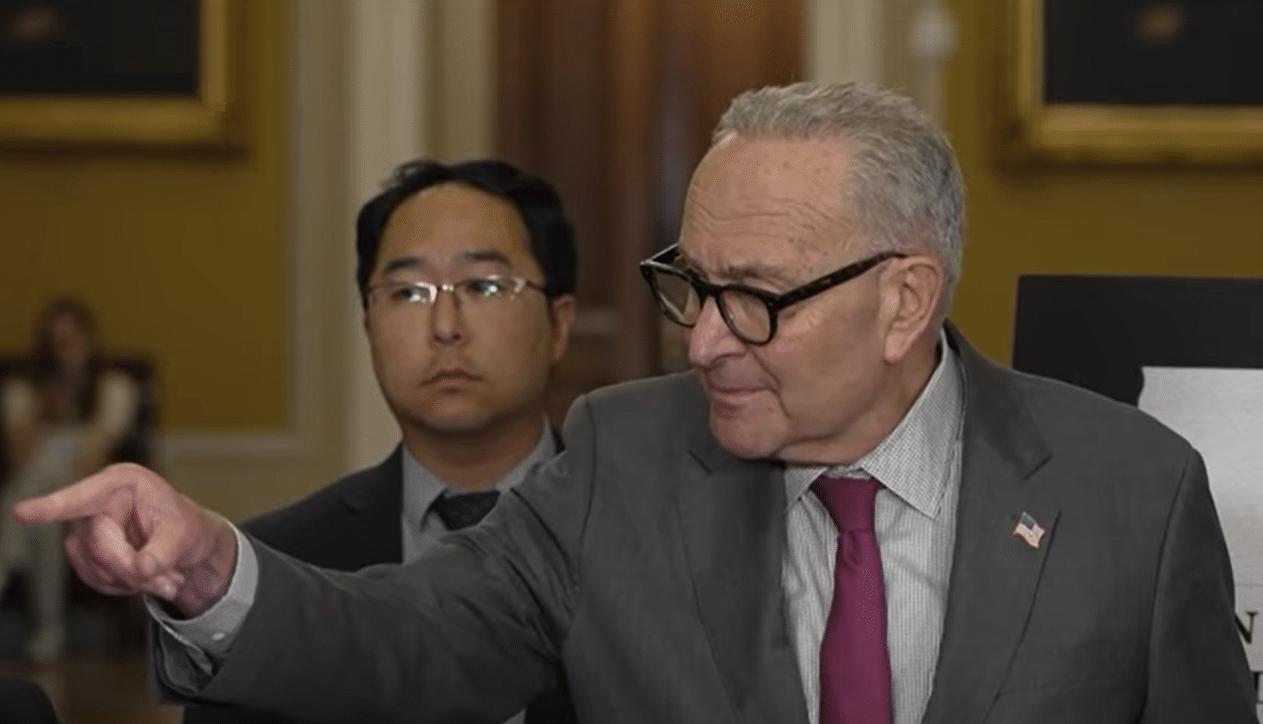
Another partial government shutdown appears imminent as Senate Democrats led by Senate Minority Leader Chuck Schumer (D-N.Y.) look to hold up Department of Homeland Security (DHS) funding in the aftermath of the shooting deaths of Renee Good and Alex Pretti by federal immigration officers in Minneapolis as ICE Watch groups target immigration enforcement operations.
Schumer laid out his demands in a statement on Jan. 26, that everything should get funded except for DHS, dangling the Jan. 30 deadline as leverage: “Senate Democrats have made clear we are ready to quickly advance the five appropriations bills separately from the DHS funding bill before the January 30th deadline.”
Schumer added, “The responsibility to prevent a partial government shutdown is on Leader Thune and Senate Republicans. If Leader Thune puts those five bills on the floor this week, we can pass them right away. If not, Republicans will again be responsible for another government shutdown.”
The remaining bills to passed by the Senate include H.R. 7147 funding DHS, H.R. 7006 funding the Department of Treasury, general government, national security and the Department of State and H.R. 7148 funding the Department of Defense (War), Labor, Health and Human Services, Transportation and Housing and Urban Development.
Those come after the House and Senate already agreed to H.R. 6938, which funded Commerce, Justice, Science; Energy and Water Development; and Interior and Environment, which was signed into law by President Trump on Jan. 23.
Of course, on its face, even if Senate Republicans caved and gave Schumer everything he wants — which is to isolate DHS funding so the immigration enforcement question can be forced to Congress — the Department would still be shut down partially while leaders haggled over the details.
So no matter what, whether the five out of six appropriations minus DHS get funded or not, there will be a partial government shutdown on Jan. 30.
On DHS, the question will inadvertently stop funding for the Federal Emergency Management Agency and the Transportation Security Administration and the Federal Aviation Administration including air traffic controllers in the middle of the worst snow event of the season across the country, when emergency personnel are still recovering from the last shutdown in 2025 — the longest in U.S. history.
It also comes amid heightened U.S. tensions with Iran and ongoing terrorist threats from Tehran, narcoterrorists in the Americas and continued illegal alien gang activities in U.S. cities that come under DHS’ purview to enforce the laws and prevent terror attacks — all which more radical members of the Democratic caucuses in the House want to block funding for.
Have Democrats considered that’s exactly the argument Republicans want to have? Immigration and border enforcement including deporting violent criminal aliens that include rapists and murderers still rank among the President’s top-approved issues in polls, which Democrats are hoping to eat into using Minneapolis to stoke up their political base.
The idea that it’s a “package” might be up to the Senate to consolidate the three with an amendment but the fact is the three spending bills were passed separately in the House and remain unconsolidated as of this writing.
House Republicans could have passed the DHS bill together with other bills in a minibus or omnibus, but purposely passed it on a party-line vote, making isolation by Senate Democrats an increasingly likely outcome.
There are several factors that contribute to government shutdowns structurally: The Article I, Section 8 power of the purse that Congress wields plus standing Senate rules that require 60 votes to proceed, meaning all continuing resolutions, omnibuses, minibuses and individual appropriations bills require bipartisan consensus to go forward. The minority gets a limited voice in every spending measure, which is appropriate but can only go so far.
Consider the last three government shutdown 2013, 2018-2019 and 2025 all resulted in zero concessions. Republicans didn’t defund Obamacare in 2013, President Donald Trump could not secure border wall funding in the 2018-2019 shutdown and Democrats could not extend Obamacare expanded exchange tax credits and to roll back One Big Beautiful Bill prohibitions on illegal aliens getting Medicaid in 2025.
Each shutdown therefore follows a similar pattern. Either minority party or the President in the case of the 2018-2019 shutdown, wants something extra in the appropriations bill already under consideration. The demands are issued, the impasse begins and then the government shuts down. Lots of back and forth, just waiting it out, and when it appears there are no concessions to be had, the group holding up final passage gives up — getting nothing in exchange but maybe for a headache.
And Democrats want to do it again. In the meantime, thanks to the One Big Beautiful Bill Act of 2025, Immigrations and Customs Enforcement (ICE) already has an additional $75 billion of funding it can partially live off of for the time being, although federal agents would still be working without pay as “excepted” employees.
In other words, the operations Democrats are determined to “stop” by blocking funding will ultimately continue at President Trump’s direction, making the shutdown simply another “game” of just waiting out the intransigent Democrats.
Democrats might believe that politically shutdowns don’t matter. In 2013, Republicans staged a shutdown and went on to win their largest House majority since the 1920s in 2014. On the other hand, the GOP didn’t try to do a shutdown — which are painful for federal workers and anyone using public transportation — during an election year when everyone already knows that nobody gets any concessions from shutdowns.
Illustrating the futility of shutdowns, gone are Democratic demands for expanded Affordable Care Act tax credits. Now, it’s a fresh new set of largely irrelevant demands since Democrats don’t control the floor of either the House or the Senate and can only do so much to work with Republicans to include provisions in what was otherwise a bipartisan process moving along. Republicans aren’t getting everything they want, either.
But the show must go on. So, here we go again.
Robert Romano is the Executive Director of Americans for Limited Government.