
Light sweet crude oil surged to a high of $78 before slipping back to $73, and Brent crude oil to $81 before dropping back to $78, in trading on March 3, as markets attempted to price in supply shocks from the U.S.-Israeli war in Iran.
The price volatility comes as Tehran has used drones, fighter jets and missiles to target oil and gas facilities and other targets in the region. Already, the Ras Tanura oil refinery in Saudi Arabia has temporarily halted production after being targeted by drones, QatarEnergy has suspended liquified natural gas production after its Ras Laffan facility was struck by drones and Israel ordered Chevron to shut offshore gas fields as a precaution and United Arab Emirates’ (UAE) Fujairah port was also targeted.
Iran’s decision to target neighboring Arab countries has been viewed by many as a strategic blunder — so far it has attacked Bahrain, Saudi Arabia, Iraq, Jordan, Kuwait, Oman, Qatar, UAE, Cyprus and Israel — but clearly the intent is to set off a global oil supply shock.
The consequence of course is these other countries may be entering the war, including Qatar and Saudi Arabia, even if only defensively at the moment. Qatar shot down two Iranian fighter jets and Saudi Arabia is threatening retaliation if there are further attacks.
In that context, Iran’s strikes could be viewed as a warning shot not to enter the war offensively, or else wider attacks by Iran on her Arab neighbors could be even more widespread, with further disruptions to oil and gas production.
As it is, President Donald Trump has responded to Iran’s aggression, promising U.S. Navy escorts through the Strait of Hormuz, which Iran has threatened to block. Posting on Truth Social on March 3, the President wrote, “the United States Navy will begin escorting tankers through the Strait of Hormuz, as soon as possible. No matter what, the United States will ensure the FREE FLOW of ENERGY to the WORLD.”
To that end, the U.S. Navy has already sunk about 11 Iranian navy ships, according to U.S. Central Command, posting on X: “Two days ago, the Iranian regime had 11 ships in the Gulf of Oman, today they have ZERO. The Iranian regime has harassed and attacked international shipping in the Gulf of Oman for decades. Those days are over. Freedom of maritime navigation has underpinned American and global economic prosperity for more than 80 years. U.S. forces will continue to defend it.”
The other thing, of course, that the U.S., which produces 13.7 million barrels of oil per day, along with Saudi Arabia, which produces about 10.1 million barrels of oil per day, and Venezuela, which produces 800,000 barrels of oil per day, would be to immediately boost oil production with whatever spare capacity there is to offset Iran’s own 3.3 million barrels per day oil production output.
Whereas, Saudi Arabia is said to have about 12 million barrels a day of potential maximum capacity output and can ramp up faster, the U.S. and Venezuela, the latter of which is said to have 241 billion barrels of recoverable oil, require longer term investment to bring up capacity.
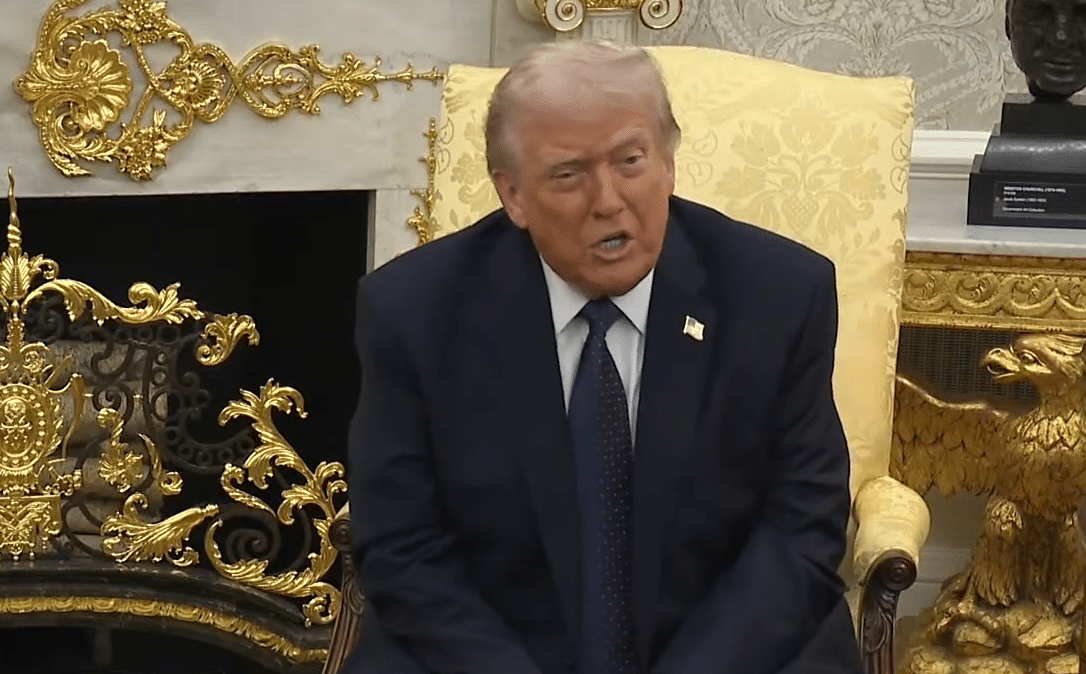
Speaking on the war’s progress to reporters at the White House, President Trump touted the successes seen so far, saying the war “is coming along as you see very well. They have no navy. It’s been knocked out. They have no air force that’s been knocked out. They have no air detection that’s been knocked out. Their radar has been knocked out. And uh just about everything’s been knocked out.”
And on oil prices: “if we have a little high oil prices for a little while, but as soon as this ends, those prices are going to drop, I believe, lower than even before…”
But was emphatic on his decision: “Something had to be done and it’s been 47 years. They’ve been killing people all over the world for a long time.” Since the Islamic Republic of Iran was founded in 1979, they have killed more than 1,000 Americans in Iraq and Lebanon, and maimed and wounded many thousands of more. The U.S. and Israel have been targeting Iran’s navy, air force, missiles and nuclear weapons capabilities.
With such rapid success, the question might be how much of a counterpunch Iran has left. China kind of needs it to keep pumping oil — it imports about 1.5 million barrels of oil a day from Iran out of the 11.5 million barrels of oil a day total it takes in — and so there is a limit to how much damage Tehran can inflict on the global energy trade before it is harming its own allies. But that is their weapon, and they’re going to use it.
Robert Romano is the Executive Director of Americans for Limited Government Foundation.