
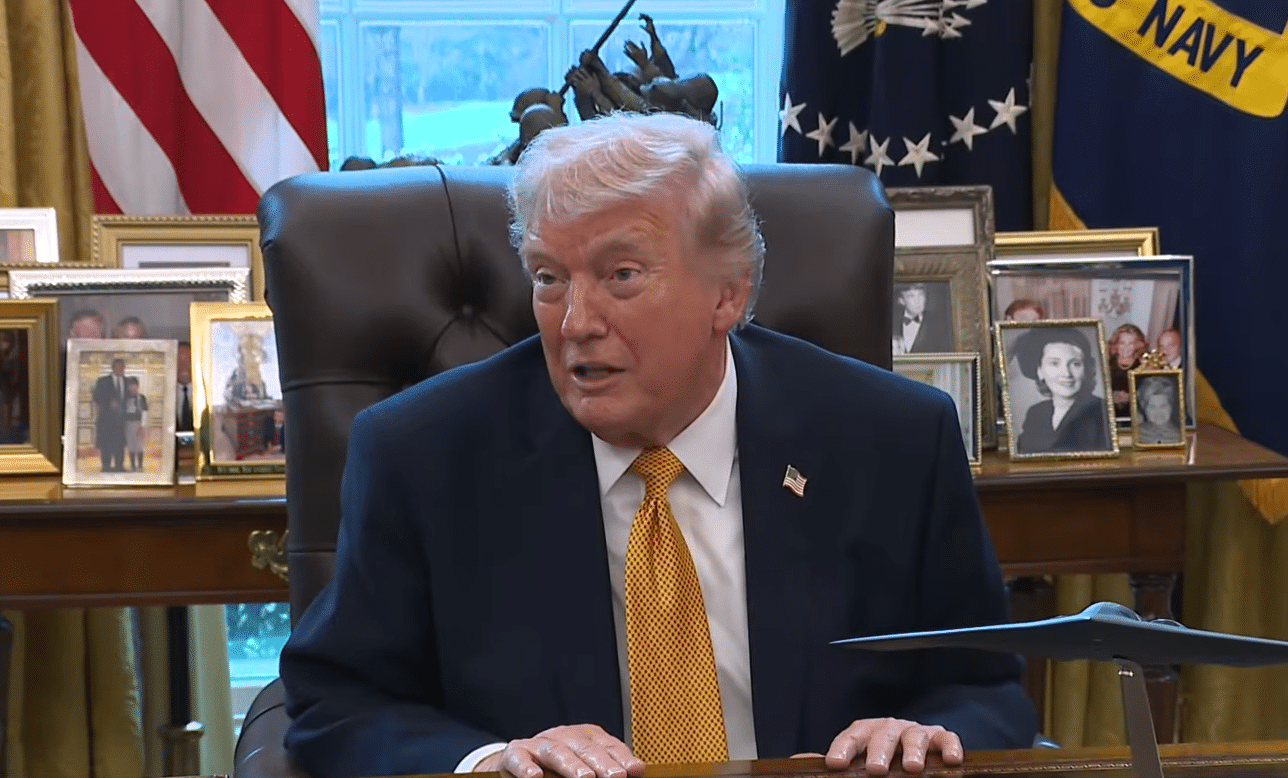
“[T]hey should be thanking me because many of them get 90 percent… [of] their energy from the straits and or as they call it the strait and they should be not only thanking us, they should be helping us. What does surprise me is that they’re not eager to help. There are a couple, we’ll be announcing some names. There are some that really were right up front.”
That was President Donald Trump taking questions from reporters in the Oval Office on March 16, noting the distinction between really good allies who will help us in a war versus our other, more gentle allies who don’t seem to want to do anything even when their interests — for example, getting oil out of the Persian Gulf that provides 20 percent of the global oil supply — are at stake.
As of this writing, light sweet crude oil is trading at about $94 a barrel and Brent crude oil is trading at about $101 a barrel, while the Strait of Hormuz that leads from the Persian Gulf along the southern coast of Iran to the Gulf of Oman, remains closed, as Iran keeps targeting oil and gas infrastructure in the Middle East including oil tankers that traverse the Strait.
If ever there was a textbook case for why the U.S. always seems to be involved militarily around the world, this is it. That is, if you want cheap oil and gasoline — every poll says that inflation and the economy remain the top issues for voters — then you need the U.S. Navy to be protecting shipping lanes including the Strait of Hormuz. How could one come to any other conclusion?
The alternative would be to try to keep oil and gasoline prices lower by appeasing terrorist countries like Iran, which has been exporting its revolution for 47 years, that have been seeking nuclear weapons.
You think oil prices are high now? Imagine if Iran had succeeded in obtaining nuclear weapons and was holding the Strait of Hormuz hostage all the same. Then, there would still be military options, but very bad options.
Say what you will about Iran, a Holocaust-denying Nazi regime, but they’ve always been very transparent about their designs.
The first Ayatollah, Ruhollah Khomeini, declaring war on the U.S. in 1980, wrote, “[W]e are fighting against the Western world — devourers led by America, Israel and Zionism… We should try hard to export our revolution to the world, and should set aside the thought that we do not export our revolution, because Islam does not regard various Islamic countries differently and is the supporter of all the oppressed people of the world. On the other hand, all the superpowers and all the powers have risen to destroy us. If we remain in an enclosed environment we shall definitely face defeat. We should clearly settle our accounts with the powers and superpowers and should demonstrate to them that, despite all the grave difficulties that we have, we shall confront the world with our ideology.”
When the enemy tells you who they are, believe them. They want to kill us.
And so they have, killing more than a thousand Americans over the years including in Iraq and Lebanon, but the U.S. did little in response even as Jimmy Carter invoked the War Powers Act in 1980 to attempt to rescue the hostages, and Ronald Reagan in 1987 and 1988 when Iran was bombing oil tankers in the Persian Gulf. — because there was an overall desire not to disrupt oil supplies.
But when the oil supply is threatened, that is precisely when the U.S. has acted, for example, when Iraq invaded Kuwait in 1990. Then, the price of oil doubled, from $17 a barrel before the war to $39 a barrel during the war, only to settle back down when Iraq could no longer threaten oil infrastructure in the region.
Love it or hate it, that’s where the U.S. and its allies find itself today. Either, Iran will be able threaten the transit of oil to the rest of the world until the end of time, or it will be degraded, like Iraq was, to the point where it can no longer do anything like that.
The U.S. has enough oil production now at 13.6 million barrels of oil a day to be able to now export some oil, but not nearly enough to be immune the global supply disruptions, whether in 2022 after Russia invaded Ukraine, in 2011 during the Libyan Civil War, in 2003 to 2008 during the Iraq War, in 1990 and 1991 during the Gulf War, from 1979 to 1986 following the Iranian Revolution or from 1973 to 1979 following the Arab Oil Embargo.
Here, President Trump is testing U.S. allies by asking them to do the most basic thing to preserve the peace: Protect the global economy and shipping lanes. At the Oval Office, he noted, “We defend all these countries. And then do you have any mine sweepers? And they say, well, would it be possible for us not to get involved? I’ve been saying it for a long time. This is the greatest thing to come out of this. We spend trillions and trillions of dollars on NATO to defend other countries. And I always said, but if it ever comes time to defend us, they’re not going to be there. Many of them would not be there. And we’re going to have to start thinking more wisely in this country.”
The President is right. What we’re once again learning is that our gentle allies not only have no interest standing with the U.S., they don’t even have an interest in protecting themselves and their interests. Yes, the U.S. could stand back and leave it to others to protect global shipping lanes but so far, there’s just zero evidence they have the capability or the will to do so. So, if you want low prices, you need the U.S. Navy.
Robert Romano is the Executive Director of Americans for Limited Government Foundation.