
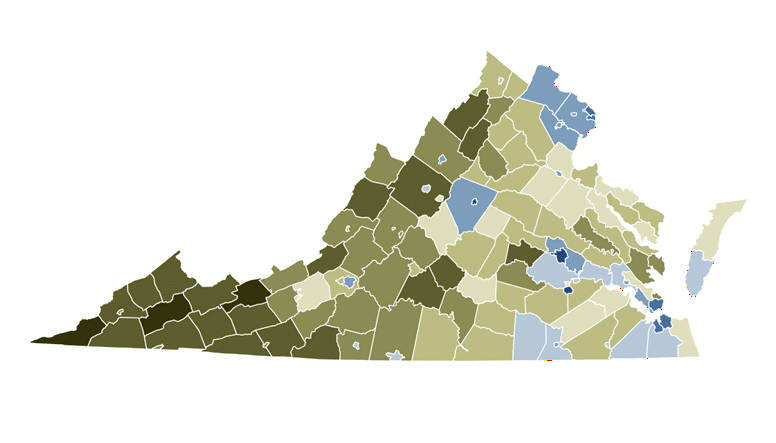
Democrats in Virginia, although they won their redistricting referendum 1.57 million to 1.48 million, or 51.5 percent to 48.5 percent as of this writing, dramatically underperformed their 2025 voting levels in the commonwealth’s gubernatorial race that elected Democratic Gov. Abigail Spanberger with 1.976 million votes. Whereas, Republicans appear to have slightly exceeded former Lieutenant Gov. Winsome Earle-Sears’ 2025 showing of 1.449 million votes.
Diminished Democratic turnout in blue areas was the only reason the referendum was close was lower turnout in blue areas. For example, in the 2025 governor’s race in Fairfax County, Spanberger received 330,000 votes to Earle-Sears’ 116,000, whereas for the referendum in Fairfax, Yes got 263,000 to No’s 115,000.
That made the referendum competitive, but to win, Republicans would have still needed almost presidential-level turnout in the rural counties.
For example, in 2024, President Donald Trump got 45,000 votes in Hanover County but 2026’s No only got 36,000 votes. Trump got 42,000 votes in Spotsylvania County, but No only got 30,000, basically doing no better than Earle-Sears in the 2025 governor’s race in those same counties.
To do better in November, although maybe not in Virginia with the new districts, but everywhere else, Republicans will still want to turn out their people but just Republicans are usually not enough. You need independents. The challenge then becomes when independents turn against the incumbents, then higher turnout actually hurts you.
Alternately, Republicans might endeavor to achieve presidential levels of turnout in rural counties among lower propensity voters, that is, people who only vote in presidential election years. Democrats will turn out cities and suburbs, and with independents sour on Trump-GOP that will be enough for Democrats to win. Republicans might have an easier go at it if the President’s approval were much higher but it is what it is. The only safe place for the GOP to boost turnout will be the rural counties.
Either way, the lower Democratic turnout for Yes made the defeating referendum possible for Republicans might not be the case in November’s Congressional midterms when there will be named candidates on the ballot.
If Republicans can’t figure out how to boost low propensity turnout in rural counties there may not be a reliable offset to independents who are currently sour on the incumbent party as usually happens in midterms.
Still, for the redistricting referendum, Republicans who had everything to lose were more fired up than Democrats, some of whom might have thought the redistricting was unethical and so stayed home. Independents who voted for Spanberger might have been indifferent to the redistricting and some of them stayed home, too.
Republicans better hope they pick up all the extra seats in Texas and Florida they were promised. If gerrymandering motivates the party that’s getting screwed over, there could be statewide races at risk even if the districts appear safer on paper. If Texas and Florida don’t deliver, this might be viewed as counterproductive in hindsight. We’ll see.
But that works both ways. Now that Virginia has done what it has done, what will the response be nationally? In Virginia, Republicans woke up and boosted turnout while Democratic turnout was depressed. Does Virginia now become a rallying cry for the GOP?
Similarly, Democrats will be fired up about Texas and Florida redistricting, making the whole thing a wash in terms of raw power. That is, the seats each party was picking up might just cancel each other out in November.
So, we could just be back to a garden variety midterm cycle, where opposition turnout is still slightly favored over the incumbents. For November, then to cheat death in an off-year with their party in the White House, Republicans will need to figure out massive get out the vote of low propensity voters, likely in rural counties. As usual, stay tuned.
Robert Romano is the Executive Director of Americans for Limited Government Foundation.