
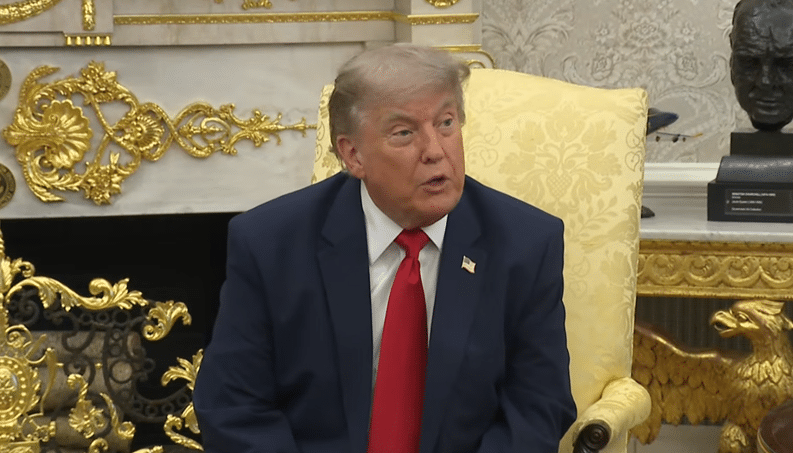
“The big Oil Companies are not dropping their price at the pump commensurate with the sharply lower prices they are paying for Oil. Those prices are dropping like a rock! In other words, customers are being ‘gouged.’ I have instructed the DOJ to immediately start looking into this. Gasoline prices better start going down a lot faster than what I’m seeing!”
That was President Donald Trump on June 24 in a post on Truth Social, stating he had ordered the Justice Department to investigate alleged price gouging at the gas pump, noting oil prices are falling faster than gasoline. The implication is there might be illegal price collusion.
In fact, since the April ceasefire in the Iran war, when oil prices began falling, they have fallen on average 2.43 percent a week, while gasoline prices have fallen an average of 0.41 percent, according to data compiled by the U.S. Energy Information Administration. So, the President is correct, oil prices are falling faster than gasoline prices.
It is worth noting that as the war was escalating in March and the first week of April, oil rose more than 8 percent a week on average while gasoline rose 5.1 percent.
So, when oil is rising, gasoline rises too but not as much, and when oil is falling, gasoline falls but not as much.
In 2026 so far, oil prices have risen 1.57 percent a week while gasoline rose 1.41 percent, so it appears to average out over time.
In 2025, oil fell 0.327 percent a week on average, while gasoline fell 0.126 percent.
And from January 2021 to December 2024, oil fell slightly 0.0139 percent a week, while gasoline fell slightly 0.0187 percent.
In 2014, the St. Louis Federal Reserve’s Michael T. Owyang and E. Katarina Vermann highlighted this phenomenon in an article, “Rockets and Feathers: Why Don’t Gasoline Prices Always Move in Sync with Oil Prices?” noting the oil and gasoline price movements are often asymmetrical.
It stated, “Both casual and industry observers say that gas prices adjust to changes in oil prices faster when gasoline prices are relatively low compared with oil than when gasoline prices are relatively high compared with oil. This uneven pass-through can be seen when oil prices rise after being steady for some time — gasoline prices shoot up quickly. In contrast, when oil prices fall after being steady for some time, gasoline prices retreat slowly. In the gasoline industry, this phenomenon is known as ‘rockets and feathers.’”
The study noted, “Although oil and gas prices appear to move together, the speed at which changes in the upstream price (oil) affects the downstream price (gasoline) can vary. The adjustment process back to the long-run relationship may depend on whether gasoline prices are above or below their long-run ratio with oil prices.”
But could there be price manipulation? Owyang and Vermann wrote, “Seller market power implies that retail gasoline markets are not perfectly competitive: Opportunities exist for retailers to take advantage of price changes to maintain a higher overall profit. For example, Borenstein, Cameron and Gilbert noted that retailers increased gasoline prices as oil prices rose to keep a constant margin. When prices fell, retailers adjusted prices downward slower because consumers were already accustomed to the higher prices…” citing a 1997 paper by Severin Borenstein, A. Colin Cameron and Richard Gilbert, “Do Gasoline Prices Respond Asymmetrically to Crude Oil Price Changes?”
Meaning, there could be something to President Trump’s claims, but if so, it might be down to the individual gas station level, as seller market power appears to vary based on how close gas stations are to one another. As Owyang and Vermann noted, “One factor that influences market power is market concentration: Gas stations that are physically close together have less market power than do gas stations that are farther apart.”
Suffice to say, the asymmetry between oil and gasoline prices is nothing new, but that doesn’t mean gas stations aren’t leaving prices higher for longer to increase profit margins. This time President Trump noticed — and now the Justice Department is taking a look. Stay tuned.
Robert Romano is the Executive Director of Americans for Limited Government Foundation.