
“This is like maybe super heterodox… I am not sure that I think the reserve currency is actually good for the United States of America. I think there is a good argument that reserve currency status is akin to coal and Appalachia. It’s a resource curse, right? It allows your consumers to consume very cheaply, right? That’s been the story of the American economy for the last 15 or so years, even before that, is we can just borrow basically in an unlimited way because we have the reserve currency.”
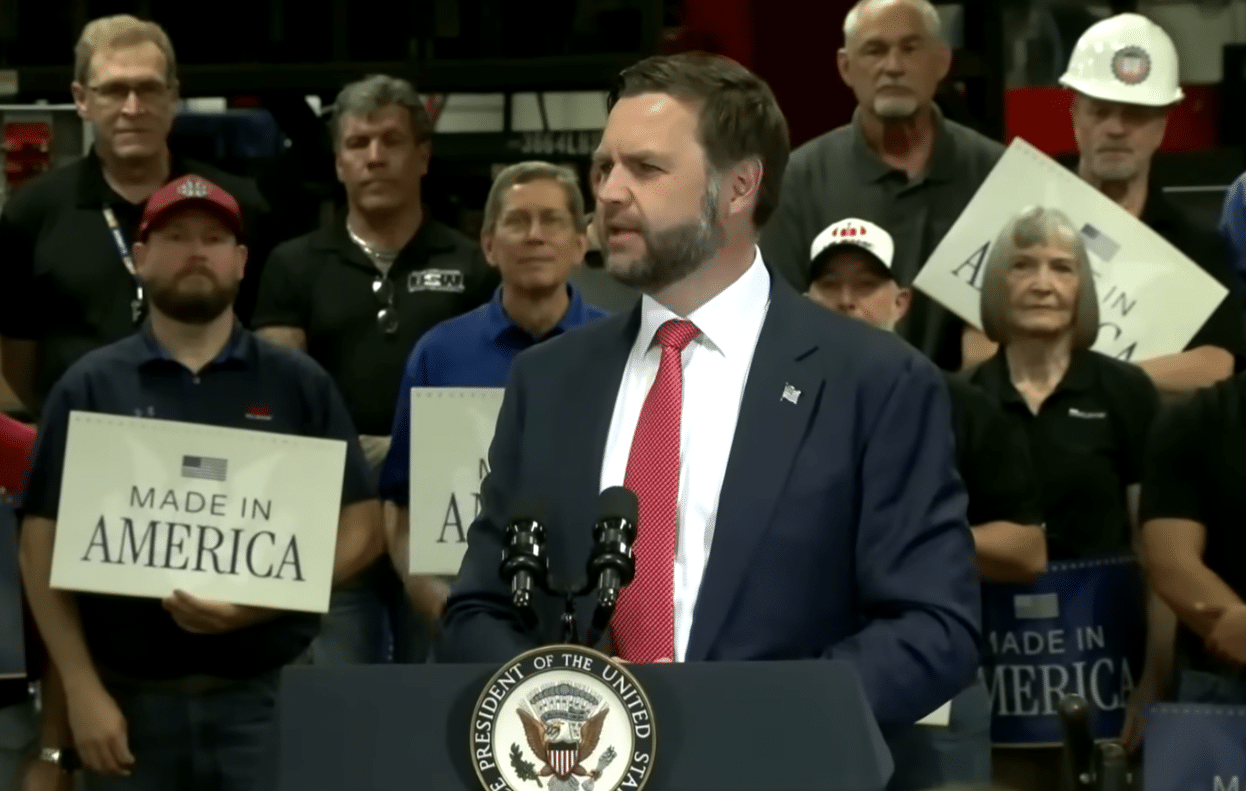
That was Vice President J.D. Vance, then Ohio Republican Senator, in April 2023, at an American Moment forum in part questioning the U.S. dollar’s status as the world’s reserve currency in a clip that recently resurfaced on X.com in a post by economic historian and senior fellow at the Independent Institute Phil Magness.
Magness stated, “J.D. Vance wants to end the U.S. dollar’s position as a global reserve currency, because he thinks it allows Americans to consume too much and do so too cheaply.”
Now, Vance did not go quite that far — nowhere did he say the U.S. should undertake a new policy to somehow “end” the dollar as the world’s reserve currency or to discourage foreign investment in U.S. treasuries — but he did discuss some of the tradeoffs involved with foreign governments’ stockpiling of U.S. treasuries, now $9.3 trillion.
Vance explained, “So, that’s a massive subsidy to incurring debt. The debt is cheaper even in raised interest rate environments. That’s one of the crazy things about what’s going on right now is the market is in some ways pricing future interest rates lower than what the Fed is right now… [W]e have this massive subsidy to cheap debt for the American consumer. Well, that’s good, right? Consuming is important especially food, medicine, things like that but I think it’s a massive tax on American producers…”
Similarly, questioning former Federal Reserve Chairman Jerome Powell in March 2023, Vance stated, “Americans have enjoyed one of the greatest privileges of the international economy for the last nearly eight decades, a strong dollar that acts of course as the world’s reserve… [T]his has obviously been great for American purchasing power: we enjoy cheaper imports, Americans when they travel abroad benefit from lower costs but it does come at a cost to American producers. I think in some ways you can argue that the reserve currency status is a massive subsidy to American consumers but a massive tax on American producers. Now, I know the strong dollar is sort of a sacred cow of the Washington consensus but when I survey the American economy and I see our mass consumption of mostly useless imports on the one hand and our hollowed out industrial base on the other hand I wonder if the reserve currency status also has some downsides and not just some upsides as well.”
He noted that military manufacturing output did not match U.S. adversaries in the event of war: “I read recently that the United States is trying to ramp up production from 14,000 artillery shells to 20,000 artillery shells, that’s per month, while the Russians are firing 20,000 artillery shells in Ukraine per day. And when I look at the American economy we have a lot of financial engineers and a lot of diversity consultants, we don’t have a lot of people making things, and I worry that the reserve currency status and the lack of control we have of our currency is perhaps driving that.”
That’s not an unusual position, particularly within the second Trump administration. For example, former Chair of the Council of Economic Advisers and former Federal Reserve Board of Governors member Steve Miran, right after President Donald Trump’s re-election in November 2024, published a thorough analysis of the issue, “A User’s Guide to Restructuring the Global Trading System.”
Miran wrote that the reserve currency results in “persistent dollar overvaluation”: “The root of the economic imbalances lies in persistent dollar overvaluation that prevents the balancing of international trade, and this overvaluation is driven by inelastic demand for reserve assets. As global GDP grows, it becomes increasingly burdensome for the United States to finance the provision of reserve assets and the defense umbrella, as the manufacturing and tradeable sectors bear the brunt of the costs… From a trade perspective, the dollar is persistently overvalued, in large part because dollar assets function as the world’s reserve currency. This overvaluation has weighed heavily on the American manufacturing sector while benefiting financialized sectors of the economy in manners that benefit wealthy Americans.”
Miran described the dilemma posed by the dollar’s role “Such phenomena reflect what can be described as a ‘Triffin world,’ after Belgian economist Robert Triffin. In Triffin world, reserve assets are a form of global money supply, and demand for them is a function of global trade and savings, not the domestic trade balance or return characteristics of the reserve nation… In Triffin world, the reserve asset producer must run persistent current account deficits as the flip side of exporting reserve assets. [U.S. Treasuries] USTs become exported products which fuel the global trade system. In exporting USTs, America receives foreign currency, which is then spent, usually on imported goods. America runs large current account deficits not because it imports too much, but it imports too much because it must export USTs to provide reserve assets and facilitate global growth.”
And, as the global economy grows, the U.S. must output yet more treasuries to keep up with global demand, Miran wrote: “As the United States shrinks relative to global GDP, the current account or fiscal deficit it must run to fund global trade and savings pools grows larger as a share of the domestic economy. Therefore, as the rest of the world grows, the consequences for our own export sectors—an overvalued dollar incentivizing imports—become more difficult to bear, and the pain inflicted on that portion of the economy increases.”
This is one of the reasons behind President Donald Trump’s reciprocal tariffs. In February 2025, very early in the second Trump administration, Treasury Secretary Scott Bessent on Fox Business with Maria Bartiromo identified competitive devaluations and other currency manipulations as a non-tariff barrier that the tariffs: “As we learned with President Trump, you should take him at his word. This is not theater. The April 1 deadline is for a study that the Commerce Department is doing on global tariffs that apply to U.S. products country by country. And also, we’re not just looking at tariffs but we’re looking at non-tariff barriers, the local content, things like that and we’re also looking at currency manipulation. As I’ve repeatedly said, the U.S. has a strong dollar policy, but because we have a strong dollar policy, it doesn’t mean other countries get to have a weak currency policy. So, we’re going to come up with what is the equivalent of an index—what I would call a reciprocal index—country by country: outstanding tariffs, non-tariffs, the trade barriers and currency manipulation.”
That differed from Bessent’s January 2024 take from Key Square, where he thought Trump would be more likely to weaken the dollar than do the tariffs: “Another differentiated view that we have is that Trump will pursue a weak dollar policy rather than implementing tariffs. Tariffs are inflationary and would strengthen the dollar — hardly a good starting point for a U.S. industrial renaissance. Weakening the dollar early in his second administration would make U.S. manufacturing competitive. A weak dollar and plentiful, cheap energy could power a boom. The current Wall Street consensus is for a strong dollar based on the tariffs. We strongly disagree. A strong dollar should emerge by the end of his term if U.S. reshoring effort is successful.” Still, this articulated the view that a weak dollar could boost exports and that questioning the costs of a strong dollar is not outside the bounds of serious debate in the current administration.
Sometimes, policymakers do call for the end of King Dollar. For example, from across the political aisle, in August 2014, Jared Bernstein, Miran’s predecessor as Chair of the Council of Economic Advisers published a piece entitled “Dethrone ‘King Dollar'” calling for an end to the dollar as the reserve currency, saying “what was once a privilege is now a burden, undermining job growth, pumping up budget and trade deficits and inflating financial bubbles…”
Bernstein argued that foreign nations accumulate dollar reserves usually in the form of treasuries to weaken their own currencies against the dollar, thereby making the exports to America cheaper, making domestically produced goods more relatively expensive: “It is widely recognized that various countries, including China, Singapore and South Korea, suppress the value of their currency relative to the dollar to boost their exports to the United States and reduce its exports to them. They buy lots of dollars, which increases the dollar’s value relative to their own currencies, thus making their exports to us cheaper and our exports to them more expensive.” These are bipartisan concerns.
And it also incentivizes borrowing by keeping interest rates low: “Of course, if fewer people demanded dollars, interest rates — i.e., what America would pay people to hold its debt — might rise…”
This is a well-known problem, that the dollar’s reserve currency status incentives the perpetual expansion of the $39.9 trillion national debt by driving down interest rates. In proposing the 2018 Fair Trade with China Enforcement Act, then-Sen. Marco Rubio (R-Fla.), now Secretary of State and National Security Advisor, noted that China’s stockpiling of treasuries was driving interest rates lower as a perverse incentive for government borrowing: “After China rose to the World Trade Organization, it had all this excess capital resulting from its large surpluses. That drove them to take that excess capital they were making now that they were part of the WTO and invest it… This cheap financing of our debt, this buying up so many of our Treasury notes because there is such demand for our debt, our yield — the amount of interest we pay back to the investor — is lower. The result is it is one of the things that has driven our national debt here. It has been easy to borrow because it has been cheap.”
Explaining his proposal on Fox News with Tucker Carlson on May 3, 2018, Rubio explained his proposal to tax China’s “excess” investment, and how China’s investment in treasuries increases the value of the dollar, makes American exports more expensive and “destroy[s] our capacity”: “The second thing we would do is place a tax basically on excess Chinese investment in the United States. How that works, basically, let’s say a company buys $10 billion of Fortune 500 stocks, that will raise the price of the stock. That will issue revenues, dividends. They then take that dividend money and they use it to buy U.S. treasuries which increases the price of the dollar, the value of the dollar, thereby making American exports more expensive than a Chinese export, thereby destroying our capacity.”
Rubio similarly added how China’s investment in dollar denominated assets like treasuries undermined U.S. manufacturing, “This is not economic development on their part, this is a strategic use of investment as a weapon to undermine our production capacity.”
So, to sum: the dollar as the reserve currency has some benefits, such as cheaper imported goods and relatively lower interest rates, but it also has had drawbacks including incentivizing trade deficits, government overspending and undermining U.S. manufacturing, shared by key administration figures as Rubio and Miran.
And yet according to Magness, “Vance’s objection to the dollar’s reserve currency position is entirely about protectionism and tariffs…” even though Vance mentioned cheap borrowing, cheap goods and undermining domestic production including national security production in the event of war. Yes, there is a trade component, but the problems that arise from foreign governments stockpiling treasuries do not end there. These appear to be misrepresentations of what the Vice President said in full.
As for the dollar as the reserve currency, that’s not going anywhere—for now. As President Donald Trump threatened at a Wisconsin campaign rally in September 2024, the U.S. would tariff countries that dumped treasuries: “We will keep the dollar as the world’s reserve currency, and it is currently under major siege. Many countries are leaving the dollar. You’re not going to leave the dollar with me. I’ll say, ‘You leave the dollar, you’re not doing business with the United States, because we’re going to put 100 percent tariff on your goods, sir.’”
And in July 2025, at a White House Cabinet meeting, President Trump reiterated, “If we lost the standard … that would be like losing a war, a major world war. We would not be the same country any longer. We’re not going to let that happen. … The dollar is king. We’re going to keep it that way.”
Neither Trump’s statements on the campaign trail or after taking office disqualified either Vance, Rubio, Bessent or Miran from serving — nor are they disqualifying today. The debate about the dollar is a robust one that will continue.
Now, whether we would eventually be better off without being the reserve currency, or would have been better off if we never had been, is still an interesting question. But it is one that will largely be determined, not by the U.S. government, but by the decisions that foreign governments make to purchase treasuries or not.
The percentage of debt held by foreigners has been declining since the Great Recession, down from a peak of 34 percent in 2013 to 24 percent today. In 1970 it was less than 5 percent. After Covid the Fed held 18 percent but it’s back down to 11 percent. The rest is held by U.S. financial institutions, investors and pension funds and the like. Now the question of whether this is still helping America or not is interesting and widely debated.
That’s true. The tradeoff comes by way of cheaper borrowing costs for the U.S. So, when treasuries are in high demand, especially when foreigners are loading up on them as if they were gold bars, then interest rates should be lower, and then when they buy fewer of them relative to size of the debt, then rates should rise.

The problem is that the situation is temporary and largely dependent on the U.S. being in a stable financial situation. We aren’t. The national debt, nearly $40 trillion, tends to double every decade or so once wars and recessions are factored in (it’s been growing more than 8 percent a year since 1980). Bank of America projects it will hit $50 trillion by 2029.
By 2040 or so, it’ll be approaching $100 trillion. For a generation, interest rates were plummeting, creating an illusion of cheap finance that largely came crashing down in the financial crisis. It has also created perverse incentives for Congress not to manage our spending, although autopilot entitlement spending is the greatest culprit. So, in that sense, it’s not good for us; it has led to mismanaged policies. Vance is right. It exacerbated the trade deficit and made us dependent on foreign supply chains needed for national security hardware. On the other hand, the tradeoffs are real. As foreign investment in treasuries has declined as a percentage of the total debt, interest rates have begun predictably rising.
That was my own objection to Bernstein in 2014. I called it “rash” and argued interest rates would rise as foreigners dumped treasuries. That part is turning out to be true, but… Then again, back then, I also thought going back to gold would be awesome. That was before I read how not awesome that was in the Great Depression. I recommend Barry Eichengreen and Jeffrey Sachs’ 1985 piece on this topic, “Exchange Rates and Economic Recovery in the 1930s”. In truth, the countries that came off the gold standard first saw currencies weaken, inflation restored (back then deflation was the problem) and their unemployment rates came down. We stuck to gold for a time and deflation and unemployment worsened until we too departed from gold, and then inflation was restored and unemployment came down.
Returning to foreigners’ appetite for treasuries, we should really consider how large their stomachs are. Now, we’re obviously not going to stop auctioning treasuries. And foreigners won’t stop buying them. But as the national debt continues exploding the world will buy less and less of our debt’s sum total — because they can’t. Where’s the next $50 trillion of foreign investment supposed to come from? It won’t come, and so we’ll have to print it ourselves in part from the Fed but also by issuing more commercial debt via private banks (who will borrow from the Fed), and foreigners’ share of the debt will decrease further, and if we don’t manage inflation, interest rates will be much higher.
In other words, the U.S. won’t have to wave a magic wand and “end” the dollar as the world’s reserve currency, it will happen all by itself because we never figured out how to control the growth of the debt or to overcome the need for cheap foreign imports and supply chains, making the 2023 analysis by Vance more relevant than ever.
Robert Romano is the Executive Director of Americans for Limited Government Foundation.