
An additional 406,000 Americans said they had jobs in the U.S. Bureau of Labor Statistics’ September household survey, bring employment to 163.15 million. On the payroll side of the equation, employers (excluding the self-employed) reported a record 159.04 million persons employed, the most ever.
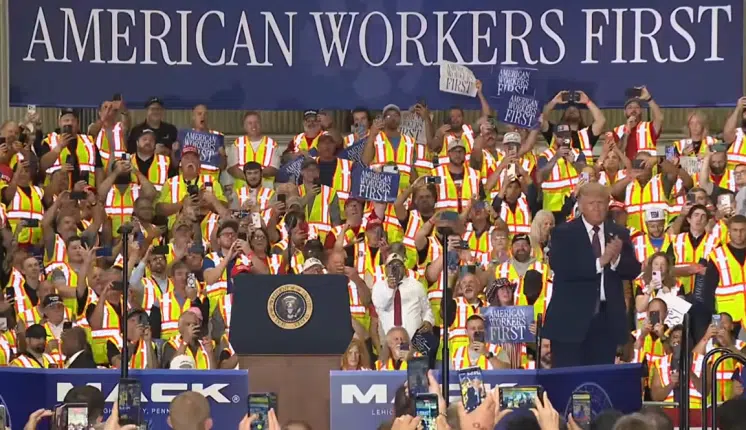
President Donald Trump often touts the figure on the campaign trail in the 2026 Congressional midterm cycle, and harkens back to Ronald Reagan’s old adage “any worker knows a job is the best social program there is.”
The labor force also increased 485,000, bringing the labor participation rate up to 61.8 percent, but still far below its generational peak of 67.3 percent in April 2000. The steady decline in participation over the past 26 years has followed seniors leaving the labor force, now up to 53.3 million from its 30.9 million level in 2008.
Overall, the civilian labor force has shrunk by 1.3 million since November 2025 to its current 170.2 million. So too has employment dropped by almost 1.28 million since that time to its current 163.15 million level.
Overall, the Baby Boomer retirement wave has also fueled labor shortages in recent years, with job openings peaking at 12.3 million in March 2022 before settling down to their current 7.07 million in August 2026. And there are just 7.1 million unemployed, also down from 7.78 million in November 2025.
Which also means an historically low unemployment rate, now at 4.2 percent, well below the 5.65 percent postwar average.
Other countries around the world with aging demographics see similar phenomena: During Covid, Japan’s unemployment rate got to a “whopping” 3.3 percent in September 2020 and currently sits at 2.6 percent, and South Korea it peaked at 4.5 percent in January 2021 and currently is down to about 2.8 percent. That’s low!
In other words, if you want a job, you can find a job.
That’s the promise President Trump ran on in 2016 and 2024, prioritizing U.S. trade interests in a bid to bring manufacturing back to the U.S. And it is one of the fastest growing sectors, with job openings in manufacturing up to 522,000 in August from 376,000 in April 2025.
In the meantime, gloomy predictions about artificial intelligence — the President calls it superintelligence — replacing workers appears to be wrong, at least so far, instead delivering productivity boosts for employers and employees. You still need people, but the tools of the trade are getting better.
As for the 522,000 job openings for factories, that is undoubtedly a positive sign. While it signals an ongoing skills gap as manufacturers increasingly utilize robotics that require additional training — while the demand for manufacturing workers is exploding the number entering the trade has only increased 72,000 this year — it demonstrates the opportunity for the next generation to be on the floor of the factories of the future, powered by superintelligence.
Looking forward, the economy, nation and humanity as a whole are on the cusp of the next industrial revolution — and what we’re seeing so far is that it is going to be a jobs boom, too. As the President is fond of saying, the best is yet to come. Stay tuned.
Robert Romano is the Executive Director of Americans for Limited Government Foundation.