
“Anywhere between 218 and 240 feels very viable.”
That was Democratic Congressional Campaign Committee (DCCC) political director Brooke Butler telling Politico she is very confident House Democrats will pick up between 3 and 25 seats in the November Congressional midterm elections as Democrats expand the map to target red state House seats traditionally held by Republicans.
The current House is split 219 to 214 in Republicans’ favor, with the two vacancies evenly split between a Republican and a Democratic seat.
So, starting at 215, plus-3 would get Democrats to 218 seats, a bare 50.1 percent of the 435 seats available, while plus-25 would get Democrats 240 seats, or almost 55.2 percent of the seats.
There’s a lot of uncertainty there. The DCCC can’t tell if it’s in a 1-2 point race or a 10-point race.
“We feel confident that we will get to 218. The question that I’ve told people from the beginning cycle is ‘How much?’” Butler added.
While gaining 25 seats is about average in midterms, if that’s what happens, in future elections the gap Republicans will be trying to overcome is needing too pick up 28 seats in the next few cycles just to break even. But I suppose prognosticators can chime in after the election and say “it was only 25”.
Historically, in modern history, the party that wins the popular vote for the House tends to win the House majority, with exceptions in 1942, 1996 and 2012. So, in the runup to the elections, the thing to watch is the generic Congressional ballot.
Right now, the national average of polls measured by RealClearPolling.com puts the race at +8.3, which would put a popular vote at about 54 percent to 46 percent if that were the final spread, at about 234 or 235 seats. So, maybe plus-19 or plus-20 seats in that case.
Recently, however, the Cook Report projected anywhere from a 5-seat to 15-seat swing for Democrats, which might mean Democrats poll anywhere from 50.5 percent to 52.8 percent. More uncertainty.
Every additional 1 percent in the popular vote represents about 4 to 5 seats.
Historically, that matches up rather well.
In fact, Democrats as the out-party in midterm elections almost never underperform the national popular vote in terms of seats acquired, according to an Americans for Limited Government Foundation analysis of midterm election results.
Since 1906, Democrats only underperformed once: In 1906, and not by much—they got 42.7 percent of the seats off of 43.6 percent of the vote — and it was year Congress was expanding so it’s too noisy.
Every other year, Democrats overperformed the popular vote on a percentage of seats basis, sometimes dramatically, including 1910 (+10.9 percent), 1930 (+5.7 percent), 1958 (+8.7 percent), 1974 (+9.4 percent) and 1990 (+9.3 percent). Don’t bet on Democrats winning the popular vote and somehow not winning the House.
Whereas, Republicans as the out-party in midterms have underperformed their popular vote totals in terms of the percent of seats acquired several times in modern history, in 1934 (-17.6 percent), 1938 (-8.6 percent), 1942 (-2.8 percent), 1950 (-3.2 percent), 1962 (-6.6 percent), 1966 (-5.2 percent) and 1978 (-8.7 percent).
The most recent midterm in 2022 agrees: The national popular vote is pretty much everything. Republicans as the opposition party to former President Joe Biden had more people vote for them in an midterm in history at 54.2 million, and still only got 50 percent of the vote and 222 seats, or 51 percent of the seats.
So, to do well, Republicans would really need to move the national popular vote in their direction. If Republicans can move the generic ballot, they’ll save a bunch of seats.
Spending and redistricting are how you keep a Democratic popular-vote win from becoming a large majority, if by doing so they prevent Democrats from overperforming their popular vote total. That’s a salvage operation.
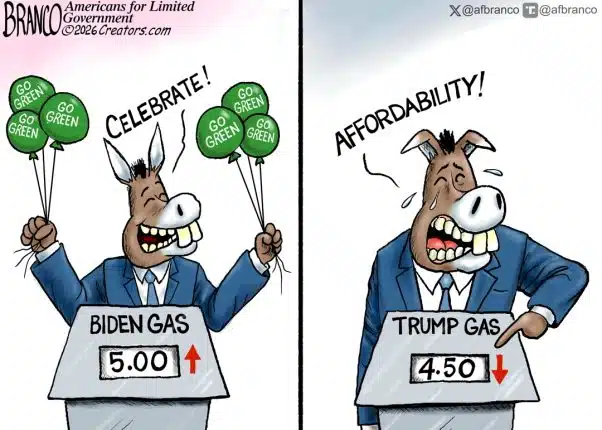
Inflation is still the top issue that any party ignores at its peril. In the meantime, independents require special attention as President Donald Trump remains upside down on approval. What the GOP is trying to overcome is a mood that is almost always unfavorable to the White House incumbent party in midterms.
In 2022, Democrats had abortion after Roe v. Wade was overturned to keep the generic ballot close, and keeping the generic ballot close is what made the difference. The whole affair is turnout: The opposition party out of power is motivated to vote, and the incumbents are usually complacent. If President Trump can overcome that complacency, the midterms could be closer than the national average shows — but it’s very difficult.
Robert Romano is the Executive Director of Americans for Limited Government Foundation.