
“Tuesday will be Power Plant Day, and Bridge Day, all wrapped up in one, in Iran. There will be nothing like it!!! Open the Fuckin’ Strait, you crazy bastards, or you’ll be living in Hell – JUST WATCH!”
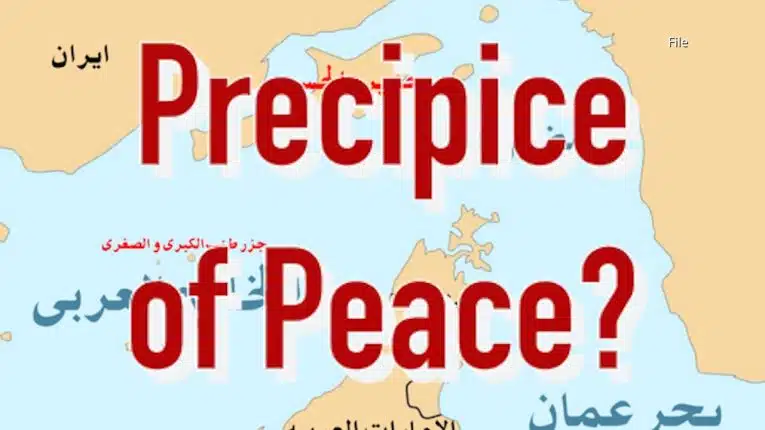
That was President Donald Trump on April 5, threatening to target Iran’s nuclear power plants and bridges in what might be an irreversible escalation of the war if the government there does not reopen the Strait of Hormuz to ship traffic including tankers.
In a follow-up post the same day, the President wrote, “Tuesday, 8:00 P.M. Eastern Time!” setting a hard deadline to get the strait reopened.
Since March 1 when the war began, about 121 ships have traversed the Strait of Hormuz, including just 56 tankers including oil and liquified natural gas, according to the United Kingdom Maritime Trade Operations (UKMTO) Centre Joint Maritime Information Center’s advisories.
It used to be a pre-war average of 138 ships per day, down to about 3.45 ships per day — a 97.5 percent decrease.
And it is having massive impacts on the global economy, with oil prices skyrocketing on both sides of the ocean, with light sweet crude oil hitting about $112 a barrel and Brent crude oil hitting $109 as of this writing.
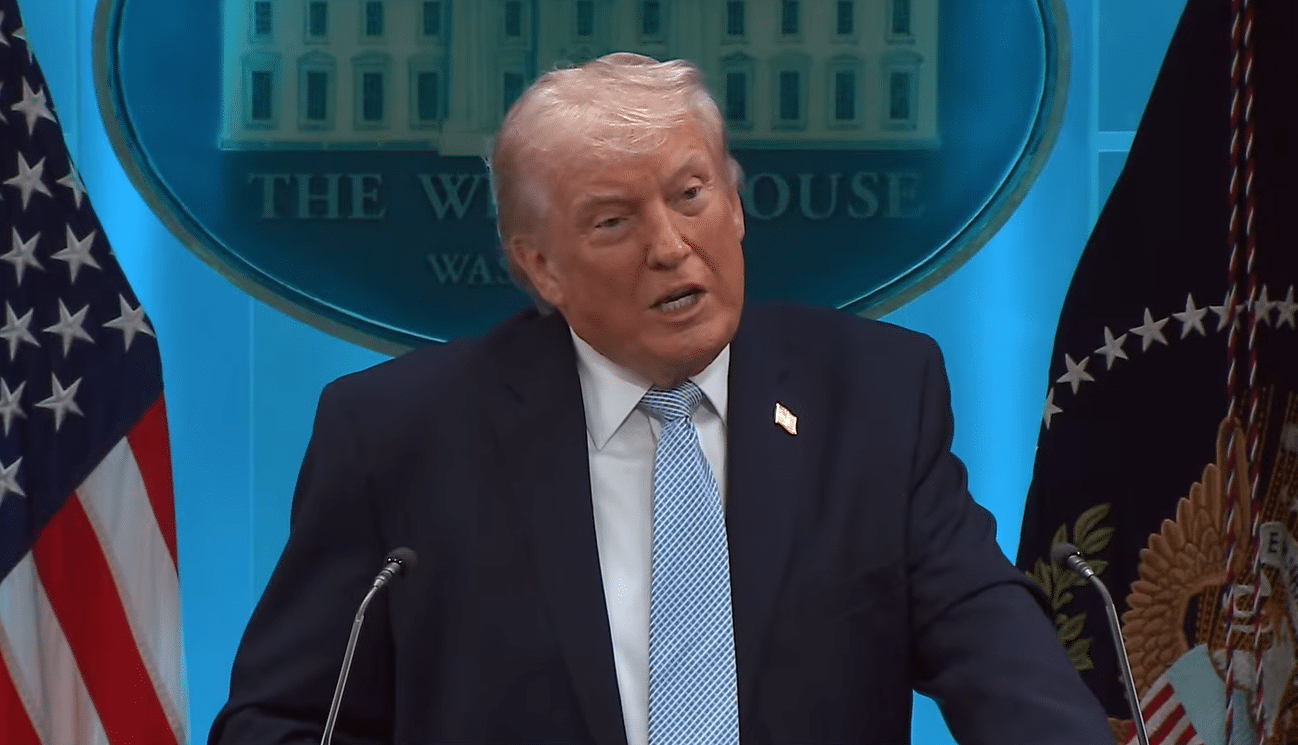
Speaking at a press conference on April 6, the President reiterated his priority of reopening the strait, saying, “I would say it’s a very big priority because… see … that’s one thing that’s a little different than another. We can bomb the hell out of them. We can knock them out for a loop. But to close the straight, all you need is one terrorist that somehow has a truck loaded with, because you can carry them in trucks, large trucks, a water mine, drop them in the water, and now you tell people that own ships that cost a billion dollars to don’t worry about the mine.”
Explaining the dilemma, the President added, “You can do that even just by saying, ‘We put mines in the water.’ So, it’s not like the rest. We can knock out their military. We already have. We’ve knocked out their navy. We’ve knocked out their air force completely. knocked out 158 ships in three days. We’ve knocked out even their mine droppers. They don’t have any mine droppers anymore, but they put them on other boats and they could drop them. I’m not even sure they have any mines there, by the way. I’m not sure… personally… They say there might be eight. I don’t know. I don’t know. I think there might be none… Because they’re very good bullshit artists. That’s why for 47 years they’ve been bullshitting other presidents and they haven’t done the job.”
When asked about targeting the power plants, the President said he really did not wish to target Iran’s power plants, stating, “I hope I don’t have to do it.”
But, that he would if he had to stop Iran from getting a nuclear weapon: “We’re never going to let Iran have a nuclear weapon. And if you think it’s okay for people that are sick of mind, that are tough, smart, and sick, really sick … from a policy standpoint. If you think I’m going to allow them and powerful and rich to have a nuclear weapon, you can tell your friends at the New York Times, not going to happen.”
The President also alluded to the ongoing negotiations, and how they might be later used to stall action by a future president: “47 years, they’ve been negotiating with these people. They’re great negotiators. And, because they’re not going to have a nuclear weapon. And, if somebody that takes my place someday is weak and ineffective, which possibly that will happen because we had numerous presidents that were weak, ineffective, and afraid… of Iran.”
As for the nuclear materials that had previously been documented by the International Atomic Energy Agency’s (IAEA) May 2025 assessment, in his April 1 address to the nation, President Trump noted the programs at Isfahan and the Natanz were buried following the success of June 2025’s Operation Midnight Hammer and might take months to recover: “The nuclear sites that we obliterated with the B2 bombers have been hit so hard that it would take months to get near the nuclear dust. And we have it under intense satellite surveillance and control. If we see them make a move, even a move for it, we’ll hit them with missiles very hard.”
On March 19, before the House Permanent Select Committee on Intelligence, Director of National Intelligence Tulsi Gabbard testified, “The [Intelligence Community] IC has high confidence that we know where it is…” when asked by U.S. Rep. Steve Cohen (D-Tenn.).
On reopening the strait, President Trump has said he’s asked NATO for help, but they’re not coming: “I have to tell you, I’m very disappointed in NATO. Very. I think that NATO I think it’s a mark on NATO that will never disappear. Never disappear in my mind. You know, they’re coming to see me on Wednesday. They’re going to say, ‘Oh, we’ll do this. We’ll do that.’ Now, they all of a sudden want to send things…”
Which, that would be nice, if NATO were to secure the strait, but suppose they don’t. Then, the U.S. Navy will need to do it. No question — and they will.
Because the costs of the war in the U.S. are not just economic — closing the strait means cutting off about one-fifth of the world’s oil supply indefinitely. Ultimately, the costs become political and White House should be well aware of the risks involved for the President, Republicans in Congress and whoever succeeds the President to run for the GOP nomination in 2028.
The world has had a few oil shocks, and in the U.S., the White House incumbent lost most of the elections that followed: 1976, 1980, 1992, 2008 and 2024 following the Arab oil embargo, the Iranian revolution, the Gulf War, the Iraq War and the Ukraine War. 2012 was the exception following Libyan Civil War. Not a great track record. Nobody can claim Trump authorized this offensive against Iran for political or economic gain. No, this is just for security.
And so time is a real factor as it relates to the war. American voters don’t usually go along with inflation. They keep throwing the bums out until it ends usually, war or no war. If oil prices do not come down, we’ll have inflation. Therefore, economically and politically, the U.S. ultimately needs the strait open as much as Europe and Asia do. Whatever the President does must be politically sustainable. Inflation never is.
Besides securing the remaining nuclear material, the high oil and gas prices and the strait are the controllable aspects of the war by which success will be evaluated. High prices if they linger will throw 2028 in question, making not getting the nukes riskier. It might be if the nuclear material left over from Operation Midnight Hammer cannot be recovered quickly, the President might need to resort to just bombing those sites into total obliteration so that nothing can ever be recovered. Either way, the President appears determined to finish the job as Power Plant Day approaches. Stay tuned.
Robert Romano is the Executive Director of Americans for Limited Government Foundation.