
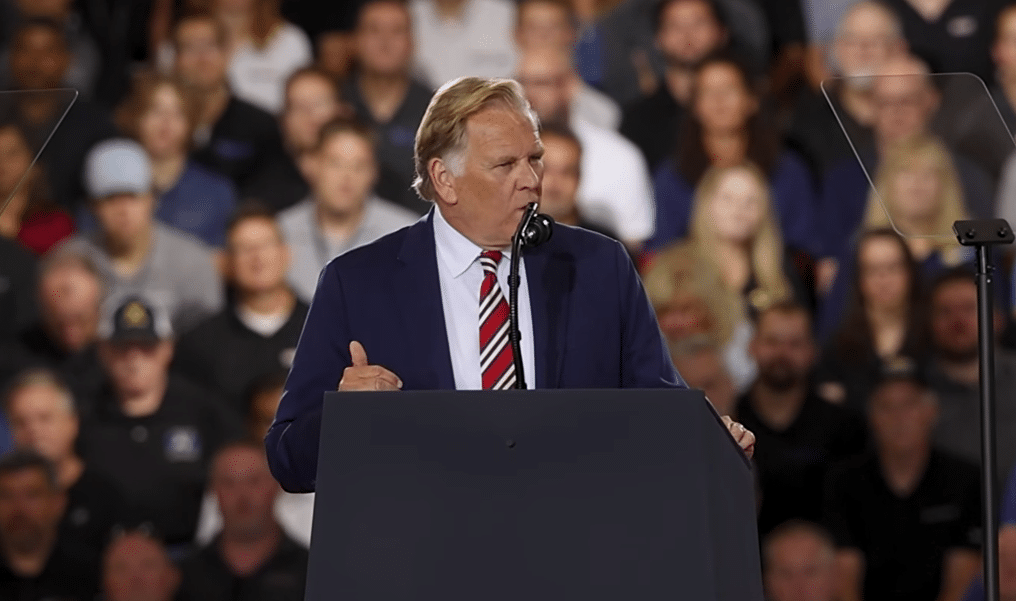
With Michigan Democrats attempting to fill the U.S. Senate seat left open after Senator Gary Peters declined to run again, and former U.S. House Representative Mike Rogers vying to secure the seat for Republicans, Michigan is a state to watch this November. Young voters, who have shifted substantially toward the right in Michigan, could impact these races.
The U.S. Senate race between Rep. Elissa Slotkin and former Representative Mike Rogers was extremely close in 2024, with Rogers losing to Slotkin by fewer than 20,000 votes.
Young voters moving toward the right were a key reason the race was so close, with Slotkin losing voters aged 18-29 to GOP challenger Mike Rogers by a single percentage point two years ago.
The race this November is likely to be close as well, and young voters could be pivotal. Michigan is the number one state in the country for youth voter impact based on demographics, political engagement, and turnout patterns, according to The Center for Information and Research on Civic Learning and Engagement (CIRCLE) at Tufts University.
In the 2022 midterm election, Michigan had the highest youth turnout rate in the country at 37 percent for voters aged 18-29. In the 2024 presidential election, Michigan youth came in third in the nation, with a turnout rate of 58 percent.
Michigan saw a significant swing toward Republicans among young voters between 2022 and 2024. Young voters went from supporting Gov. Gretchen Whitmer by 32 percentage points in 2022 to narrowly supporting Republican Mike Rogers for U.S. Senate in 2024 by a single percentage point.
With Rogers running for U.S. Senate again in 2026, young voters who showed a significant break from Democrats in 2024 could be influential.
In 2022, Democratic Gov. Gretchen Whitmer won voters aged 18-29 by a whopping 32 percentage points, 65 percent to 33 percent, at the tail end of the COVID-19 pandemic. Whitmer did best among voters aged 25-29, winning them by 37 percentage points, 67 percent to 30 percent. She won the youngest voters, aged 18-24, by 29 points, 64 percent to 35 percent.
By the 2024 election, with voters souring on the Democrats’ response to the COVID-19 pandemic and reckless open-borders agenda, young Michigan voters were part of a powerful shift toward Republicans.
In the U.S. Senate race, Democratic Rep. Elissa Slotkin lost voters aged 18-29 to former U.S. Representative Mike Rogers by a single percentage point, 45 percent to 46 percent. After Whitmer won young people by 32 points, Slotkin lost them by one point — a 33-point swing toward the Republican candidate in two short years.
Rogers wasn’t the only Republican candidate to benefit immensely from a youth surge toward the Republican Party in 2024.
President Donald Trump won young Michigan voters by three percentage points, 50 percent to 47 percent, according to CNN exit polls. This was a substantial swing toward the GOP compared to the 2020 election. In the 2020 election, President Trump lost young voters to Joe Biden by 24 percentage points, 61 percent to 37 percent.
Michigan is not only ranked number one in the nation for youth impact heading into the 2026 midterm cycle, but recent elections also demonstrate that Democrats no longer have a solid grip on the youth vote.
The survey data available for the 2026 midterm cycle shows that a substantial share of young Michigan voters are questioning the Democratic Party’s values.
An April 2026 Detroit Regional Chamber survey of 500 likely Democratic voters found that young Michigan voters are wary of the two-party system and believe the Democratic Party’s values have changed over the past twenty years compared to older generations.
The survey found a meager share of Michigan voters under age 40 believe the “two-party system works,” with just 12 percent of young voters saying so compared to 83 percent who say it does not. For comparison, 42 percent of voters over age 65 say the two-party system works.
The survey found Michigan voters under age 40 also say by 52 points, 72 percent to 20 percent, that the Democratic Party has “different values” than it did twenty years ago.
Young Michigan voters have shown a consistent pattern of political engagement over the past several election cycles and have shifted toward the Republican Party since 2020, putting Democrats on notice. Recent surveys of Michigan voters indicate young people in particular believe the Democratic Party has changed, and a dwindling share of young Democratic voters believe in the two-party system. Whether that will benefit the GOP in November remains to be seen, but young Democrats soured on the Democratic Party after the pandemic.
Manzanita Miller is the senior political analyst at Americans for Limited Government Foundation.