
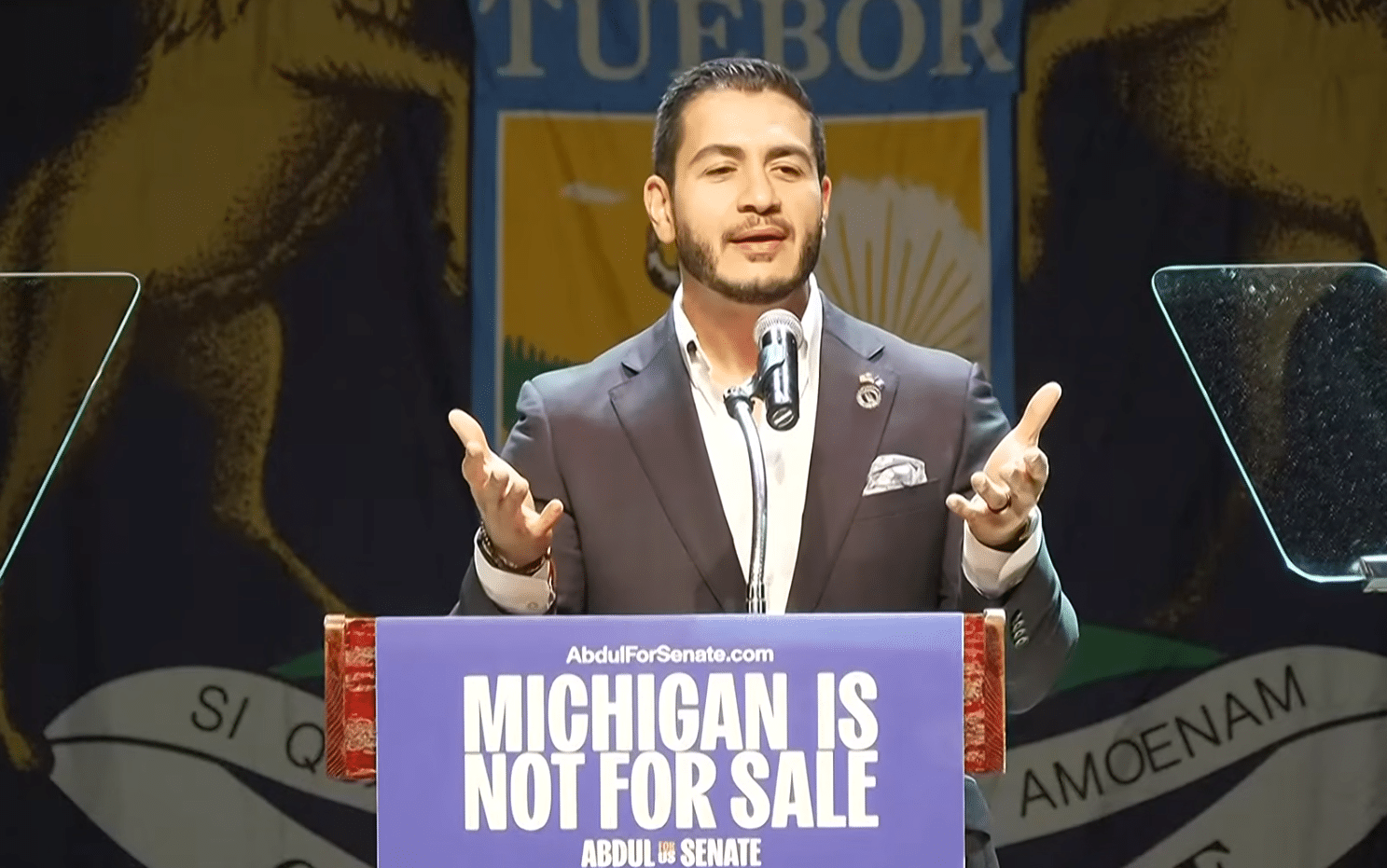
Michigan voters believe radical leftist Abdul El-Sayed, who is vying for the U.S. Senate seat left open by Sen. Gary Peters, is too radical for the state. However, El-Sayed has maintained a moderate lead over former U.S. Representative Mike Rogers in polling for months in a state Republicans have not won a Senate race in since 1994. This could mean El-Sayed wins in six weeks and Michigan elects one of the most left-wing Senate candidates running this November. It could also mean polls are overestimating El-Sayed’s support or that voters may get cold feet.
An Emerson poll from Sept. 12–14 has El-Sayed ahead of Rogers by two points, 48 percent to 46 percent, while a Washington Post poll from Sept. 9–14 shows El-Sayed ahead by three points, 48 percent to 45 percent. A Trafalgar Group survey from Sept. 7–9 has El-Sayed ahead by a single point, 46 percent to 45 percent. While El-Sayed has maintained a modest lead in most surveys since June, there are signs voters find the far-left Democrat too radical for Michigan.
Looking at a CNN survey released Sept. 9, El-Sayed leads Rogers by three percentage points, 47 percent to 44 percent. Five percent of voters say they’ll support neither candidate, and three percent say they’ll support someone else, indicating that the final tally could go either way.
El-Sayed says he is not a socialist, but he is running on a platform of Medicare for All, abolishing Immigration and Customs Enforcement (ICE), wealth taxes, and public ownership of artificial intelligence (AI) companies.
These socialist-style proposals haven’t escaped the minds of voters. The CNN survey shows Michigan voters say by six points — 50 percent to 44 percent — that El-Sayed is “too liberal.”
According to the same survey, voters believe Rogers’ views are closer to their preferences. By three percentage points (45 percent to 42 percent), voters say Mike Rogers’ views are “about right.” Specifically, 45 percent believe his views are “about right,” while 42 percent say his views are “too conservative,” and 12 percent say his views are not conservative enough.
For El-Sayed, it is the opposite. Voters say by six points, 50 percent to 44 percent, that his views are “too liberal,” while five percent say his views are not liberal enough.
What is interesting is the contrast between the share of voters who believe El-Sayed is too liberal and their voting intention. For instance, a full 37 percent of voters aged 18 to 34 say El-Sayed’s views are too liberal, while 54 percent say his views are about right.
When looking at voting intention, however, just 28 percent of voters aged 18 to 34 plan to vote against the grain for their age group and oppose El-Sayed. Overall, voters aged 18 to 34 plan to support El-Sayed by 25 points, 53 percent to 28 percent, with 18 percent saying they are unsure or will not support either candidate.
This suggests that even among young voters, El-Sayed is viewed as too far to the left. Whether that translates into a change of heart at the ballot box remains to be seen.
Another group that broadly admits El-Sayed is too liberal, yet plans to support him, is white voters with a college degree. College-educated white voters admit El-Sayed is too liberal by a margin of 13 points, 54 percent to 41 percent. Yet, this same voting block plans to support him by three points, 48 percent to 45 percent.
Among voters who disapprove of President Donald Trump, 28 percent say El-Sayed is too liberal, while 63 percent say he is about right. Yet, voters who disapprove of Trump plan to support El-Sayed by 54 points, 71 percent to 17 percent.
This signals that even if one of the most liberal candidates for the U.S. Senate in 2026 gets elected in Michigan, it won’t be on a wave of unbridled enthusiasm. Over half of Michigan voters say El-Sayed’s policies are too liberal, yet he leads in the polls. Among key coalitions supporting El-Sayed — young people, white college-educated voters, and anti-Trump voters — a large share admits that he is too far to the left. This could indicate that polls are over-capturing support for El-Sayed, or it could suggest that a portion of voters may change their minds on Election Day.
Manzanita Miller is the senior political analyst at Americans for Limited Government Foundation.