
The conflict with Iran could continue past the midterm election according to President Donald Trump, but the Trump administration’s efforts to retake control of the critical Strait of Hormuz and to keep oil flowing are beginning to pay off.
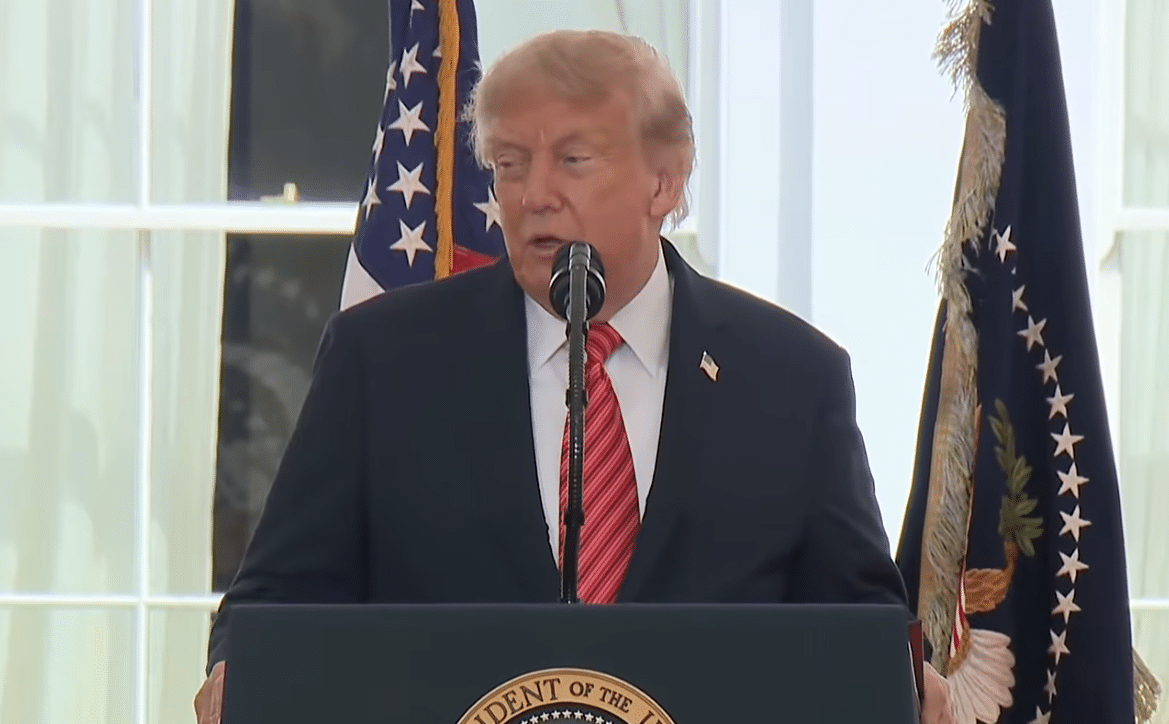
Speaking Sept. 13 at the Joint Base Andrews military facility in Prince George’s County, Maryland, President Trump stated that he believed the Iran war would end “immediately after the election,” stating he believes that Iran will not be able to hold out much longer than that.
When asked how to explain the Iran conflict to Americans concerned about rising oil prices, President Trump stated, “Well, I think it’s very easy to explain to America. All you have to do is say, will you let Iran have a nuclear weapon, and the answer is no.” President Trump continued, “I think the war will end immediately after the election, because they can’t afford to hold out any longer.”
While oil prices have surged in recent weeks in response to new strikes on Saudi Arabian energy infrastructure, with U.S. West Texas Intermediate crude oil trading at over $105 a barrel as of this writing, there is evidence that the U.S. is now squeezing the Iranian oil supply.
In response to the U.S. airstrikes this spring intended to deter Iran from developing nuclear weapons, the nation of Iran retaliated by closing the Strait of Hormuz to most oil traffic, driving up prices.
However, in recent weeks the U.S. has flipped that power, with a U.S. naval blockade limiting Iran’s oil exports.
Homayoun Falakshahi, an oil expert at Kpler, found that Iran’s oil exports dropped from 1.85 million barrels a day this spring to just 255,000 in August. The research found that oil from non-Iranian countries spiked in September. Oil from non-Iranian countries rose from about 300,000 barrels a day this spring during the height of the conflict with Iran to 8.4 million barrels in September.
Despite Americans wanting the conflict with Iran to come to an end, voters also say by 30 points that the United States, not Iran, is winning the conflict, and a vast majority of Americans support President Trump’s strategy of doing everything possible to keep the Iranian government from retaking control of the Strait of Hormuz.
A comprehensive poll of 2,100 registered voters conducted Aug. 28-30 by Harvard CAPS-HarrisX reveals that voters support President Trump’s key policies regarding the Strait of Hormuz, which includes exerting U.S. power through force, sanctions, and blockades to ensure the Strait remains open and is not controlled by Iran.
Voters say by 44 points, 72 percent to 28 percent, that the U.S. should resume the use of force, sanctions, and blockades if Iran does not give up control of the Strait. Even Democrats support using force and sanctions to force Iran’s hand, with Democrats supporting the use of force and sanctions to retake the Strait by a full sixteen points, 58 percent to 42 percent. Independents agree, saying the U.S. should resume the use of force or sanctions to retake the Strait by 38 points, 69 percent to 31 percent. Republicans support the use of force or sanctions to take the Strait by 76 points, 88 percent to 12 percent.
Americans also strongly believe that keeping the Strait open is an important national security concern to the United States, with voters saying by 58 points, 79 percent to 21 percent, that the Strait is a national security concern. Here, there is widespread support across party lines. Democrats say by 44 points, 72 percent to 28 percent, that the Strait is a national security concern. Independents agree, saying by 52 points, 76 percent to 24 percent, that the strait is a national security concern. Republicans say by 76 points, 88 percent to 12 percent, that keeping the Strait open is an important national security interest for the U.S.
Americans largely say the United States is winning the Iran conflict, with Americans saying 43 percent to 13 percent that the U.S. is winning against Iran. However, a full 29 percent say they aren’t sure who is winning, and 14 percent say neither is winning. Even Democrats and independents say the U.S. is the one winning against Iran, with Democrats saying so by four points and independents saying so by 24 points. Republicans say the U.S. is winning against Iran by 60 points.
The president’s approval rating on Iran sits at just 39 percent, but that number has moved only marginally over the past five months. It began at 41 percent approval in March and has dipped as low as 38 percent, settling at 39 percent approval in late August. This means that while the conflict was always unpopular, the share of Americans who disapprove of Trump’s handling of the war hasn’t risen much. Voters are strongly concerned about the cost of fuel, and the vast majority of Americans support using force, sanctions, and blockades to ensure the U.S. remains in control of the Strait. If the U.S. is able to maintain control of the Strait and continue squeezing the Iranian oil supply, that will put pressure on Iran to come to the table.
Manzanita Miller is the senior political analyst at Americans for Limited Government Foundation.