
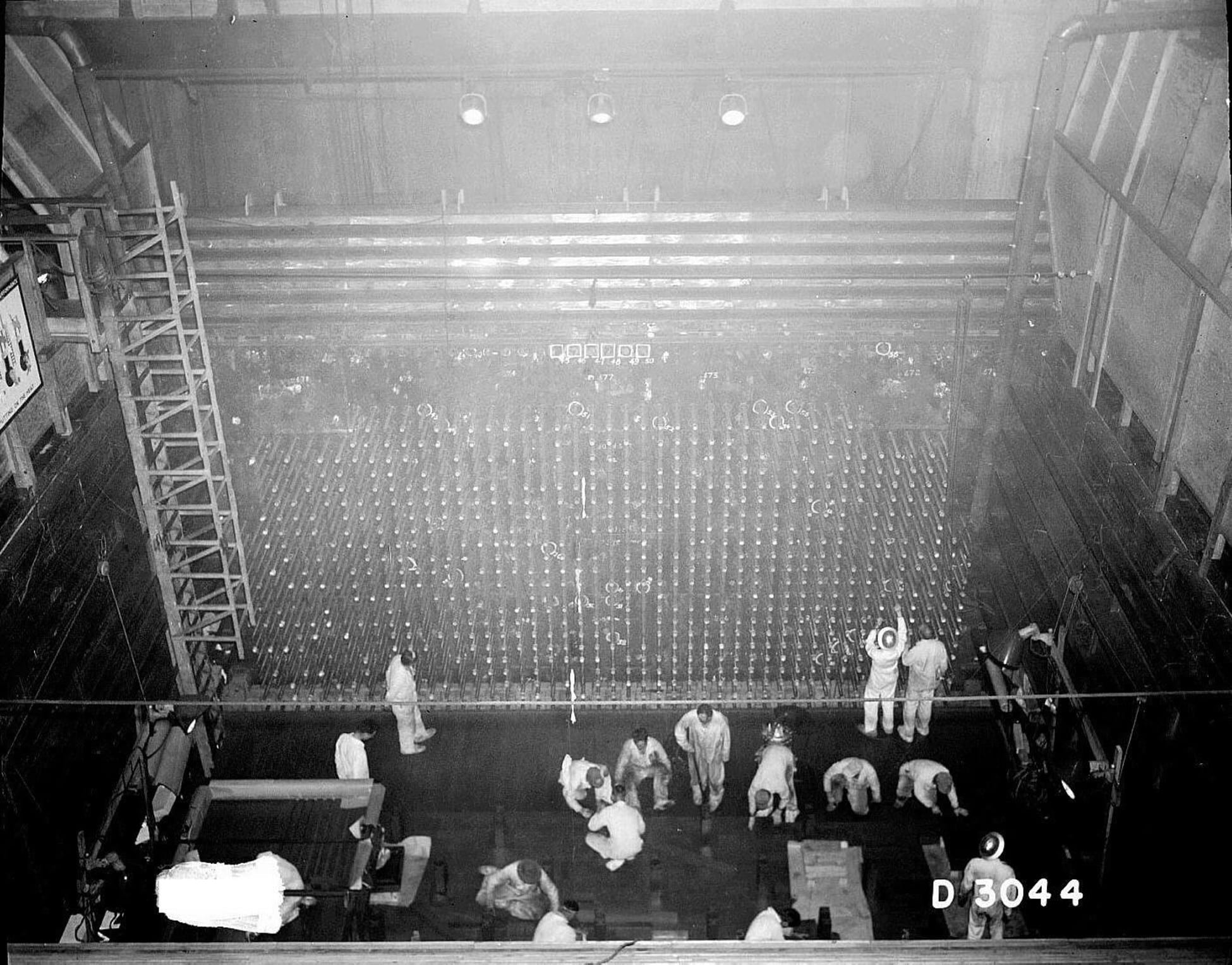
In 1939, theoretical physicist Albert Einstein signed a letter by Hungarian physicist Leo Szilard to President Franklin Roosevelt to warn of advancements in nuclear energy and military technologies including by Nazi Germany, urging the U.S. to engage in its own research, that ultimately led to the formation of the Manhattan Project to build atomic weapons before Germany could.
The Einstein-Szilard letter warned: “the element uranium may be turned into a new and important source of energy in the immediate future… it may become possible to set up a nuclear chain reaction in a large mass of uranium, by which vast amounts of power and large quantities of new radium-like elements would be generated. Now it appears almost certain that this could be achieved in the immediate future. This new phenomenon would also lead to the construction of bombs, and it is conceivable – though much less certain – that extremely powerful bombs of a new type may thus be constructed.”
The project, as everyone knows, was successful, and led to the detonation of the atomic bombs at Hiroshima and Nagasaki in August 1945, immediately leading to the surrender of Japan in World War II in the Pacific. By then, Nazi Germany was already defeated in Europe via conventional means and at great cost.
On the nuclear front, the Soviets were already advancing in the nuclear arena, but were sped along by German-born physicist Klaus Fuchs, a communist, who continually handed parts of the project’s blueprints to the Russians beginning in 1942 and continuing through his participation in the Manhattan Project which began in the U.S. in 1943. Fuchs’ espionage was already underway when discussions began internally — in which Fuchs did not comment — about whether the nuclear technology should be shared with the Soviets.
In 1944, Niels Bohr had urged President Roosevelt to an “exchange of information” with U.S. allies including the Soviet Union: “The prevention of a competition prepared in secrecy will therefore demand such concessions regarding exchange of information and openness about industrial efforts, including military preparations, as would hardly be conceivable unless all partners were assured of a compensating guarantee of common security against dangers of unprecedented acuteness.”
But while Bohr wanted a treaty or other international regime, Fuchs just took matters into his own hands but with a similar rationale. Later, after being caught and confessing, Fuchs stated in prison to Rudolf Peierls (who had recruited him to work on the nuclear project in Great Britain in 1941 before Fuchs went to Los Alamos, New Mexico to work on the U.S. project), “Knowledge of atomic research should not be the private property of any one country but should be shared with the rest of the world for the benefit of mankind.”
Today, humanity is reaching a similar moment with artificial intelligence (AI) technology inevitably becoming militarized. But this time, researchers are not urging that the knowledge be shared, but that it is so dangerous it ought to be compartmentalized or held back.
Writing for the UK Guardian on Sept. 14, former Google Deepmind engineer Alex Turner explained his resignation from the company for working as a defense contractor: “I tried to hold the company to its ethical commitments against supplying AI for military use. When Google broke those commitments, I resigned…”
As if there was ever any doubt AI would be used in military applications, and as if companies could withhold technology with deadly national security implications from the government.
Upon the declarations of war upon Japan and Germany in December 1941, President Roosevelt established the War Production Board via Executive Order 9024 to “Exercise general direction over the war procurement and production program…” and to “Determine the policies, plans, procedures, and methods of the several Federal departments, establishments, and agencies in respect to war procurement and production, including purchasing, contracting, specifications, and construction; and including conversion, requisitioning, plant expansion, and the financing thereof; and issue such directives in respect thereto as he may deem necessary or appropriate.”
Later, in 1950, Congress similarly enacted the Defense Production Act, whose declaration of policy in 50 U.S. Code Sec. 4502 states “the security of the United States is dependent on the ability of the domestic industrial base to supply materials and services for the national defense and to prepare for and respond to military conflicts…”
The law also provides under 50 U.S. Code Sec. 4511(a) for the President to commandeer military production in the event of war or just in the interest of national defense without any declaration of war: “The President is hereby authorized (1) to require that performance under contracts or orders (other than contracts of employment) which he deems necessary or appropriate to promote the national defense shall take priority over performance under any other contract or order, and, for the purpose of assuring such priority, to require acceptance and performance of such contracts or orders in preference to other contracts or orders by any person he finds to be capable of their performance, and (2) to allocate materials, services, and facilities in such manner, upon such conditions, and to such extent as he shall deem necessary or appropriate to promote the national defense.”
Neither Google nor any other U.S. company in the event of war could go against that. The car company needs to be converted to a tank, munitions or aircraft factory? The chip factory needs to sell high-end AI chips to only the military? The plane factory needs to focus on manufacturing drone swarms? That is what the law provides for in the event of war, or just to prepare for war and keep the peace. It’s not optional.
No U.S. company, no matter how well-capitalized, well-connected or self-important gets a vote against U.S. national security — and certainly not against an acknowledged threat to national security.
In 2022, Turner himself in his PhD dissertation stated that AI had a very high probability of resulting in human extinction: “Unless the field of AI is wrenched off of its current trajectory, I expect intelligent yet unaligned AI will probably (≈ 70%) wipe out humanity within the next fifty years.”
That is, unless the current trends of AI advancements—which are being achieved globally in the U.S., Great Britain, China and elsewhere—are “wrenched off of its current trajectory,” human extinction is the current default path. The AI could wipe us out. And Turner’s plan to counteract that was “ethical commitments against supplying AI for military use.” Yeah, that’ll stop them.
In a similar vein, Anthropic CEO Dario Amodei on Sept. 12 called for a slowdown in AI development, urging “[s]ome kind of ‘speed limit’ on the rate of recursive self-improvement (RSI)…” explaining, “As models build future models, the rate of improvement may become staggeringly fast. Slowing the rate from “extremely fast” to “only somewhat fast” gives up relatively little strategic advantage, while potentially greatly improving safety.”
But, Amodei noted, China is a peer adversary in the AI arena, and is racing towards these same military capabilities and urged export controls, “Do not sell powerful AI chips or semiconductor manufacturing equipment to China, and crack down on chip smuggling operations and remote access to data centers outside China. Chips will be the main determinant of China’s AI strength.”
Certainly, a 2022 Department of Commerce AI export control regulation against China remains in effect, as do twin, related interim final rules in 2023.
And for good reason. A 2025 Center for Security and Emerging Technology brief warned of China’s advancements in AI: “Key to the Chinese government’s aims is the use of artificial intelligence (AI) and related technologies to boost the Chinese military’s development and adoption of advanced capabilities to outmatch rivals in future conflicts.”
And a Sept. 13 South China Morning Post report by Chong Ming Lee finds China is already moving toward recursive self-improvement development, too: “Leading AI companies in the United States and China are increasingly focused on deploying advanced models to write code, design experiments, and develop training techniques that can be used to improve more powerful models… Chinese developers are also working towards RSI. During an earnings briefing on August 31, Tang Jie, the founder of Beijing-headquartered AI firm Z.ai, said its next-generation GLM-6 model was heading in the direction of ‘self-evolution’.”
So, it’s not a question of whether AI is being militarized, or whether the development is increasingly becoming automated via AI self-learning. Whether the U.S. wishes to or not, China and other adversaries are already moving there. It’s the 21st Century’s new arms race without question. The genie is out of the bottle — and we cannot wish it away.
That is why the U.S., in addition to working with the foremost technology companies, needs its own allocation of compute, labs and factories under the Defense Production Act and other laws — an AI Manhattan Project.
Already, on June 29, Secretary of War Pete Hegseth issued a memo “Establishment of the Direct Reporting Portfolio Manager for Unmanned Systems” that sets up the Direct Reporting Portfolio Manager as “the single joint integrator for all unmanned and autonomous system programs” including AI, swarming software and drones under 10 U.S. Code Sec. 4204 and DX priority ratings under the Defense Priorities and Allocations System under 15 C.F.R. Part 700 and 50 U.S. Code Sec. 4511.
In the end, if Turner is even half right that there’s a very high probability that a superintelligent, unbound, “bad” AI that poses an existential threat to humanity is eventually developed, then action is still called for. If so, there must also be superintelligent, aligned, “good” AI that can defeat it and not itself turn into the “bad” AI.
The real race therefore is not only for capable AI — we can already see what it can do in the realm of coding and other engineering — but ethical AI that does what it’s told. Whatever we’re spending on this now, maybe it’s not enough. And maybe the danger shows up sooner than 50 years from now.
On Sept. 14, President Donald Trump in a Truth Social post called it fake news, writing, “The claim that ‘AI is going to take over the World’ is a Hoax…” and noted in a separate post that the real danger was a peer adversary like China wielding AI and they aren’t slowing down: “President Xi, of China, just announced that China will be doing absolutely nothing to stand in the way of AI, or its future.”
President Trump is right. Everyone is using science fiction horror stories to frighten people of the dangers of AI, and maybe some of those scenarios are a real danger. But even in those same science fiction stories, to defeat the T-1000, you needed a reprogrammed T-800. To defeat Dr. Wily’s robots, Dr. Light developed Mega Man. Perhaps that is far-fetched, but if so, then maybe so does saying the Matrix is inevitable.
If that’s the real danger, then we need real countermeasures. In the very least, we need to stay ahead of China.
The U.S. under President Trump’s leadership is already accelerating AI development domestically, incentivizing chip manufacturing and data center development here. We have already seen the damage automated drones can do in the Ukraine and Iran wars, and how automation is utilized in missile defense systems like Iron Dome. The next major war could indeed be an AI-driven one. If so, America has to be ready.
Robert Romano is the Executive Director of Americans for Limited Government Foundation.