

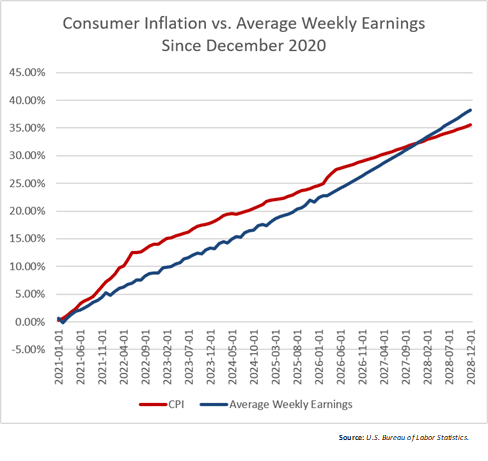
Consumer inflation once again outpaced average weekly earnings for the third straight month, with prices pushing upwards by 0.47 percent while earnings only grew 0.32 percent, according to the latest data by the U.S. Bureau of Labor Statistics, amid higher energy and particularly oil, gasoline and electricity prices.
Also, for the second month in a row, consumer prices outpaced earnings on an annual basis, with inflation up 4.2 percent the past twelve months while earnings only increased 3.7 percent.

One way to look at the current dilemma is that since 2021, inflation has outpaced average weekly earnings 27.45 percent to 23.67 percent. Obviously, if inflation keeps outpacing earnings, Americans will never break even on the post-Covid inflation any time soon.
Concerningly, even if inflation and earnings were restored to their pre-war levels in February right this very moment, hypothetically if the strait were reopened, oil production and distribution went back to what it was, etc. American households would not break even until November 2027, an Americans for Limited Government Foundation analysis of the data shows.
With inflation continuing its four-year run of being the top polled issue in U.S. politics, consistent across different polls and among every single significant demographic whether age, sex, race, party, etc., that’s obviously not great news for President Donald Trump and Congressional Republicans hoping to hold onto majorities in the House and Senate in the November Congressional midterms, particularly in the House with the slender current 218 to 212 majority.
In 2024, Republicans won 220 seats to Democrats’ 215 seats — there have been a few member deaths, resignations and special elections (but no upsets from the specials) since then — meaning, just a three-seat swing would tip the majority back to Democrats in the House.
But mid-decade redistricting favoring Republicans in 2026 — the GOP could be looking at as much as a 11-seat swing in their favor just from redrawing after the Supreme Court’s Louisiana v. Callais decision on April 29 that found that southern states that had drawn Congressional District maps based on racial considerations were unconstitutional — could alter the equation a bit in November in terms of which seats are now competitive.
And yet inflation remains an ever-present majority killer, leading to Democrats losing the House in 2022 and then the Senate and White House, too, in 2024. The key consideration was inflation outpacing incomes.
In 1980, Ronald Reagan famously asked Americans if they were better off than they were four years prior. History has proven this to be a bellwether perhaps like no other.
Historically, when inflation has outpaced personal incomes for sustained periods, the White House incumbent party lost: Gerald Ford in 1976 after 15 consecutive months of inflation outpacing incomes in 1974-1975, Jimmy Carter in 1980 following 15 consecutive months in 1979-1980, George H.W. Bush after 12 consecutive months in 1990-1991, George W. Bush after 4 consecutive months in 2008 and Joe Biden following 12 consecutive months in 2022.

When compared to personal incomes, so far there have been two consecutive months of inflation outpacing incomes on an annual basis, with another release on June 25 incoming that will likely make it three consecutive months.
A couple of exceptions emerge in the dataset with George W. Bush after 4 consecutive months of inflation outpacing incomes in 2002 following the terrorist attacks of Sept. 11, 2001, and Barack Obama for 13 consecutive months in 2009 and 2010 following the financial crisis. Both of those instances were coming out of recessions, and perhaps occurred early enough in the administrations to mitigate the damage, similar to the recession of 1981-1982, although in that case there was no diminution of wealth from inflation outpacing incomes in the latter case. But in 1984, 2004 and 2012, the White House incumbents won.
Still, five out of seven cases in modern history of inflation outpacing incomes resulting in incumbent presidential losses in the following election — a 71 percent loss rate — is nothing to sneeze at. If you’re Trump and Republicans, you’re hoping that the current war and any price volatility coming from the Strait of Hormuz being too risky for ships to transport can be remedied as soon as possible — one way or another. As usual, stay tuned.
Robert Romano is the Executive Director of Americans for Limited Government Foundation.