
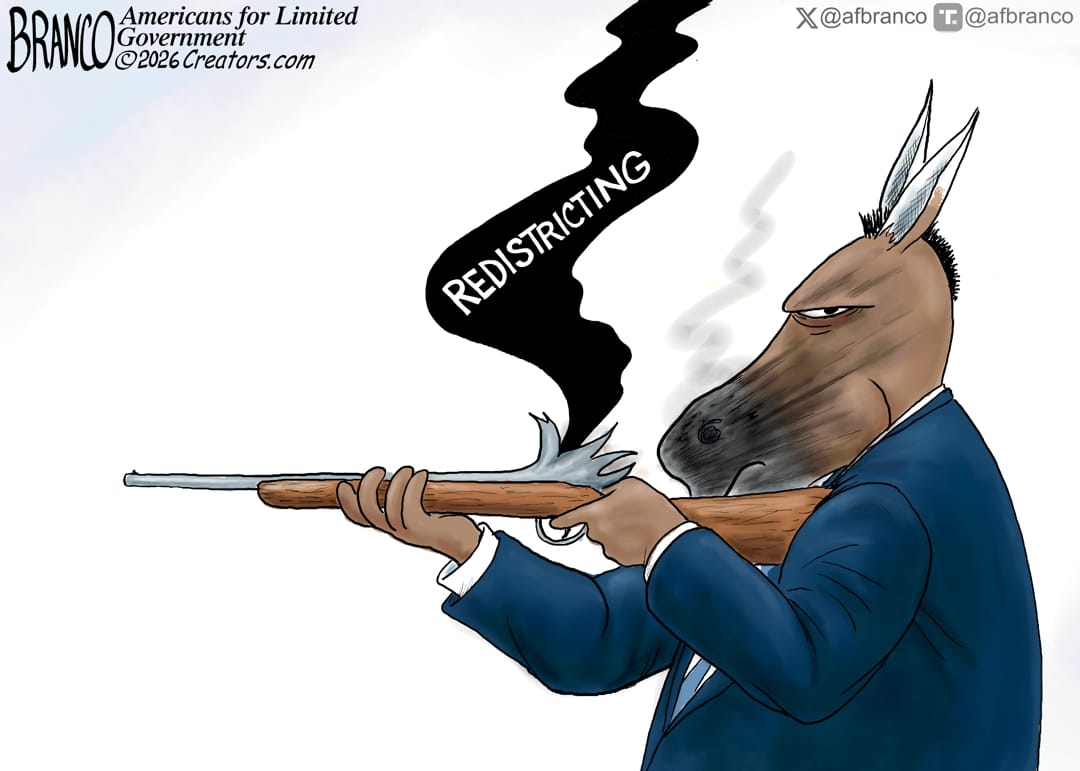
The U.S. Supreme Court on May 15 shot down a last-ditch effort by Virginia Democrats to overturn a Virginia Supreme Court ruling that found Virginia’s redistricting to be unconstitutional, with the nation’s highest court refusing to even hear the case.
As a result, instead of the new gerrymandered 10-1 Congressional District map Democrats were hoping for will remain the current map, which currently has 6 Democrats and 5 Republicans serving in the House.
Democrats had planned to offset expected Republicans gains in the current redistricting battle between states, particularly after the Supreme Court’s Louisiana v. Callais decision on April 29 that found that southern states that had drawn Congressional District maps based on racial considerations were unconstitutional.
As a result of that, with redistricting in Louisiana, Tennessee, North Carolina, South Carolina, Alabama, plus Texas, Florida and Ohio with their own redistricting bids, Republicans could net as many as 17 additional Republican seats according to an estimate by the Cook Report.
Whereas, Democrats, down to just their own redistricting in California and Utah, might only net 6 additional seats, per Cook.
Meaning, Republicans could have a +11 seat edge coming into November’s Congressional midterms. In 2024, Republicans won 220 seats — a net 3-seat majority — but with the new maps, Republicans could be looking at more like a 14-seat cushion.
That is significant because while normally the opposition party gains seats in the midterms, about 90 percent of the time, the question will be how many seats are picked up, if any, under the new maps.
In 10 out of the past 30 Congressional midterms since 1906, the White house incumbent party lost less than 14 seats — about 33 percent of the time — in 1926 (lost 8), 1934 (gained 9), 1962 (lost 3), 1970 (lost 12), 1986 (lost 4), 1990 (lost 8), 1998 (gained 5), 2002 (gained 8), 2014 (lost 13) and 2022 (lost 9).
For the most part of those cases, one common denominator in doing better than usual in the midterms was very popular presidents: Calvin Coolidge, Franklin Roosevelt, John Kennedy, Richard Nixon, Ronald Reagan, George H.W. Bush, Bill Clinton and George W. Bush.
Barack Obama and Joe Biden had lower approval — about 40 percent — but still managed to minimize losses in 2014 and 2022. To be fair there weren’t that many more seats for Democrats to lose after getting wiped out in 2010, losing 63 seats, and in 2022, the Supreme Court overturning Roe v. Wade seems to have had a significant impact in boosting Democratic turnout.
In 2026, President Donald Trump seems to be more on the Obama-Biden side of that potential equation in terms of approval, which normally doesn’t bode too well in the final analysis — anything less than 50 percent in Gallup’s approval usually averages losing about 37 seats.
But those are not guarantees, they’re more likelihoods. Still, with a potential +14 seat cushion headed in the midterms thanks in large part to the redistricting battles — the outcome of Virginia is definitely not helping Democrats — Republicans have a better chance than usual to retain control of the House of Representatives. Stay tuned.
Robert Romano is the Executive Director of Americans for Limited Government Foundation.