
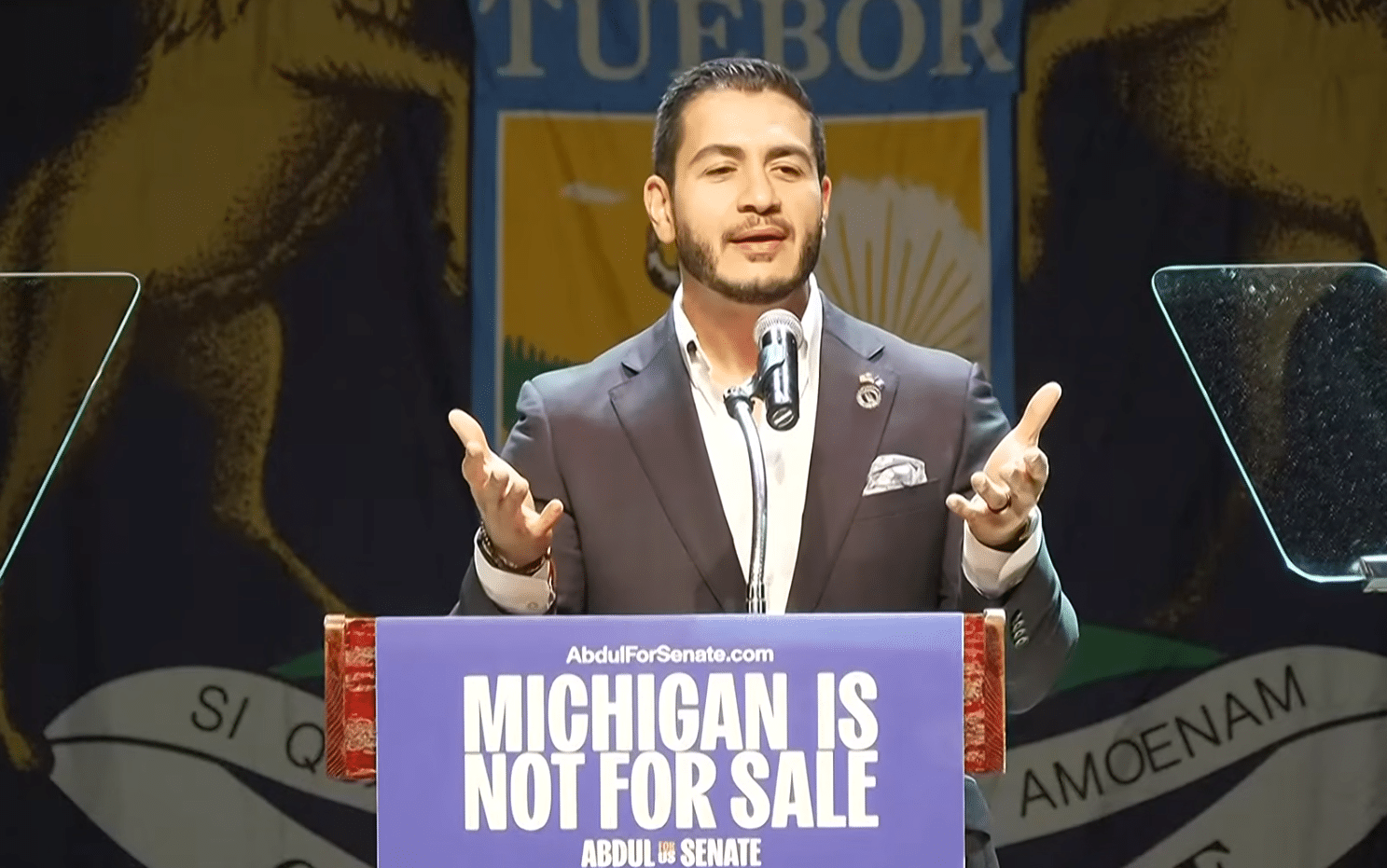
Abdul El-Sayed is now the Democratic Party nominee for the open Senate seat in Michigan with retiring Democratic Senator Gary Peters stepping aside after holding the seat since 2015. El-Sayed defeated Democratic U.S. Rep. Haley Stevens by a narrow 48.5 percent to 47.5 percent, and will now face former U.S. Rep. Mike Rogers (R-Mich.), with El-Sayed running on a platform for Medicare For All, abolishing Immigrations and Customs Enforcement (ICE), wealth taxes and public ownership of artificial intelligence (AI) companies.
El-Sayed earned the endorsements of democratic socialists U.S. Rep. Alexandria Ocasio-Cortez and U.S. Sen. Bernie Sanders in the campaign.
And yet, El-Sayed says, he’s not a socialist: “I am not somebody who is a socialist. I believe in capitalism. I just believe that capitalism has to be regulated.”
A good follow-up question might be: Why not? What’s wrong with socialism?
Because the trouble is, we’ve seen this movie before, with leaders who ran on socialist ideas, rejected the label but then when they came into power, later openly instituted socialist one-party rule. The two most notable examples were Fidel Castro in Cuba and Hugo Chavez in Venezuela.
Despite telling the world in April 1959 after taking power on NBC’s Meet the Press that he was not a communist: “I am not communism. I am not agree with communism.” A month later, Castro nationalized agriculture in Cuba.
In Castro’s case, it was a deliberate deception, stating in 1961 that he had hid his communist affiliations “because otherwise we might have alienated the bourgeoise and other forces which we knew we would eventually have to fight.” And that “The revolutionary thinking was completely formed” as early as 1953 when he began his revolutionary movement.
As it turned out, Castro really was a communist, he was in league with the Soviet Union and by 1962 he was parking nuclear warheads capable of striking the U.S. in Cuba, leading directly to the Cuban Missile Crisis and bringing the world to the brink of nuclear annihilation.
And then there’s Hugo Chavez who in a 1998 interview while running for president in Venezuela assured everyone he was not a socialist: “I am not a socialist. I believe that today’s world, Latin America and the world to come require a leap forward. We are going beyond socialism and even savage capitalism.”
But by the end of 2006, Chavez had consolidated power in Venezuela with his reelection, dissolved his Fifth Republic party and turned Venezuela into socialist one-party state under the United Socialist Party of Venezuela: “I, Hugo Chávez Frías… declare today that I am going to create a new party… a political instrument at the service not of blocs or groupings but of the people and the Revolution, at the service of socialism.”
In 2007, Chavez moved to take over oil fields that had been owned by ExxonMobil, ConocoPhillips, Chevron, BP, Total and Statoil.
In the case of El-Sayed, however, there is already a couple of red flags, namely, Medicare for All and endorsing Sen. Bernie Sanders’ proposal to nationalize AI companies, the American A.I. Sovereign Wealth Fund Act, which would require 50 percent public ownership of AI companies.
By most accounts, AI will be the means of production this century. A 2023 McKinsey report noted that half of all work could be automated as soon as 2045: “The pace of workforce transformation is likely to accelerate, given increases in the potential for technical automation. Our updated adoption scenarios, including technology development, economic feasibility, and diffusion timelines, lead to estimates that half of today’s work activities could be automated between 2030 and 2060, with a midpoint in 2045, or roughly a decade earlier than in our previous estimates.”
And under the Sanders bill, that automation would be owned and operated by the government — taking public ownership of AI is therefore acquiring the means of production.
So, sometimes socialists lie in order to curry favor with the wider public — and only later when it is too late do the people find out what the revolution is really all about. Usually, totalitarians will tell you exactly what they’re going to do. And when they do — we should listen.
Robert Romano is the Executive Director of Americans for Limited Government Foundation.