
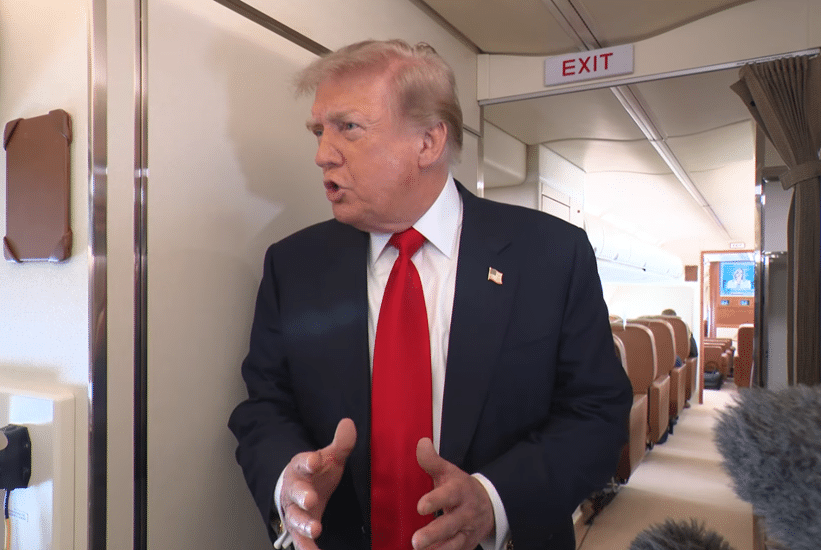
Consumer prices slowed again in July, growing 3.4 percent the past twelve months, or 0.1 percent for the month, after the U.S. and Iran resumed hostilities last month and then paused again for more diplomatic negotiations before President Donald Trump declared on August 12 the U.S. has “total control” over the Strait of Hormuz between the Persian Gulf and the Gulf of Oman.
Trump stated, “The U.S.A. has total control over the Strait of Hormuz. I THINK WE WILL KEEP IT! Our Naval Blockade is being called, by everyone, “A WALL OF STEEL,” and there is nothing Iran can do about it. They have no Navy, they have no Air Force, their remaining soldiers are unpaid, the IRGC is decimated and fleeing, and their “Leadership” is uncertain, at best! They have No Money – Their country is “shot.” All they have is FAKE NEWS and 300% INFLATION, and getting worse! Iran is all talk and no action, the Bully of the Middle East No Longer.”
The slowing of consumer inflation was led by a 2.9 percent decrease of gasoline prices and a 1.7 percent decrease in fuel oil prices during the pause in the Iran war.
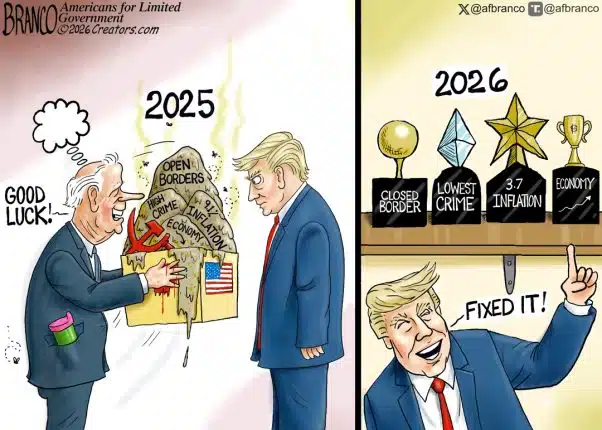
That’s good news, as average weekly earnings kept pace with consumer inflation, also growing at 3.4 percent the past 12 months, and staying ahead of inflation in June and July after prices raced ahead of incomes in April and May.
Historically, whenever inflation has outpaced personal incomes on any sustained basis — just a few months is enough — it has often proven to be disastrous for the White House incumbent party, as it was Gerald Ford in 1976 (15 consecutive months of inflation outpacing incomes in 1974-1975), Jimmy Carter in 1980 (15 consecutive months in 1979-1980), George H.W. Bush (12 consecutive months in 1990-1991), George W. Bush (4 consecutive months in 2008) and Joe Biden (12 consecutive months in 2022). In each of those cases the White House incumbents lost the following general presidential election.
That’s pretty much common knowledge, giving oil-rich countries in the Middle East extraordinary sway over the global economy — with the ability to potentially destabilize electoral politics. But that could be starting to change.
In 2026, inflation briefly outpaced personal incomes in April and May, just like average weekly earnings, so the question going forward, particular to any war-induced inflation, is whether the worst is already behind us and enough of the oil is getting out of the Middle East to stabilize global oil prices, particularly as oil producers increasingly use alternate routes to get the oil out.
As it is, West Texas Intermediate (WTI) crude oil is at almost $83 a barrel as of this writing, after peaking at more than $114 a barrel on April 7. And that’s with the U.S. Navy blockade ongoing against Iran and container traffic at a fraction of what it was prior the war’s escalation on February 28.
Meaning, we could be seeing the beginning of the end of Iran’s ability to leverage global oil prices as a method of terrorist and/or nuclear blackmail — in the event the country attempts to again acquire nuclear weapons — even with maximum U.S. pressure via the blockade plus sanctions are being applied. The joint Departments of War and Treasury operation, then, as oil prices stabilize appear to be successful.
As it is, while break-even from the 2021 to 2023 inflation had been set to be achieved by the end of 2026 prior to the start of the war, if prices and incomes go back to the rates where they were prior to March, the break-even date might still come as soon as November 2027, according to an Americans for Limited Government Foundation analysis of Bureau of Labor Statistics data.
And so as the economic outlook improves, with inflation expectations dampening while Iran’s influence diminishes, so to will the political outlook improve for President Trump, Vice President J.D. Vance and Congressional Republicans going forward, particularly past 2026 into the 2028 cycle. As usual, stay tuned.
Robert Romano is the Executive Director of Americans for Limited Government Foundation.