
“The nuclear sites that we obliterated with the B2 bombers have been hit so hard that it would take months to get near the nuclear dust. And we have it under intense satellite surveillance and control. If we see them make a move, even a move for it, we’ll hit them with missiles very hard.”
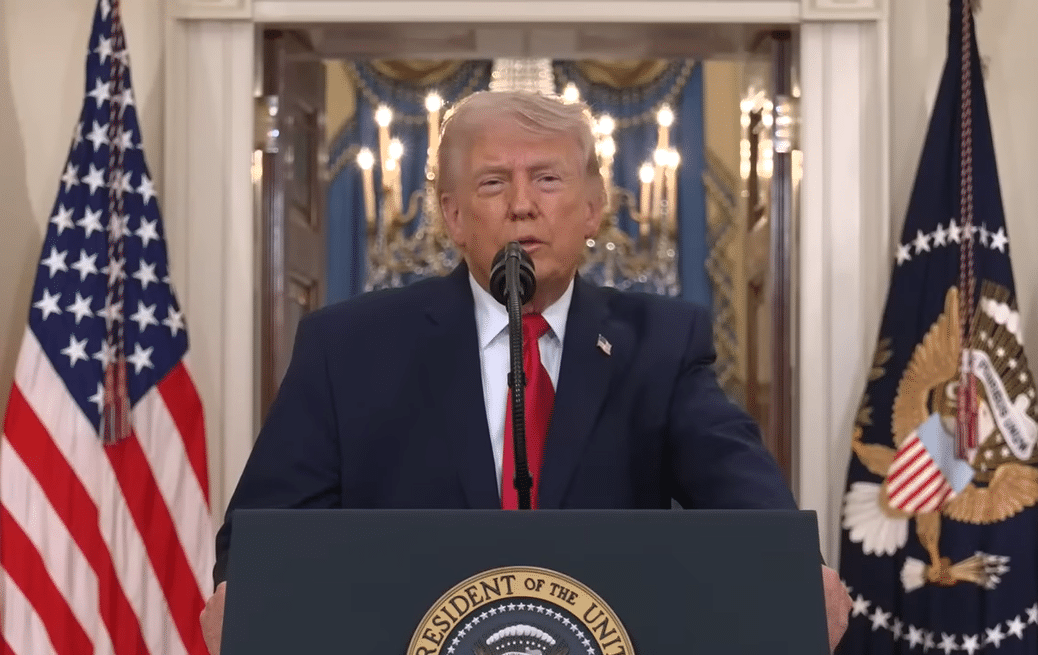
That was President Donald Trump in his April 1 address to the nation, the first to cut into primetime from the White House since the U.S.-Israeli offensive began on Feb. 28, outlining what Director of National Intelligence Tulsi Gabbard testified to last month, which is that the U.S. knows where Iran’s already-enriched uranium is — and it’s buried.
On March 19, before the House Permanent Select Committee on Intelligence, Gabbard testified, “The [Intelligence Community] IC has high confidence that we know where it is…” when asked by U.S. Rep. Steve Cohen (D-Tenn.).
The Times of Israel reports that the 450 kg of uranium is reportedly at the Isfahan and Natanz nuclear sites that were bombed by the U.S. in June 2025 in Operation Midnight Hammer: “Iran’s stockpile of some 450 kilograms of 60 percent-enriched uranium is believed to be buried under the rubble of sites bombed by the US last year, specifically near Isfahan and the Natanz area.”
And that the President had been briefed on a potential mission to extract it requiring boots on the ground if it were to happen, with the Times reporting, “requir[ing] flying in excavation equipment and building a runway for cargo planes to fly off with the radioactive material… [E]xperts said such an operation would take weeks and carry enormous risks to troops… The mission to extract it would demand an airlift of hundreds or even thousands of troops specially trained to remove nuclear material from behind enemy lines, along with heavy equipment, all while operating under Iranian fire…”
The news comes as the U.S. continues to move assets into the region, including those that would be capable of carrying out such a mission. The President did not say whether he would greenlight the mission, but also did not rule it out. The message is clear: We know where it is, and we’ll go get it if we have to.
But even at this late hour, the President is still holding out the prospect for a diplomatic solution to end the war, get the nuclear material under International Atomic Energy Agency (IAEA) supervision and reopen the Strait of Hormuz.
Trump once again issued his ultimatum that if the new leadership in Iran does not make a deal to reopen the Strait of Hormuz, the U.S. would target its electricity generation capacity, for which he has previously given Iran until April 6: “In the meantime, discussions are ongoing… The new group is less radical and much more reasonable. Yet, if during this period of time no deal is made, we have our eyes on key targets. If there is no deal, we are going to hit each and every one of their electric generating plants very hard and probably simultaneously. We have not hit their oil, even though that’s the easiest target of all because it would not give them even a small chance of survival or rebuilding. But we could hit it and it would be gone and there’s not a thing they could do about it.”
Trump also called on Europe and Asia, the principal customers of Middle Eastern oil, to come and police the strait going forward: “the countries of the world that do receive oil through the Hormone Strait must take care of that passage. They must cherish it. They must grab it and cherish it. They can do it easily. We will be helpful, but they should take the lead in protecting the oil that they so desperately depend on. So, to those countries that can’t get fuel, many of which refuse to get involved in the decapitation of Iran, we had to do it ourselves. I have a suggestion. Number one, buy oil from the United States of America. We have plenty. We have so much. And number two, build up some delayed courage. Should have done it before. Should have done it with us as we asked. Go to the strait and just take it, protect it, use it for yourselves. Iran has been essentially decimated. The hard part is done. So, it should be easy.”
Or, the world could just wait until the operation is over: “in any event, when this conflict is over, the strait will open up naturally. It’ll just open up naturally. They’re going to want to be able to sell oil because that’s all they have to try and rebuild. It will resume the flowing and the gas prices will rapidly come back down.”
On that count, Trump projected another few weeks of military operations before U.S. objectives to degrade Iran’s ability to project power in the region were achieved: “we are going to hit them extremely hard over the next two to three weeks. We’re going to bring them back to the stone ages where they belong.”
On the news that the strait could still be closed for some time, perhaps a few more weeks until after the current conflict has been resolved, that a diplomatic breakthrough still has not occurred and that getting the uranium, one of the principal stated justifications for the war, could take weeks and months, oil prices are once again increasing, with light and sweet crude at around $111 a barrel and Brent crude at about $108 a barrel as of this writing.
Overall, the President’s address, directed to the American people, appears to have conveyed that while he is hoping for the best that a deal can be reached, that the U.S. is preparing for the worst if strait isn’t reopened.
Robert Romano is the Executive Director of Americans for Limited Government Foundation.