

Democrats have opened up a 7-point lead in the latest average of generic Congressional ballot polls compiled by RealClearPolling.com — 48.6 percent to 41.6 percent — and yet are only favored to win 205 seats in the House, while Republicans are favored to win 211 seats, according to the latest compilation by The Cook Political Report.
Usually, the party that wins the popular vote for the House wins the majority in the House. In Congressional elections every two years dating back to 1906, the party that won the popular vote for House elections won the majority in the House 55 out of 60 times — or a near-certain 91.6 percent of the time.
The exceptions were two midterm cycles, 1914 and 1942, and three presidential cycles, 1952, 1996 and 2012.
Meaning, whoever is leading the generic Congressional ballot in the polls is usually a very reliable barometer for who’s going to win the House, predicting the winner of the 2002, 2004, 2006, 2008, 2010, 2014, 2016, 2018, 2020 and 2022 midterm elections, 10 out of 11 or 90.9 percent of the time. The lone exception was 2012.
And yet, even with a 7-point lead in the generic ballot, Democrats might still have some trouble reclaiming the House.
One reason is the midterm redistricting that has taken place.
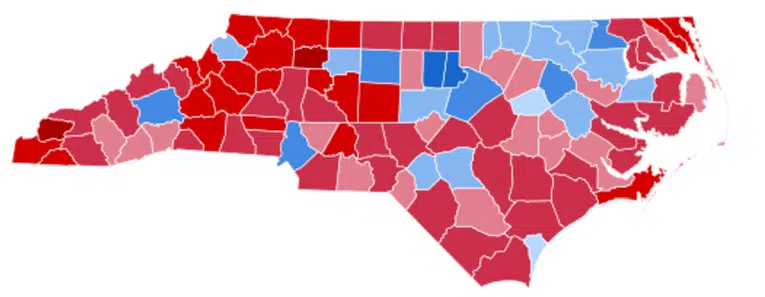
According to the Cook Political Report again, with redistricting in California and Utah, Democrats stand to gain as many as 6 additional seats in the House, while with redistricting in Texas, Florida, Missouri, Louisiana, Alabama, Tennessee and North Carolina, Republicans could gain as many as 16 additional seats.
So, headed into 2026, Republicans have about a 10-seat handicap. Cook takes that into account with the projection on the current House map and comes up with Republicans at 211 seats and Democrats at 205 seats.
A 2014 paper, “Partisan Gerrymandering and the Efficiency Gap” by Nicholas Stephanopoulos Eric McGhee found that every vote over 50 percent-plus-one is technically a wasted vote that could be allocated elsewhere.
Theoretically, and so Democrats tendency to win urban seats by 70 or 80 points is not very efficient. Democrats’ tendency towards geographic “packing” of their voters into urban centers, limiting the amount of seats that can reliably expect to pick up across the country.
On the other hand, if you run that analysis in 2024, it was Democrats who were more efficient at Republicans, winning 15 out of the 25 the closest races by margin of victory, or 60 percent of them.
The 19 toss-up seats, 15 held by Republicans and 4 held by Democrats, are where the majority will be determined. Assuming everything leaning Republican went that way, and assuming Democrats held all of their seats, Republicans would need only hold 7 out of the 15 seats. Meaning even if Democrats once again win 60 percent of the tossups, 11 or 12 out of 19, Republicans would still win 7 and keep the majority.
Now, it could just be that disproportionate Democratic turnout, like in the 2006 and 2018 midterms that saw Republicans in the White House, will be more than enough to overwhelm Republicans, picking up seats that were not originally thought to be tossups. The House popular vote winner usually wins the majority — but not always. As usual, stay tuned.
Robert Romano is the Executive Director of Americans for Limited Government Foundation.