

“I would hate to see China win the war on AI… I have a sense that China is funding the opposition to AI [data] centers.”
That was Sen. Ron Johnson (R-Wis.) in a Breitbart News interview on Aug. 31 warning that the Chinese Communist Party (CCP) might be funding opposition to data centers — there are more than 5,400 data centers nationwide according to Cloudscene — utilized by artificial intelligence (AI) and other internet companies to store and process large amounts of data used every day on our smart phones, computers and by large critical infrastructure including financial, educational, communications, entertainment, medical, military, emergency dispatch and other government institutions, and utilities, water management and the power grid.
Just about everything we do today runs on data — and it runs on electricity, a lot of it. And to keep America’s distinct advantage globally, we need to build more of it. A lot more of it.
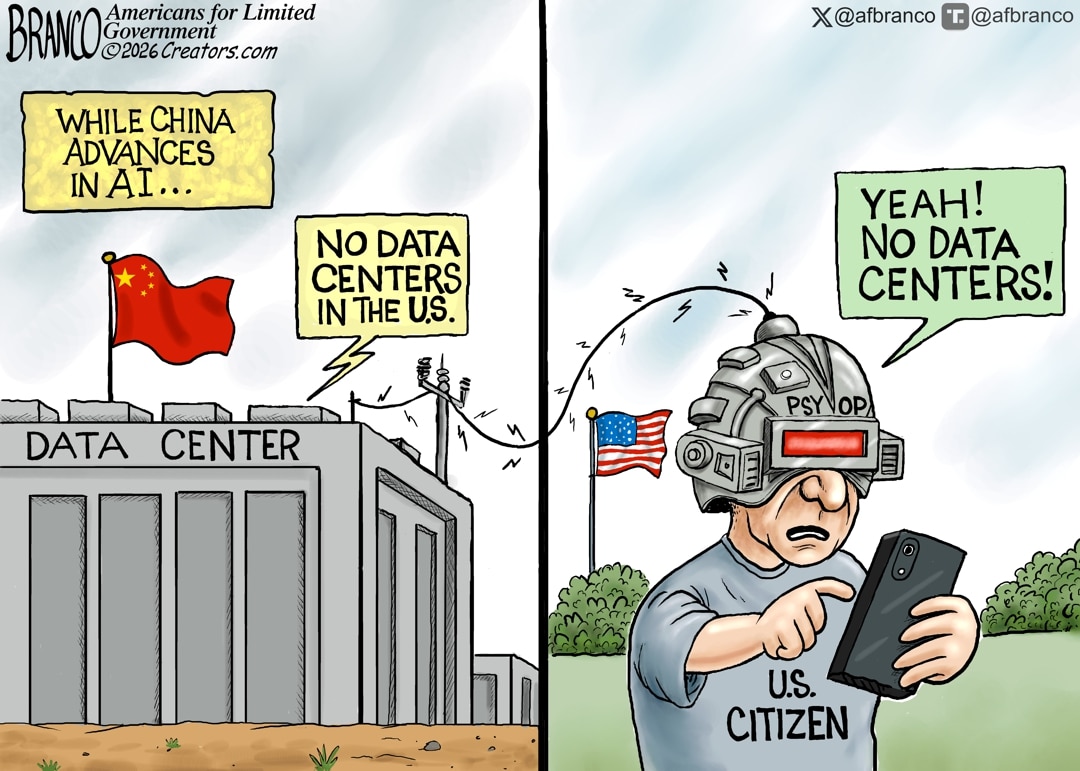
And China knows it. According to an estimate by cyber security firm Alethea, China, Russia and other foreign adversaries have been actively promoting anti-data center propaganda on state media, with social media bots providing echo chambers: “The most attributable layer is overt state media, which is already running at full steam. The message pushed by Russia, China, and Iran largely converges around the idea that America is hoarding power and water for the elites while ordinary people suffer, with each country tailoring messaging to their respective geopolitical interests and domestic audiences…”
There are several propaganda pieces promoting increasing electricity prices, China’s AI buildout succeeding while the U.S. fails and local opposition to data centers: “What domestic actors seed and foreign-linked networks amplify, the AI slop machine scales, producing a volume of emotionally resonant, locally targeted content that is difficult to attribute, harder to counter, and arrives faster than comms teams can respond.”
If this all sounds familiar, it should.
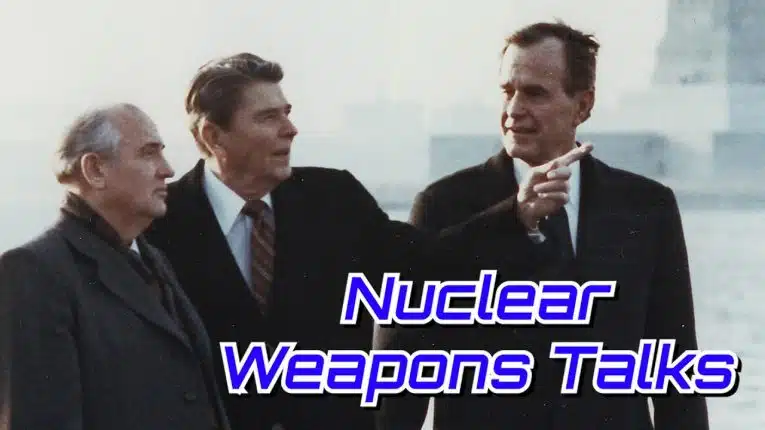
It’s the modern-day nuclear freeze movement. In the Cold War, State Department analyses show the Soviets actively funded fronts like the World Peace Council to stoke fears of the dangers of nuclear war and to push for unilateral disarmament.
Well, it was a bad idea then, and it’s a bad idea now. The KGB did not invent American fear of the bomb, but it did exploit it. The same thing is happening today.
The need to build out technology, energy and mineral infrastructure including rare earths lies at the heart of President Donald Trump’s plan to protect our economic and national security. And today’s opposition is just as dangerous as it was in the 1980s.
In May, Treasury Secretary Scott Bessent, speaking at the 2026 Reagan Economic Forum in Simi Valley, Calif. warned of the danger: “Somewhere along the way, we lost sight of a foundational principle that previous generations understood instinctively: economic security is national security, for a nation that cannot manufacture, mine, ship, or refine its needs gradually cedes its strength—and sovereignty—to others. That is a dangerous dependency for any country. It is an unacceptable one for the United States.”
Bessent added, “[S]ecure supply chains matter as much as stock indices. That productive capacity is power. That trade policy, industrial policy, and national security policy must all fit together, or they will each fail separately.” He’s right.
If we get into a world war with China or Russia we might lack the manufacturing capacity to keep up with producing planes, tanks, bombs, ships, missiles, drones, etc. because of decades of outsourcing that is still being reversed.
In 10 or 15 years, such a conflict might be AI-driven, with automated weapons systems, and the country with the most compute and the most electricity — and who could keep those systems running amid a vast assault — would be the power that wins. It is not hard to imagine a contest pitting one nation’s artificial general intelligence versus another’s.
China is already pre-positioning inside U.S. energy, water, and communications networks to conduct more cyberattacks, the Cybersecurity and Infrastructure Security Agency reports. In an actual shooting war, it will be much worse.
To compete — and to deter threats — to borrow a phrase from Captain Kirk: We need more power.
At a Potterville, Mich. Rally in August 2024, President Donald Trump warned that the U.S. needs to double electricity output to compete with China on AI, stating “For us to compete successfully with China and others on AI, we’re going to need twice the electricity that we currently produce. Can you believe that? We’re not going to be even close. The only guy that can do that is a guy like me.”
But electricity output increased by 2.8 percent in 2025, from 4.308 trillion kilowatthours in 2024 to 4.429 trillion kilowatthours (kWh), according to the latest data compiled by the U.S. Energy Information Administration (EIA). At that pace, it will take more than two decades to double the grid.
Tech companies including xAI, Meta, Amazon, Oracle and others are already increasing electricity generation on site, but the bigger projects could still be a few years off — and we’re still nowhere close to the President’s goal. We’ve got a long way to go.
Besides how long it takes to get new power stations online, one reason for the slow growth of America’s grid is because of lawsuits against America’s electric and other energy producers. On June 25, 2025, Sen. Ted Cruz (R-Texas) chaired a hearing at the Senate Judiciary Subcommittee on Federal Courts, Oversight, Agency Action, and Federal Rights entitled, “Enter the Dragon—China and the Left’s Lawfare Against American Energy Dominance.”
At the hearing, Cruz laid out the scheme, alleging, “There is a coordinated assault by the radical left, backed and paid for by the Chinese Communist Party to seize control of our courts, to weaponize litigation against U.S. energy producers. All in order to undermine American energy dominance. At stake, is a lot more than an industry. Our energy sector is the engine of American prosperity, the lifeblood of our industrial power, our national security, and our geopolitical leverage…. [F]oreign money from entities tied to the Chinese Communist Party flows into the United States to bankroll climate advocacy groups who litigate against American Energy… [A]ctivist lawyers flood our courts with lawsuits designed not to win policy debates but to bankrupt energy producers and to dismantle energy infrastructure through sheer attrition.”
Testifying at the hearing was Kansas Republican Attorney General Kris Kobach who similarly warned “it is evident that China’s asymmetric warfare against the United States extends to our nation’s courtrooms and state legislatures. The CCP plainly has a strategy of driving the United States away from domestic energy sources and increasing U.S. dependence on sources that rely on a Chinese supply of solar panels, electric vehicle batteries, and other technologies.”
Kobach outlined several areas of litigation, especially what he dubbed “environmental lawfare” against American energy production that usually comes from Democratic Party activist organizations, and also by blue states like California and New York that are imposing onerous restrictions on automobile manufacturing including a ban on internal combustion engines in medium- and heavy-duty trucks and levies fines for past carbon emissions on producers, respectively.
This is not the first time Beijing has meddled in the U.S. legal system. A Nov. 2023 Bloomberg News report by Emily Siegel, “China Firm Funds U.S. Suits Amid Push to Disclose Foreign Ties” found China-backed firms funding litigation in U.S. patent courts.
To address the threat of foreign influence in American courts undermining economic and national security, Congressional Republicans have offered vital legislation. The Protecting Our Courts from Foreign Manipulation Act, H.R. 2675, by U.S. Rep. Ben Cline (R-Va.), would prohibit or require disclosure of certain foreign-backed litigation funding arrangements. And the Litigation Transparency Act, H.R. 1109, by U.S. Rep. Darrell Issa (R-Calif.) would require parties in federal civil cases to disclose when outside financiers have a financial stake in litigation.
In addition, President Trump could issue executive orders under the Corporate Transparency Act for the Treasury Department to designate litigation funders as entities required to report their beneficial owners and under the Bank Secrecy Act to trigger additional reporting requirements.
To reach President Trump’s goal of doubling electricity output and remaining number one in technology including AI, we need all-of-the-above — whatever it takes, get more coal, nuclear, solar and everything else that has capacity to grow. In the meantime, China is able to exponentially expand, uses subsidies freely and without the federal, state and local barriers we artificially put in our own way — while Congress has appeared reluctant to subsidize at the levels that might be necessary to compete long term. America’s industrial policy along with its grid needs a substantial upgrade.
Hopefully, it will not take an emergency like Pearl Harbor to again awaken a sleeping giant. Peace through strength means that to secure peace, we must prepare for war. In so doing, we deter the next Pearl Harbor, the next 9/11.
Liberal philosopher Adam Smith, while critical of certain kinds of tariffs, supported national defense tariffs in The Wealth of Nations in 1776: “in which it will generally be advantageous to lay some burden upon foreign, for the encouragement of domestic industry… when some particular sort of industry is necessary for the defence of the country.”
Congress has enacted laws to that effect, to protect manufacturing of automobiles for example which in World War II the factories were converted to support production of armaments, aircraft, tanks, and trucks. In the age of AI, chip production (particularly those used in high-tech air, space, land and naval forces) almost certainly falls in that category, as does sourcing rare earth minerals and so forth.
Outsourcing manufacturing is a national security threat. We need the technology to be sourced and built here, from the rare earth minerals, to the silicon chips, to the electricity needed to operate the data centers. It all works today. Free trade would make it so we would have to import our rare earths from China.
Could anyone imagine importing tanks from Germany in World War II, or planes from Japan? It doesn’t even make sense.
Again, the push against mining, against technology, against AI, against data centers and against energy in the U.S., it’s the new nuclear freeze. And if we let it, it will defeat us before a shot is fired.
As a rule, I don’t like nuclear weapons, and I do hope that eventually, the superpowers will find a way to achieve reciprocal disarmament, but barring a dramatic breakthrough ala Reagan-Gorbachev in the 1980s, in the meantime we probably need to upgrade our arsenal. In a similar vein, in the event of an AI war we need the best data centers, the most compute and enough electricity to prevail.
Robert Romano is the Executive Director of Americans for Limited Government.