
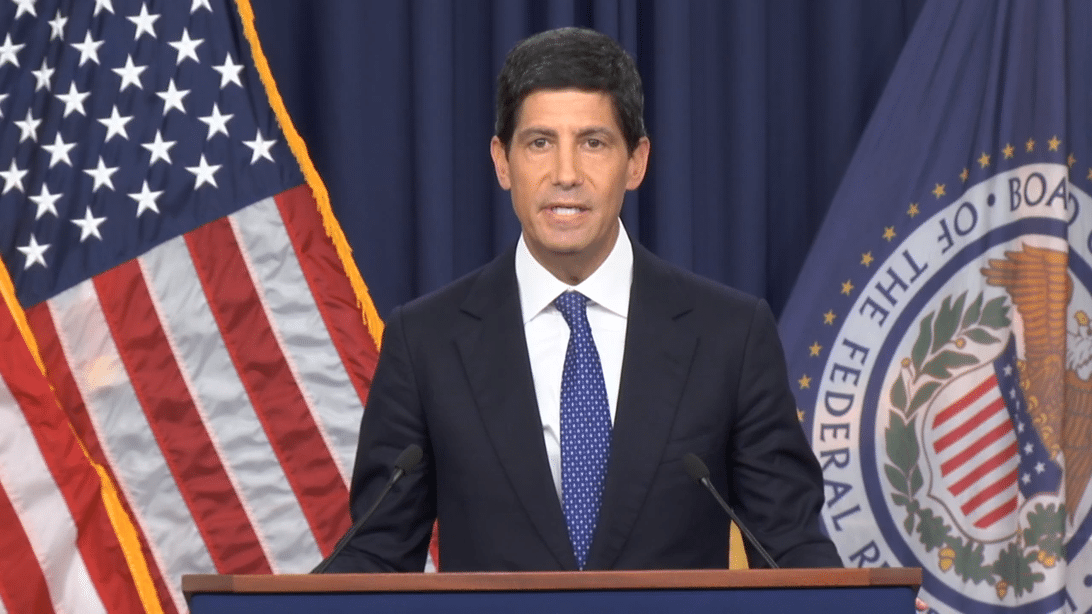
The Federal Reserve on Sept. 16 unsurprisingly and unanimously hiked the federal funds rate for the first time since July 2023 as disinflation from the post-Covid surge that began in 2021 was beginning to abate, a process that continued all the way to the beginning of 2026 before the war in Iran escalated.
The rate moved from a range of 3.5 percent to 3.75 percent to a range of 3.75 percent to 4 percent. The move comes after what had been three consecutive rate cuts in September, October and December 2025.
In its Sept. 16 statement, the central bank pointed to sticky inflation as driving the decision to move interest rates higher: “Inflation remains elevated. Today’s policy action will support a timelier return to the Committee’s 2 percent goal. The Committee will deliver price stability.”
In a Truth Social post on Sept. 16, President Donald Trump called for the Fed to instead lower rates now while the economy is still running hot, writing, “Interest Rates in the United States should be 1%, or less, because we are the Best Credit in the World — BY FAR. Our Country is BOOMING with new Investment! … LOWER THE INTEREST RATES FOR THE UNITED STATES OF AMERICA, AND FAST!”
In February, before the U.S. renewed military strikes in Iran, the consumer price inflation measured by the U.S. Bureau of Labor Statistics at 2.4 percent was approaching the desired target rate of 2 percent, but after hostilities commenced on Feb. 28, oil and gas supplies from the Middle East withstood a shock, and by May, inflation had spiked to 4.2 percent.
A temporary ceasefire was agreed to in April, but did not hold, and the U.S. imposed a naval blockade of Iran before the June memorandum of understanding was signed before being broken again.
Consumer inflation had since settled down to 3.4 percent in August but as hostilities have resumed in earnest in Iran, with an oil tanker being hit by a mine while traversing the Strait of Hormuz and President Donald Trump hinting at an attack on Kharg Island, plus continued in the Ukraine war with more refineries being struck by Ukraine in Russia, and Russia hitting fuel stations, petroleum depots and the electric grid in Ukraine, prices are moving.
Oil prices this popped again over $100 a barrel for both WTI and Brent crude oil before settling down slightly, and natural gas in Europe has jumped to about €79.07/MWh, up from about €40/MWh at the beginning of July after the memorandum of understanding was signed and then fell apart.
It’s a one-two punch from Iran and Russia, with the ongoing wars hindering not merely oil distribution but also natural gas production. After the war in Ukraine escalated with Russia’s invasion in 2022, Europe shifted its natural gas supply chains to the Middle East. But now those new supply chains are being tested.
In 2022 to 2023, there were 11 rate hikes in total, bringing rates from near-zero percent — even while the post-Covid inflation was already at 7.5 percent in January 2022 prior to Russia’s expanded invasion of Ukraine without any rate hikes — all the way up to peak of 5.25 percent to 5.5. percent by July 2023. The fact is, the first rate hikes in March 2022 did not come until after had already Russia moved.
And arguably, rates had been left too low, for too long, as the M2 money supply grew $6.29 trillion from $15.49 trillion in February 2020 to its next peak of $21.78 trillion in March 2022, a more than 40 percent increase in the money.
Now, during the rate easing, the money supply has increased from its recent low of $20.7 trillion in October 2023 to $23.2 trillion in July, another 12 percent increase.
It’s a blunt instrument, but the supply chain disruptions first brought on by Covid, the Ukraine war and then later the Iran war have left nations with little else to do slow prices down. Milton Friedman defined inflation as too much money, chasing too few goods. In the case of the post-Covid inflation, we have had both.
And when it’s more difficult to quickly increase the supply of goods and services, the only other thing to do is slow the growth of or to outright decrease the money supply, usually with utilizing interest rates.
Historically, higher interest rates is what the Fed has usually done in response to inflation. Usually the rate hikes continue until disinflation occurs towards the end of the cycle often coinciding with a slowdown or recession, and then it starts cutting rates again as inflation slows down.
That’s where we were at the beginning of the year, but the renewed war-related global supply disruptions are again coming to the fore, and they also don’t look they’re ending any time soon. If so, tightening money might not be a perfect system — but it’s the one we’ve got.
Robert Romano is the Executive Director of Americans for Limited Government Foundation.