
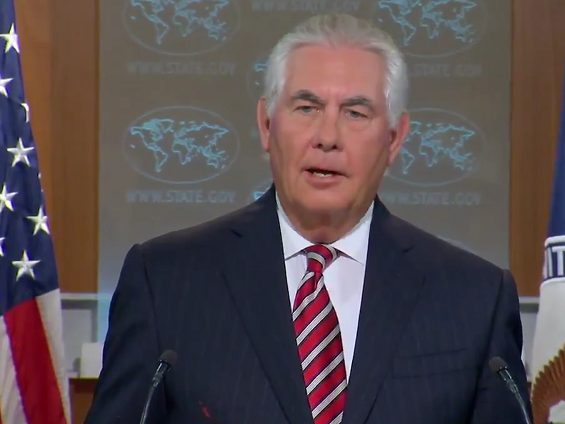
“We may not win one, but neither will you.”
That was Secretary of State Rex Tillerson’s message to the Taliban in Afghanistan in a press briefing on Aug. 22. The U.S. military might not win a battle, but we’d prevent the Taliban from winning one, too.
Tillerson added, “And so at some point we have to come to the negotiating table and find a way to bring this to an end.”
The statement appeared to contradict President Donald Trump who in his Aug. 21 address to the nation promised, “Our troops will fight to win. We will fight to win. From now on, victory will have a clear definition: attacking our enemies, obliterating ISIS, crushing al Qaeda, preventing the Taliban from taking over Afghanistan, and stopping mass terror attacks against America before they emerge.”
To be fair, Trump did hold out the possibility for a settlement in his speech. That is, after defeating the Taliban: “Someday, after an effective military effort, perhaps it will be possible to have a political settlement that includes elements of the Taliban in Afghanistan, but nobody knows if or when that will ever happen.”
In a separate prepared statement on Aug. 21, the Secretary of State had also said, “The Taliban has a path to peace and political legitimacy through a negotiated political settlement to end the war. We stand ready to support peace talks between the Afghan government and the Taliban without preconditions.”
Tillerson should have stuck with that. The language is much tighter, and did not send unintended message the U.S. believes there is no military way to win the war in Afghanistan thereby necessitating such talks.
Either, Tillerson simply misspoke at the Aug. 22 press briefing and it was a gaffe that should be corrected. Or, Tillerson was directly contradicting the President’s stated policy. Which must also be corrected.
Does Tillerson’s belief that “we have to come to the negotiating table and find a way to bring this to an end” because “we may not win” reflect the inner thinking of Trump’s cabinet?
Because taken literally, the statement appears to have broad strategic implications and if the record is not set straight, could lead the enemy to believe we are fighting to achieve a stalemate, said Americans for Limited Government President Rick Manning in a statement.
“It is immoral to expend a single ounce of American blood or another dime of our treasure to play for a tie in Afghanistan. Yet, that is exactly what Secretary of State Rex Tillerson advocated when he said that the U.S. military ‘may not win’ in Afghanistan instead justifying the President’s new policy as a way to bring the Taliban to the table for a settlement,” Manning said.
Manning added, “At best, Tillerson is proposing a war of attrition, where the U.S. forces the Taliban to the table by wearing them down. At worst, he is proposing a war of attrition, where the enemy wears us down and outlasts the Trump administration. Either way, his statement undermined the clear statement of strategy by President Trump to the nation on Monday, which promised victory. ‘We may not win’ is not a vision of victory, it is the equivalent of waving a white flag before the Trump plan ever gets off the ground.”
In short, there is a world of difference between what Trump said, that the Taliban would be defeated and that “perhaps it will be possible to have a political settlement that includes elements of the Taliban in Afghanistan” versus “we may not win” and “at some point we have to come to the negotiating table and find a way to bring this to an end.”
The President’s statement was contingent on achieving victory. Whereas, Tillerson’s statement, by saying “we may not win” because “we have to come to the negotiating table” absolutely takes the credible threat of force off the table.
By keeping all options on the table, and conditioning peace on victory, Trump clearly stated a pathway forward: Pound the enemy into submission. We must demonstrate clearly that we capable of defeating the enemy, else we may be sending mixed signals when we cannot afford to. That puts lives at risk, and makes the determination of the U.S. to win uncertain, because the President’s cabinet is visibly divided.
This risks the enemy becoming convinced a steady stream of casualties could bleed our desire to win, when we must be unequivocal in our resolve.
If the enemy perceives that we will not act with force to win first, if we send mixed signals about our own reluctance to sacrifice, then why would the Taliban ever come to the table? As Manning noted, “After almost sixteen years in Afghanistan, time is not on the side of the U.S., it is on the side of the enemy which is indigenous to the country. They only need to outlast us.”
Meaning, Tillerson must clarify his remarks and the President needs to firmly restate that peace with the Taliban will only come after victory — that is, if there’s anybody in the Taliban alive left to negotiate.
The American people do not support wars whose stated goals are to fight for a stalemate. Equivocating on our willingness or capability to act by force if we must is a very dangerous message for the State Department to be sending when our soldiers are risking their lives, for it is that type of message which could create a strategic perception in our enemy that we do not believe we will win — making the situation more dangerous by sending mixed signals.
The threat of force must be credible and the administration must present a united front on Trump’s strategy to win in Afghanistan. There is no substitute for victory, now, Mr. President.
Robert Romano is the Vice President of Public Policy at Americans for Limited Government.